

How Websites Can Stay Competitive with Claude Fable 5
Anthropic released Claude Fable 5 on June 9, 2026, and the businesses paying attention are already asking the right question. Not “what can this model do?” but “what does this mean for how customers find us online?”
Claude Fable 5 ranks highly in AI benchmarks, excelling in software, knowledge work, vision, and more. Its strong performance includes how it evaluates and cites web content in user queries. For businesses with an online presence, that is not a technical footnote but a competitive variable. The numbers back that up.
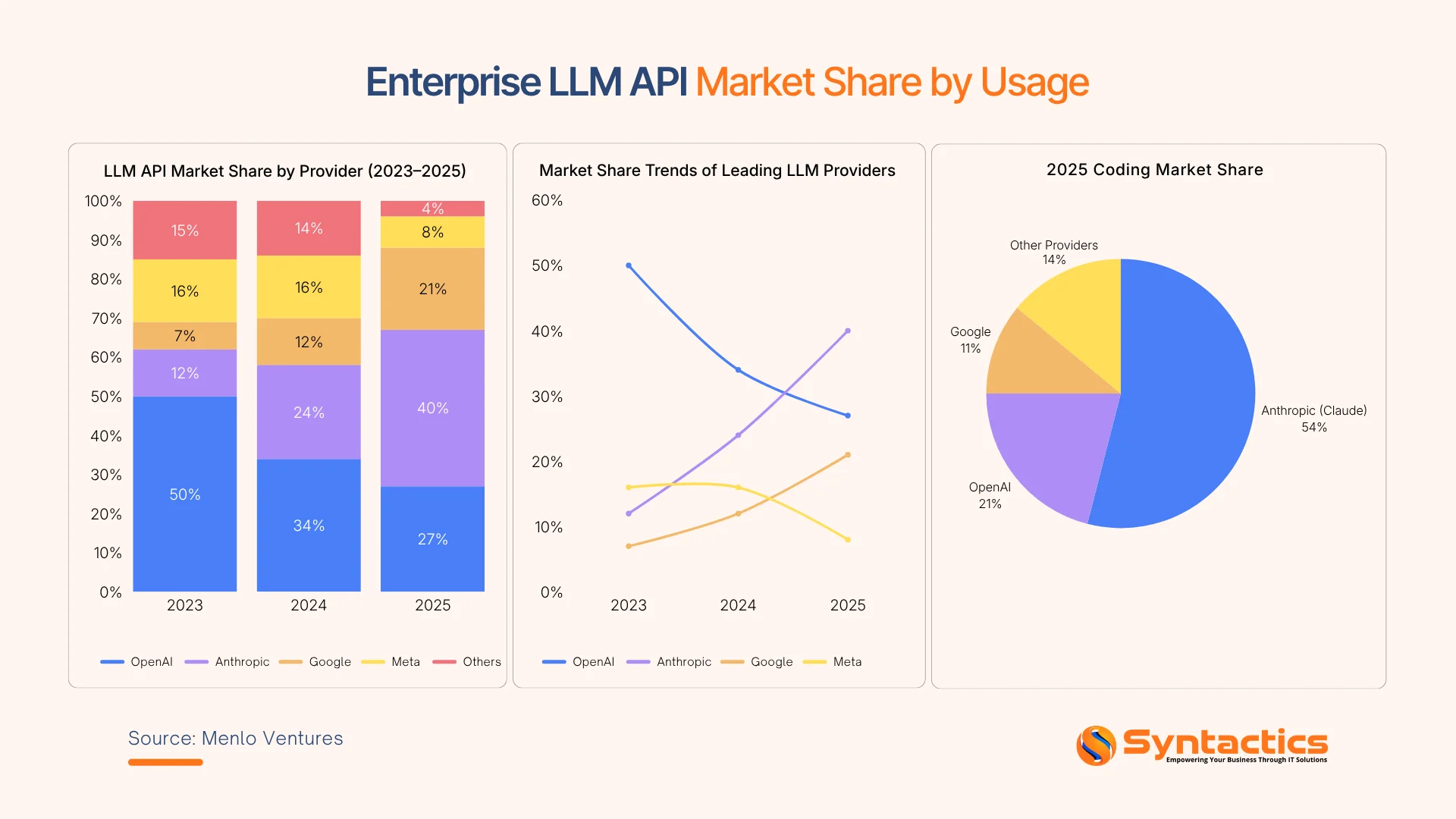
Source: Menlo Ventures.
Key Takeaways
- Claude Fable 5 is Anthropic’s most capable publicly available model, built for complex, multi-day agentic tasks.
- It evaluates and cites web content when generating AI search answers, making your site’s structure a direct ranking factor.
- Websites built without an AI-readable architecture risk being skipped entirely in AI-generated answers.
- Development teams using Fable 5 deliver faster, more accurate builds with fewer revision cycles.
- Businesses that invest in AI-ready websites now build compounding citation authority over time.
How Claude Fable 5 Changed the Rules
Most AI tools work in single exchanges. You prompt, it responds, you move on. Claude Fable 5 operates differently. It’s built for the most demanding reasoning and long-horizon agentic work, and the longer and more complex the task, the larger its lead over earlier models.
For business operations, that means AI can now handle sustained, multi-stage work with minimal supervision. Teams can delegate sophisticated multi-turn projects, from complex code refactoring and deep research synthesis to document-heavy workflows, and review completed work rather than supervising every step.
That change has clear website implications. Fable 5 isn’t just a productivity tool; it powers AI-generated answers that your customers read. When users request agency recommendations or vendor evaluations, Fable 5 reviews and cites select websites. Your site is either included or not.
Princeton’s GEO study finds that content with cited sources earns up to 40% higher AI visibility, and pages with statistics gain 37% more citations. These numbers already reflect how Fable 5 assesses content quality.
What Fable 5 Looks for in a Website
Many businesses have a gap they’re unaware of. Fable 5 evaluates content like a senior researcher, preferring pages that are:
- Directly structured. Service pages that open with a clear definition of what the service is and who it is for.
- Extractable. Answer blocks that stand on their own without surrounding context, typically 40 to 60 words per key claim.
- Marked up correctly. FAQPage, Article, and HowTo schema applied so AI systems can parse structured content cleanly.
- Internally coherent. Internal links that connect service pages to supporting content, signaling topical authority across the site.
- Recently updated. Undated content loses out to dated content because AI systems place a heavy weight on recency.
The model uses vision to check its coding work and understands diagrams and tables in files and PDFs. It applies this capability to your site’s pages when answering queries. Thus, websites made before AI search often lack a suitable structure. This isn’t a criticism, just a solvable gap.
How the Right Web Partner Closes That Gap
Staying competitive under Fable 5 is a web design and development problem before it’s an SEO problem. The structural decisions that determine whether your site gets cited by AI are made at the build level: how pages are coded, how content blocks are organized, what schema is applied, and how the site hierarchy maps to the queries your buyers actually use.
Claude Fable 5 is the most capable model available for ambitious coding projects, including large migrations, complex implementations, and multi-day autonomous sessions. It can write its own tests, implement designs with high fidelity, and use vision to check outputs against goals.
Development teams that build with Fable 5 in their workflow deliver measurable improvements:
- Faster migrations. Complex CMS migrations that previously took six to eight weeks to complete are compressed because Fable 5 sustains multi-file, multi-stage work without losing context.
- Cleaner custom builds. Custom features, integrations, and backend logic move faster because the model plans, delegates, tests, and iterates within the same session.
- Higher implementation fidelity. Fewer revision rounds because Fable 5 checks its own outputs against design goals before delivery.
For businesses evaluating a redesign or a new build, that efficiency is tangible. Faster delivery means lower project costs. A site built with an AI search architecture from the ground up means you’re not retrofitting visibility six months after launch.

The Competitive Window Is Short
Fable 5 is for subscribers and enterprise users, so agencies using it at scale are gaining ground. The advantage of AI-ready sites grows as citation authority compounds.
A site cited today earns even more citations later. Each correctly structured service page, FAQ, and internal link builds lasting authority. AI Overviews now appear in roughly 45% of Google searches and divert up to 58% of clicks away from featured websites, reducing visibility for the competition.
The question is whether your website is built to benefit or be bypassed by Fable 5. The right development partner, versed in Fable 5 and AI search, helps you achieve faster builds and a relevant structure that buyers can find.
That window is open now, and it won’t stay open indefinitely.
Current Status: Claude Fable 5
As of June 12, 2026, Claude Fable 5 is temporarily unavailable due to a US government export directive, prompting Anthropic to suspend access globally. Anthropic is seeking to restore access. Other Claude models remain available.
The suspension does not change the direction AI search is heading or what Fable 5 revealed about web competitiveness. Businesses that prepare now, while others wait, will be in a stronger position when access is restored.
Final Thoughts
Adapting to Claude Fable 5 doesn’t have to be a guessing game. Syntactics is a web design and development agency in the Philippines, helping businesses build websites that perform across traditional and AI search channels. The work covers full site builds, CMS migrations, custom development, and the structural and schema-level changes that directly affect AI visibility.
If your current site was built before AI search became a factor, the gap is worth identifying sooner rather than later. Syntactics, Inc. offers site assessments designed to help businesses uncover what’s working, identify areas for improvement, and find the right path forward.
Get Design and Functionality
Specific to your Brand!
- Build a website that's mobile-friendly and responsive.
- Custom designs aligned with your brand.
- Optimized for SEO and user experience.
- Scalable and feature-rich solutions.

Frequently Asked Questions
What is Claude Fable 5?
Claude Fable 5 is Anthropic’s most capable publicly available AI model, released on June 9, 2026. It is designed for complex, long-horizon tasks that can run for days, including coding, research, document analysis, and multi-stage enterprise workflows. It also powers AI search answers, which means it directly evaluates and cites web content when responding to user queries.
How does Claude Fable 5 affect my website’s visibility?
Fable 5 reads and evaluates websites when generating answers to search queries. Sites with clear structure, schema markup, specific content, and AI-crawlable architecture are more likely to be cited. Sites built without these elements are more likely to be skipped, regardless of how well they rank in traditional search.
What makes a website AI-ready for Fable 5?
An AI-ready website has direct, definition-led service pages; extractable answer blocks of 40 to 60 words; FAQPage, Article, and HowTo schema markup; a clear internal linking structure; and regularly updated content with visible publish or update dates. These are not cosmetic changes. They are structural decisions made at the build or redesign stage.
Do I need to rebuild my website to stay competitive?
Some businesses can close the gap with targeted content restructuring, schema implementation, and internal linking updates. However, if your site runs on an outdated CMS, has poor page hierarchy, or lacks structured data entirely, a redesign delivers better long-term results than patching individual pages.

About Ladymieh Naallatan
Related News:
Top Reasons To Use PHP For Your Next Project
Outsource Web Developers: Dedicated vs Project-Based
Lean Web Development: Why Start It

Web Application QA Testing and How It Works


Comment 0