A multi-site AEO/GEO content intelligence platform reviews and improves the pages your business already has before recommending new content. It checks each page for clear answers, usefulness for generative search, and E-E-A-T signals, then focuses on the fixes that will have the biggest impact on your business.
This matters because AI-generated summaries are changing the way people use search results.
Ahrefs analyzed 300,000 keywords and found that when an AI Overview appeared in December 2025, the average CTR for the top-ranking page dropped by 58%. Earlier in 2025, the decline was 34.5%. This shows why it’s important to treat your existing organic traffic as a business asset and optimize for both visits and conversions.
AI Overviews and organic CTR
April 2025 study: 34.5% lower CTR
December 2025 update: 58% lower CTR
Based on Ahrefs analyses of 300,000 keywords.
Source: Ahrefs.
Key Takeaways
- Review and improve your current pages before adding new content, especially those with strong traffic or commercial intent that aren’t converting well.
- Evaluate pages for direct answer quality, generative-search usefulness, topical completeness, and E-E-A-T signals.
- Prioritize recommendations using business factors such as traffic, conversion potential, strategic importance, and page relevance.
- Keep people involved in the process. AI can review pages and suggest improvements, but humans should approve what to audit, which recommendations to follow, and how to implement them.
- Manage several websites using one central workflow, covering everything from finding pages and choosing what to review, to making changes and checking results again..
The Challenge
Most established websites have years of SEO work, with lots of indexed pages, keyword-focused articles, and service pages built for search. But just showing up in search results doesn’t guarantee success. A page might rank well and get visitors, but still fail to answer the main question or help users take the next step.
This is becoming more urgent as AI-generated summaries change how people use search. Gartner predicts that traditional searches could fall by 25% by 2026, with more people turning to AI chatbots and virtual agents.
Separately, Pew Research Center found that when a Google AI summary appeared, users clicked on a traditional search result only 8% of the time, compared to 15% when there was no summary.
These studies examine different parts of search behavior, but together they show that businesses can’t judge organic performance by rankings and impressions alone.
Traditional SEO usually aims to turn impressions into clicks, but it’s just as important to track what happens after someone clicks. A page might bring in the right visitors but still fail if it doesn’t answer their questions, address their concerns, or give them a clear next step.

The Opportunity
Independent studies report different levels of organic CTR decline, ranging from 15.5% to 61%, because they use different datasets, query types, and methodologies. However, research generally indicates that AI-generated summaries can reduce clicks to traditional organic results, even when impressions remain stable or increase.
This trend creates an opportunity. Instead of always chasing new keywords, businesses can review and improve pages that already get attention and have commercial value. Google recommends making content helpful, reliable, and people-focused, and that standard lines up with what gets cited by AI.
Start by making your current pages clearer, more complete, trustworthy, and useful. Focus first on the changes that will have the biggest impact on your business.
The Solution
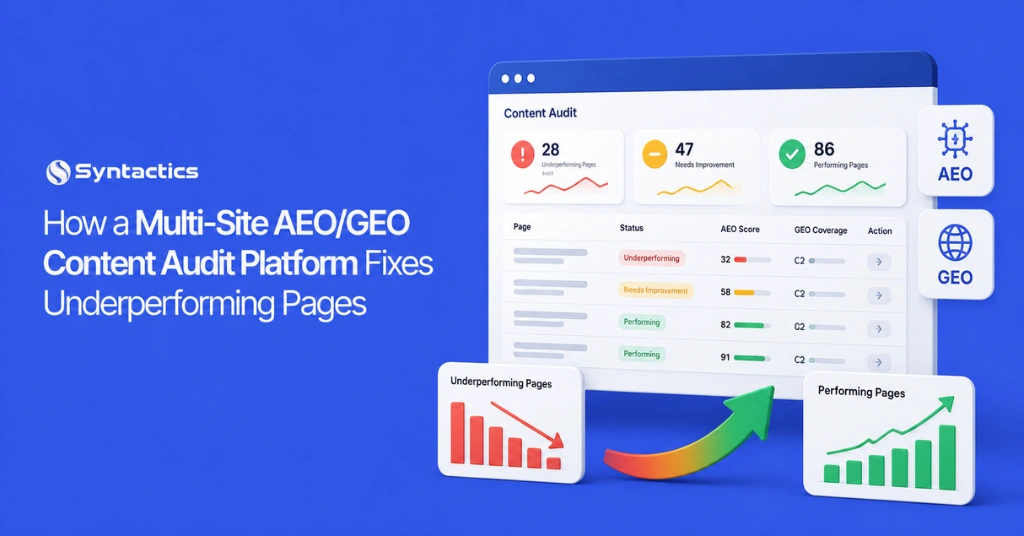
Syntactics developed a multi-site AEO/GEO content intelligence and optimization platform that guides selected pages through a 10-step process. It uses automated checks along with human approval at key stages, helping teams find, prioritize, and improve pages across multiple websites.
A Controlled, Human-Checked Pipeline
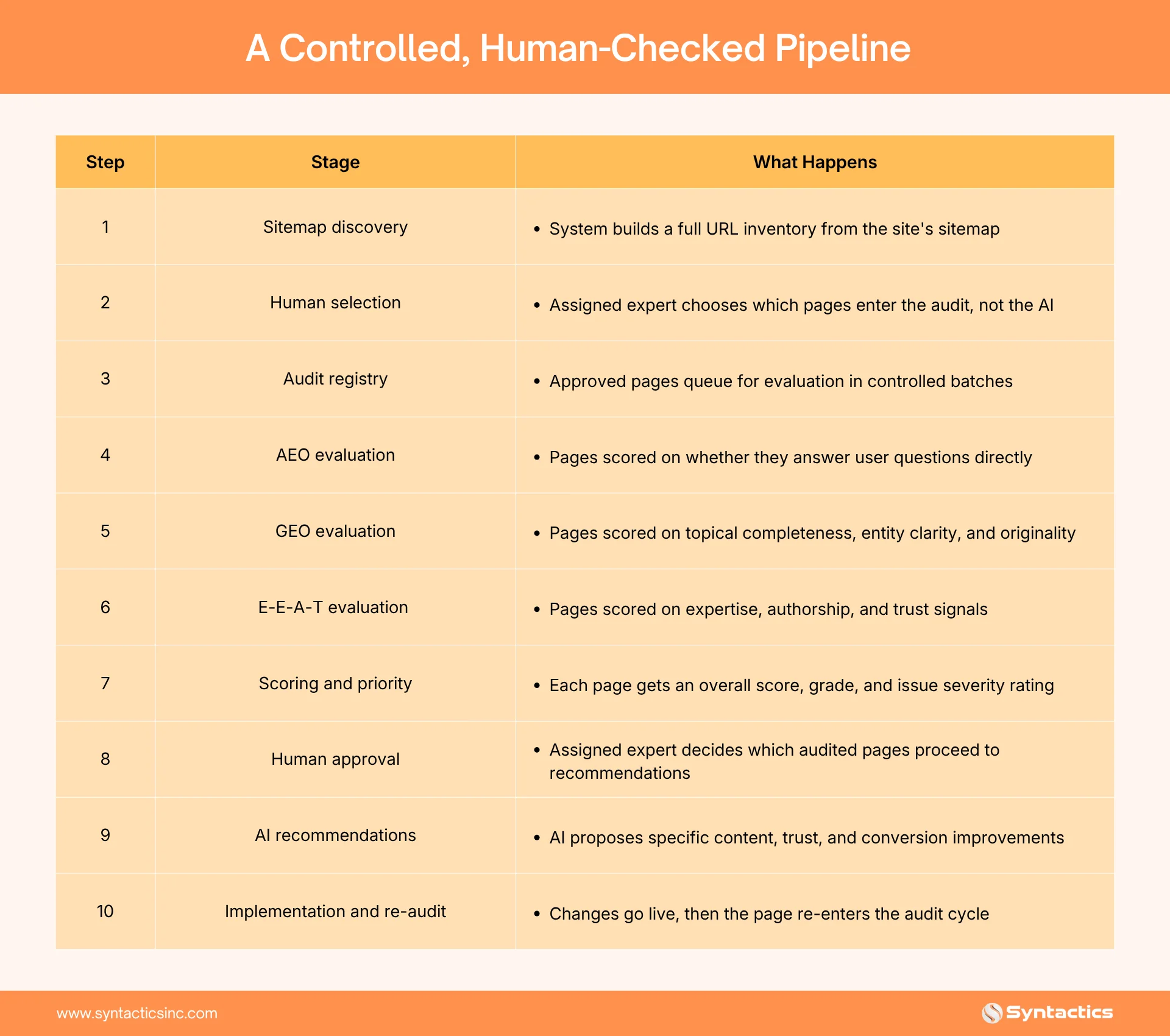
This workflow turns the platform into an ongoing optimization system, not just a one-time audit tool. The first human review picks which pages to audit, and the second review decides which changes to make.
What Each Evaluation Checks
AEO checks whether a page answers the user’s question directly, using a clear structure and enough information.
GEO checks if the page provides useful, well-organized information that generative search systems can understand. It looks at topic coverage, clarity, originality, and supporting sources.
E-E-A-T looks for trust signals such as who wrote the content, first-hand experience, expertise, authority, what makes it unique, and supporting evidence.
These are the platform’s own evaluation categories and scoring criteria, not official systems from Google or AI providers.
Why Human Selection Matters
The platform doesn’t send every URL to an AI model by default. Instead, an expert selects which pages to focus on, considering factors like traffic, conversions, commercial intent, strategic value, and review history.
Auditing every page the same way can waste time. By focusing first on pages where changes could improve business results, the platform acts as both a prioritization tool and an audit system.
Built for Scale
The platform lets you manage several websites through a central registry, tracking things like site status, priority, and how many articles to process at once. This way, a new site can join the same workflow without needing a separate audit.
The Results
A service page got 10,000 organic impressions and 800 clicks, but only led to four qualified inquiries. The audit found the problem: the page didn’t answer the visitor’s main question. It also left related questions unanswered and used generic industry copy with a vague call to action.
The answer wasn’t to write another keyword-targeted article. Instead, we restructured the existing page to match the visitor’s real decision process.
Now, the production dataset has over 36,000 sitemap inventory records and about 791 audit records.
This shows the system can support content libraries at production scale, not just a few sample pages.

Conclusion
A business website with years of SEO content doesn’t always need more pages. It needs to find out which current pages are holding back results and what to fix first. This platform helps answer that with a repeatable process:
- inventory the content
- prioritize by business impact
- evaluate against AEO/GEO/E-E-A-T criteria
- recommend specific fixes, and
- re-audit after implementation.
Syntactics, Inc. is a web development partner in the Philippines. We help businesses modernize their platforms with custom software, automation, data integration, and AI-powered systems. This approach helps you see which pages drive your business, save resources, and keep your content program flexible as AI search changes search results.
If your team is publishing content but isn’t sure which pages are converting, we can build an audit pipeline tailored to your business.
Get Design and Functionality
Specific to your Brand!
- Build a website that's mobile-friendly and responsive.
- Custom designs aligned with your brand.
- Optimized for SEO and user experience.
- Scalable and feature-rich solutions.
FAQs About AEO/GEO Content Audits
Does optimizing for AEO/GEO guarantee AI citations?
No. There are no shortcuts that guarantee your content will be included in AI-generated answers. The real goal is to meet the quality, structure, and trust standards that both users and AI systems prefer.
Why audit existing pages instead of creating new content?
A mature website often has pages that rank and get traffic but don’t convert. Fixing those pages usually brings more value than adding new content, since the traffic and relevance are already there.
How does a business decide which pages to audit first?
Start with pages with lots of traffic or commercial intent but low conversions. These pages have the most risk if they underperform, but also the most potential when improved.
Ladymieh Naallatan is the Division Head of Design and Development at Syntactics Inc., leading a team of 40+ professionals. With over 16 years at Syntactics Inc., Ladymieh brings extensive expertise in team leadership, operational management, and organizational development, driving innovation and excellence locally and internationally.