


Traditional SEO Build vs. AEO-Ready Web Design: Architecture, Tradeoffs, and When to Choose Each
Traditional SEO-built websites optimize for search engine rankings. AEO-ready web design optimizes for direct citation inside AI-generated answers like Google AI Overviews, ChatGPT, and Perplexity. Both matter, but they solve different problems: one earns clicks, the other earns visibility during a zero-click search.
This difference is becoming more important over time. In 2026, 58.5% of US Google searches end with zero clicks. That figure climbs to roughly 83% when an AI Overview appears on the results page.
SEO is still important, but it raises a key question: Can an AI model easily find, trust, and cite your website’s content, or is your site just built to rank in search results?
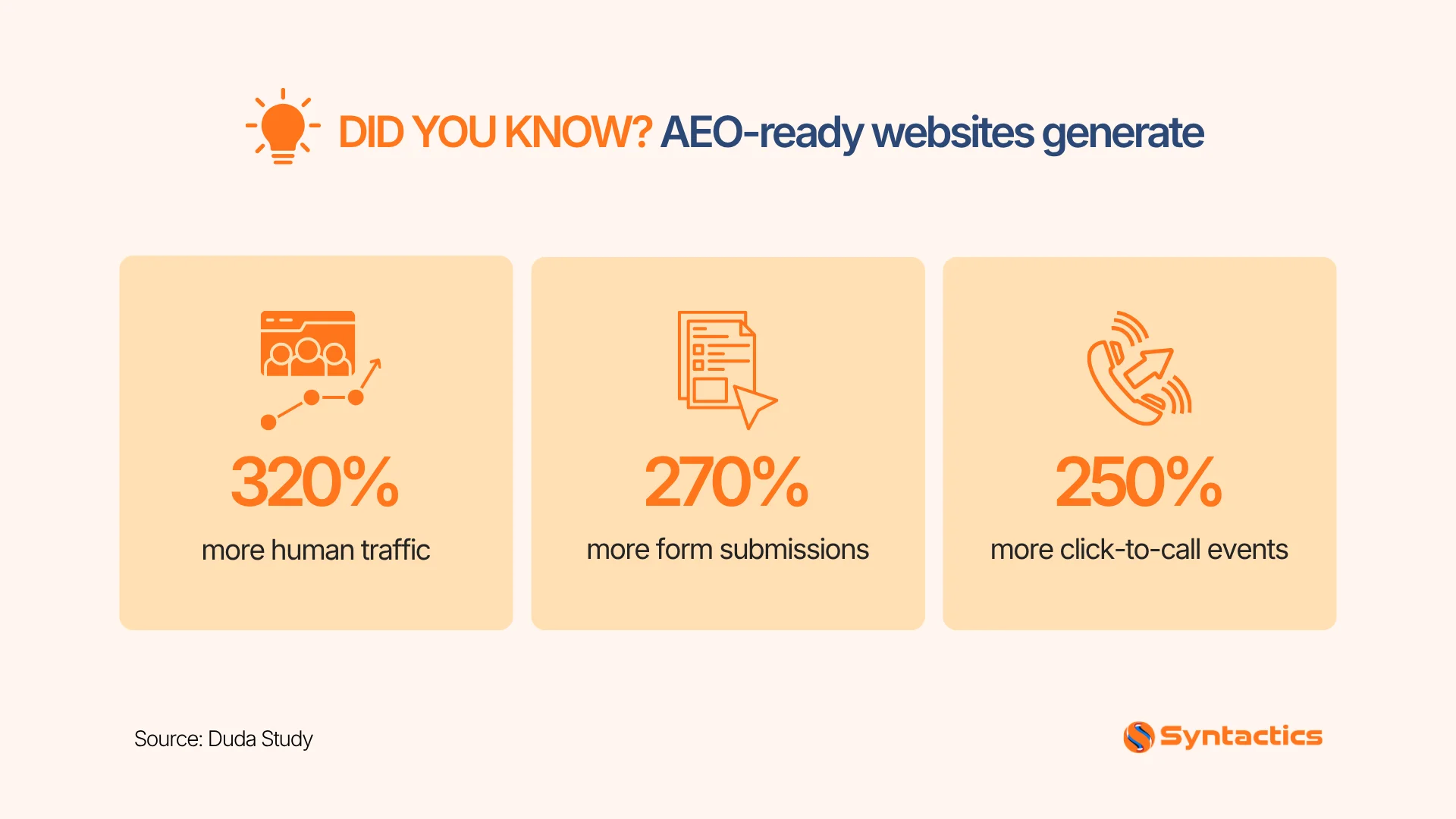
Source: Duda Study.
Key Takeaways
- Traditional SEO-built websites focus on search engine ranking. AEO-ready web design optimizes for direct AI extraction and citation.
- Most searches now end without a click, so being cited in AI answers is just as valuable as ranking high in search results.
- Schema markup and content structure now measurably influence whether AI engines cite a page at all.
- Most websites benefit from using both strategies. Ranking helps with conversions, while being cited by AI boosts your long-term visibility.
- A well-planned website update should cover both technical SEO and AEO structure together.
How Traditional SEO-Built Websites Work
Traditional SEO websites follow a set formula. Each page focuses on a main keyword, uses that keyword in the title tag and meta description, and organizes content with an H1 and supporting H2 headings. Rankings depend on things like backlinks, domain authority, page speed, and how well you use keywords on the page.
This approach has worked well for a long time. It’s backed by over twenty years of best practices. It’s especially effective for searches where people are ready to buy, and you can easily measure results with tools like Search Console and Semrush.
Where the Traditional Model Breaks Down
As more people use AI search, three common problems keep coming up:
- Zero-click answers mean users often don’t visit your page. When an AI Overview creates a summary, people rarely click the source. According to Pew Research, users only click a cited source about 1% of the time an AI Overview appears.
- Unstructured prose leaves AI guessing what to extract. Long paragraphs lacking clear headers, lists, or defined takeaways force a model to guess at the answer instead of lifting it cleanly.
- Weak entity signals reduce citation confidence. Pages that leave the business and its offer unclear leave AI models uncertain, and uncertain models tend not to cite.
How AEO-Ready Web Design Works
Answer Engine Optimization treats the website as infrastructure for machine extraction as much as human browsing. The content, code, and information architecture are all built so an AI model can lift a clean, standalone answer with confidence.
You can see this approach in four main ways:
- Pre-chunked content. Sections like Key Takeaways and FAQs give AI models ready-made answers, so they don’t have to figure out what’s important.
- AI-crawler-friendly technical setup: Clean HTML, fast loading, and open access for bots like GPTBot and ClaudeBot are now just as important as access for Googlebot.
- Explicit schema markup: Using Organization, Article, and FAQPage schema helps AI models clearly understand your content, instead of guessing from vague text.
- Topic-clustered architecture: Grouping related content into main topics and subtopics builds stronger authority, instead of spreading information across unrelated pages.
Why Structure Now Outperforms Structure-Plus-Tricks
A recent study found that pages with detailed, well-filled schema get notably more AI citations than generic markup. This benefit is even bigger for smaller sites with fewer backlinks. In short, good structure can help smaller businesses compete with larger ones.
Site performance is also important. After Google’s March 2026 core update, only 49.1% of mobile sites pass all three Core Web Vitals thresholds, compared to 58% on desktop. Slow or unstable mobile sites now hurt both your rankings and your chances of being found by AI.
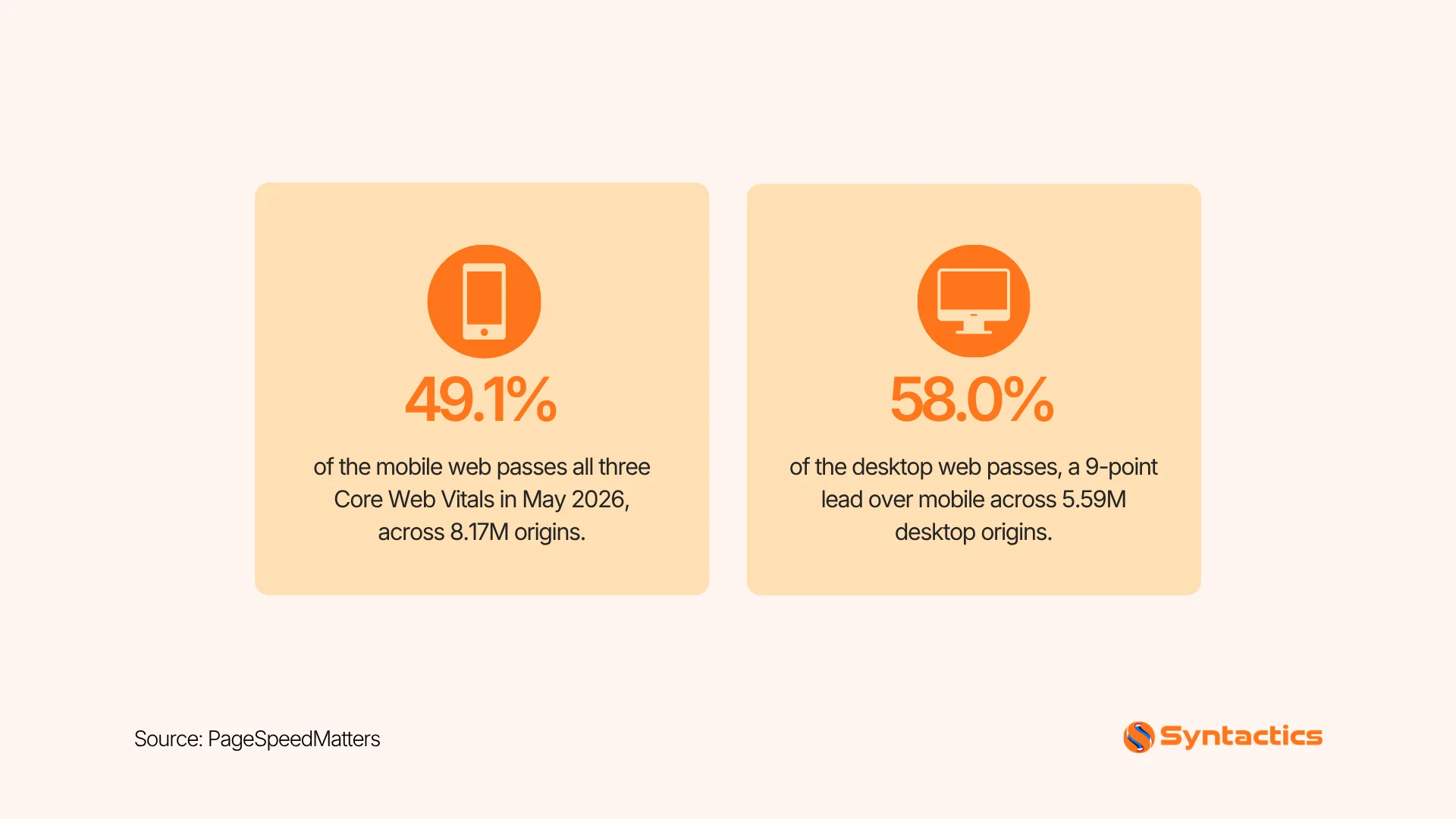
Source: PageSpeedMatters.
Traditional SEO vs. AEO-Ready Design: Key Differences
The table below shows the main differences between the two approaches in terms of content, technical focus, and how you measure success. Use it as a quick guide when reviewing a page or planning a new one.
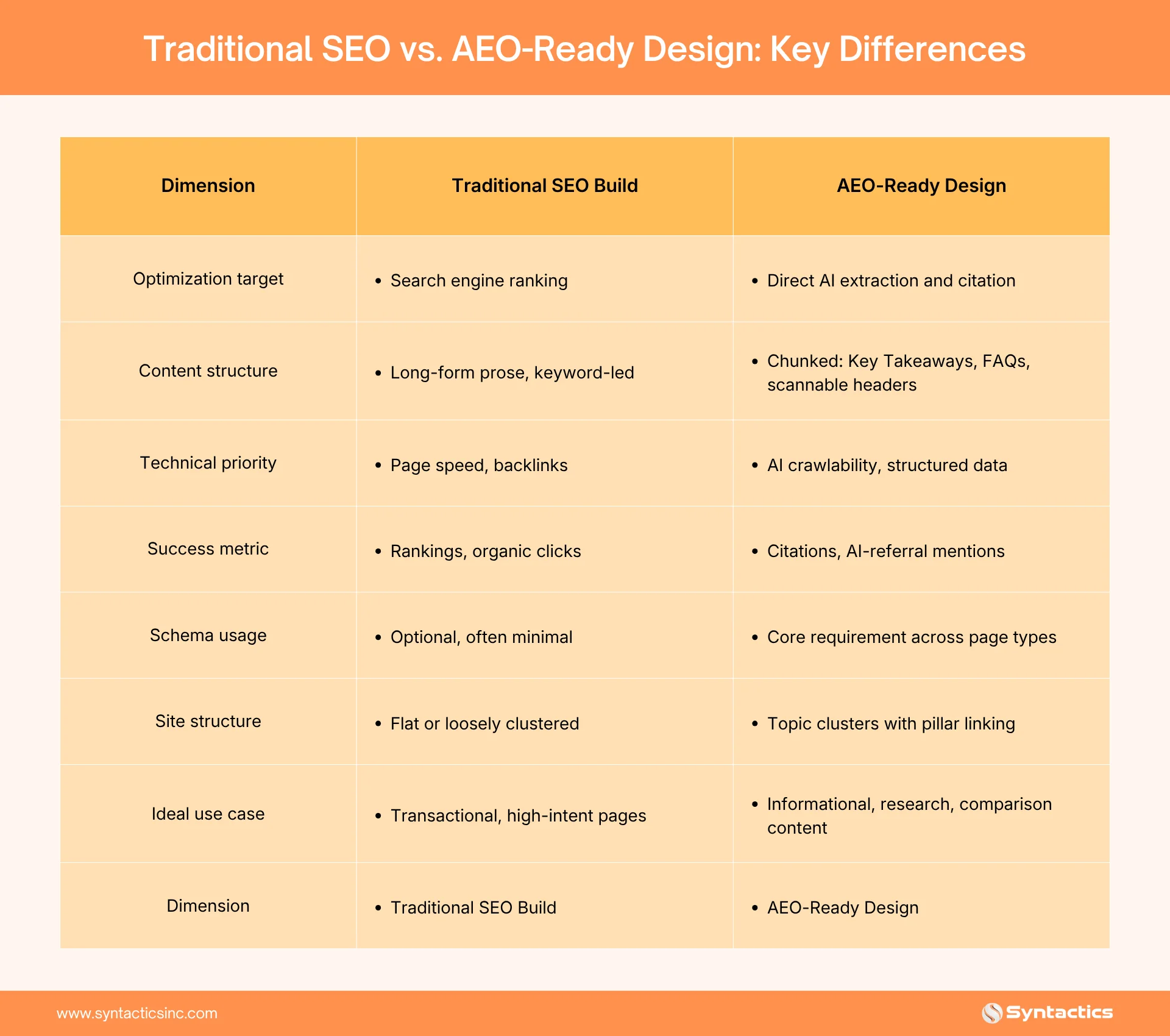
The main takeaway is consistent: AEO is designed so AI models can cite your page directly, even if no one clicks through.
Best Practices for Each Approach
Each method has its own checklist. Here’s what to focus on, depending on which approach your page requires.
Traditional SEO builds
- Keep title tags and meta descriptions within platform character limits.
- Maintain clean internal linking with descriptive, keyword-relevant anchor text.
- Treat Core Web Vitals as a baseline requirement, essential rather than optional.
AEO-ready design
- Open every page with a scannable Key Takeaways section.
- Add FAQ content with schema for any page answering common questions.
- Build content in pillar and sub-pillar clusters instead of standalone posts.
- Confirm AI crawlers have open access in robots.txt before publishing.
Decision Criteria: When to Choose Each
Different pages need different treatment. Use these criteria to decide which approach fits the page you’re building.
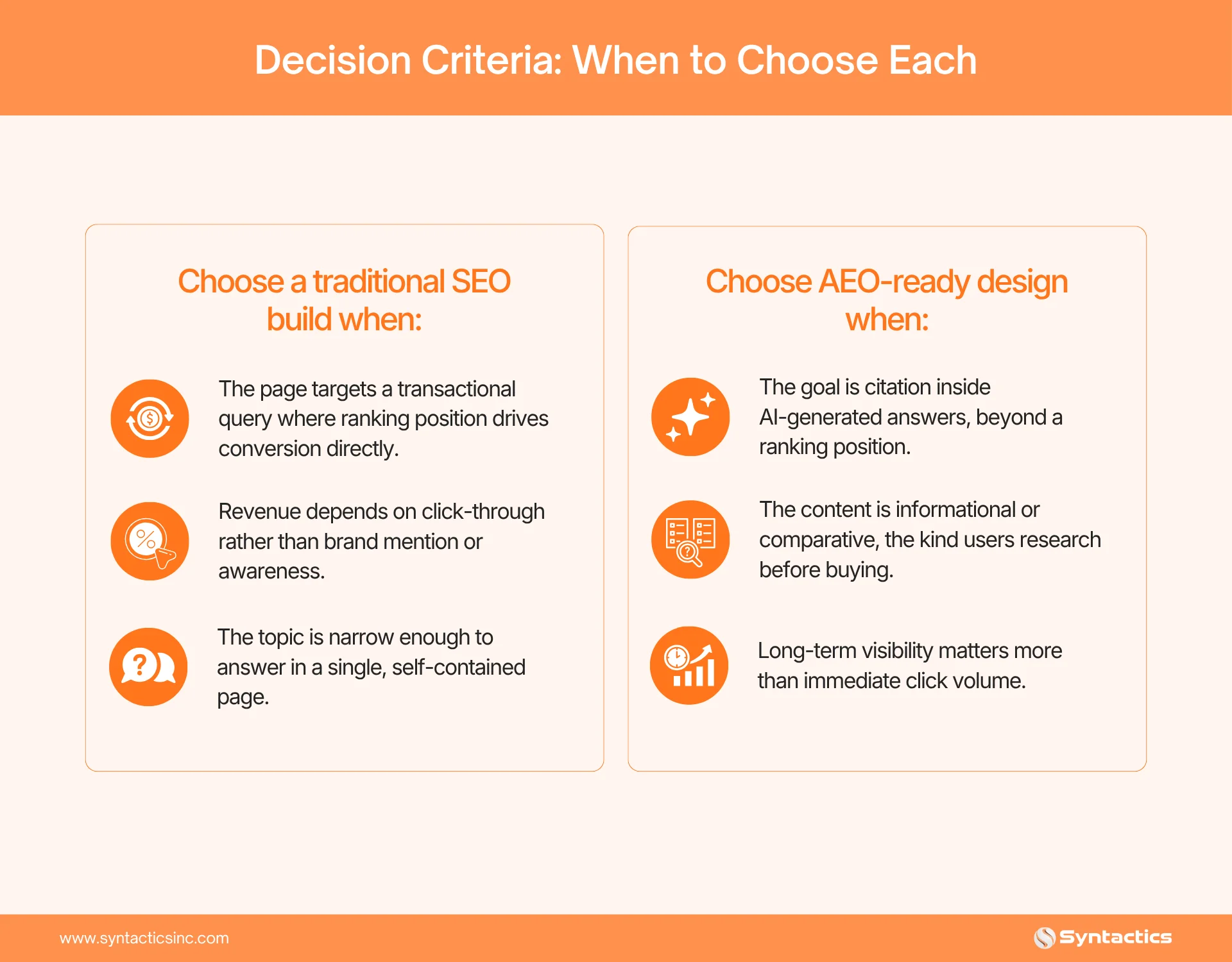
Most websites need both strategies. A good website update should rebuild your technical foundation, fix any Core Web Vitals issues on mobile, and then add AEO structure to the pages that still need to rank well.
Choosing the Right Architecture for Your Site
Choosing the right website structure is a long-term decision. It affects whether your site can compete as more searches end without clicks.
At Syntactics, we’ve been helping clients address these issues. We often see unstable mobile Core Web Vitals, limited schema use, and site structures focused only on old ranking methods instead of AI citation. Fixing this takes more than just updating content. It’s something an experienced web design and development Philippines team can handle from the ground up.
If your site ranks well but doesn’t get many clicks, or you’re unsure if AI engines can read it properly, it’s time to take a closer look. Building your site’s design and features around a solid structure helps both your brand and your visibility.
Get Design and Functionality
Specific to your Brand!
- Build a website that's mobile-friendly and responsive.
- Custom designs aligned with your brand.
- Optimized for SEO and user experience.
- Scalable and feature-rich solutions.

Frequently Asked Questions
What is AEO-ready web design?
AEO-ready web design structures a website so AI search engines can extract, trust, and cite its content directly. It relies on schema markup, chunked content, and clean technical architecture.
Does AEO replace traditional SEO?
No. Traditional SEO still drives rankings and clicks for transactional queries. AEO adds a layer focused on AI citation and zero-click visibility.
How do I know if my site needs an AEO-focused revamp?
A revamp audit is the right next step in a few cases. Your mobile Core Web Vitals are inconsistent, your content lacks structured takeaways or FAQs, or you’re unsure whether AI crawlers can access your site.
What schema markup matters most for AI citation?
Organization, Article, and FAQPage schema give AI models the clearest entity signals, especially when populated with specific, factual details rather than boilerplate fields.
Can a website rank well and still get skipped by AI answers?
Yes. Ranking and citation are measured differently. A page can hold position one and still never appear in an AI-generated answer if its content isn’t structured for extraction.










Comment 0