CASE STUDY
Building an AI-Powered Project Intelligence Layer for Bitrix24
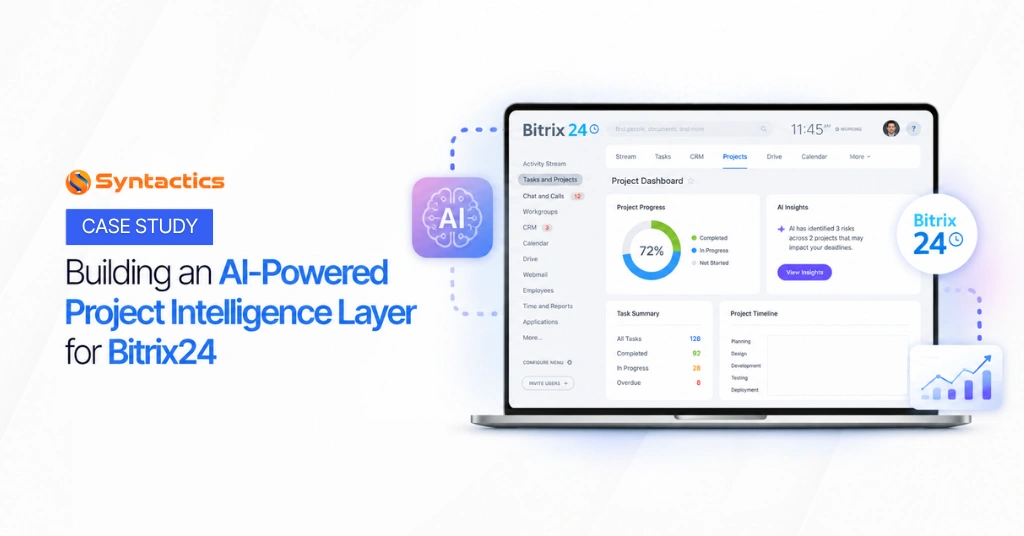
Syntactics, Inc. built a custom AI-powered Project Management Intelligence System that goes beyond Bitrix24’s basic task and project tracking.
This system automatically scores project health, identifies risks, analyzes resources, predicts completion, tracks trends, and gives AI-based recommendations. It uses Bitrix24’s data to provide real-time insights for managing projects, resources, workloads, and deadlines.
Now, this solution doesn’t replace Bitrix24. Instead, it adds an intelligence layer to the client’s current platform. Bitrix24 keeps all the records while the custom system analyzes project data and presents the results in a clear management view.
Without a doubt, the demand for AI-enabled project-management capabilities is growing. In fact, the Business Research Company projects that the global AI in project management market will grow from $3.58 billion in 2025 to $8.9 billion by 2030. This represents a projected 20.1% compound annual growth rate.
While this is a commercial market forecast, estimates may vary depending on how AI project-management software and services are defined.
Key Takeaways
- Our team developed a custom AI intelligence layer that extends Bitrix24 instead of replacing it.
- The system automates project health scoring, risk classification, and completion forecasting.
- By tracking resource use, the system can spot overloaded staff before it affects project delivery.
- Historical health snapshots show how project conditions change over time.
- An AI analysis layer converts structured project metrics into management-ready recommendations.
- Executive reports consolidate portfolio health, schedule risk, resource allocation, and financial variance.
- The system’s architecture can be adapted to Jira, Asana, Monday.com, Salesforce, ERP systems, and custom internal apps, depending on each platform’s data model and integration options.
The Challenge
Bitrix24 provides tools for managing tasks and projects, like setting deadlines, viewing workloads, tracking employee involvement, and recording time spent on tasks. It also helps plan employee workloads.
However, we needed more advanced analysis than Bitrix24’s standard views and reports could provide. As more projects became active, project managers and executives had to figure out the following manually:
- Which projects were becoming risky.
- Which employees were approaching or exceeding capacity.
- Which tasks were aging without resolution.
- Whether actual progress matched planned progress.
- Which issues required immediate intervention.
The challenge was not a lack of operational data. Bitrix24 already contained substantial information about projects, tasks, assignments, deadlines, and recorded effort. The challenge was converting that information into a consistent portfolio-level view that management could use to make timely decisions.
This reflects a broader project-management problem. Breeze reports that 47% of respondents lack access to real-time project key performance indicators and that many teams spend significant time manually compiling status information.
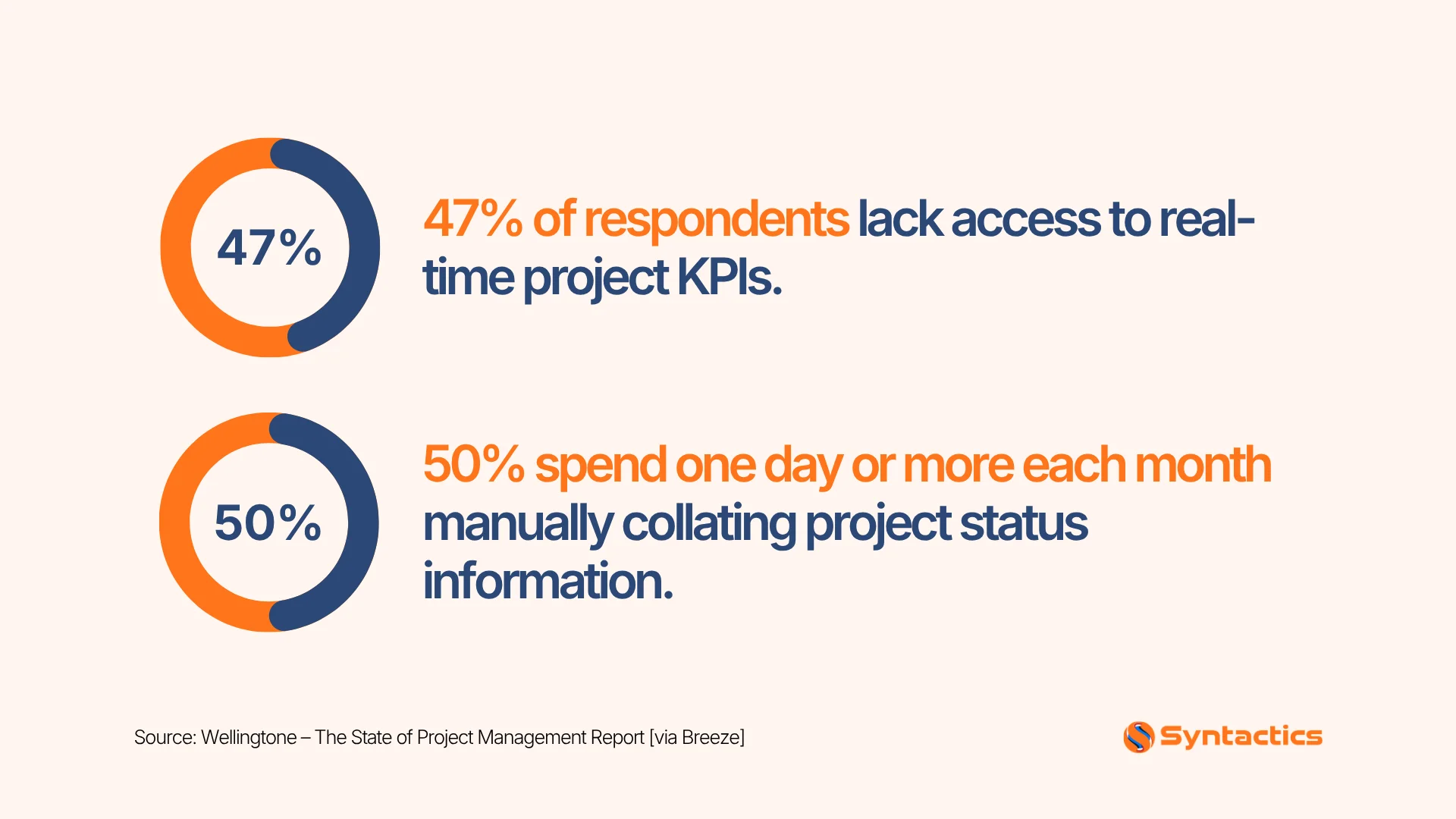
Source: Wellingtone – The State of Project Management Report [via Breeze].
The Opportunity
Organizations don’t always have to replace their current project management platform to get advanced insights. Adding a custom analysis layer can keep existing workflows while bringing in data normalization, scoring, forecasting, historical tracking, and AI-powered reports.
PMI research also links AI maturity to project performance. PMI reported that organizations classified as “AI Innovators” delivered 61% of projects on time, compared with 47% among “AI Laggards.”
These numbers come from surveys comparing different organizations. They show a connection, but do not prove that AI alone caused the difference. Other factors, such as leadership, data quality, governance, and overall organizational strength, can also affect project results.
The Solution
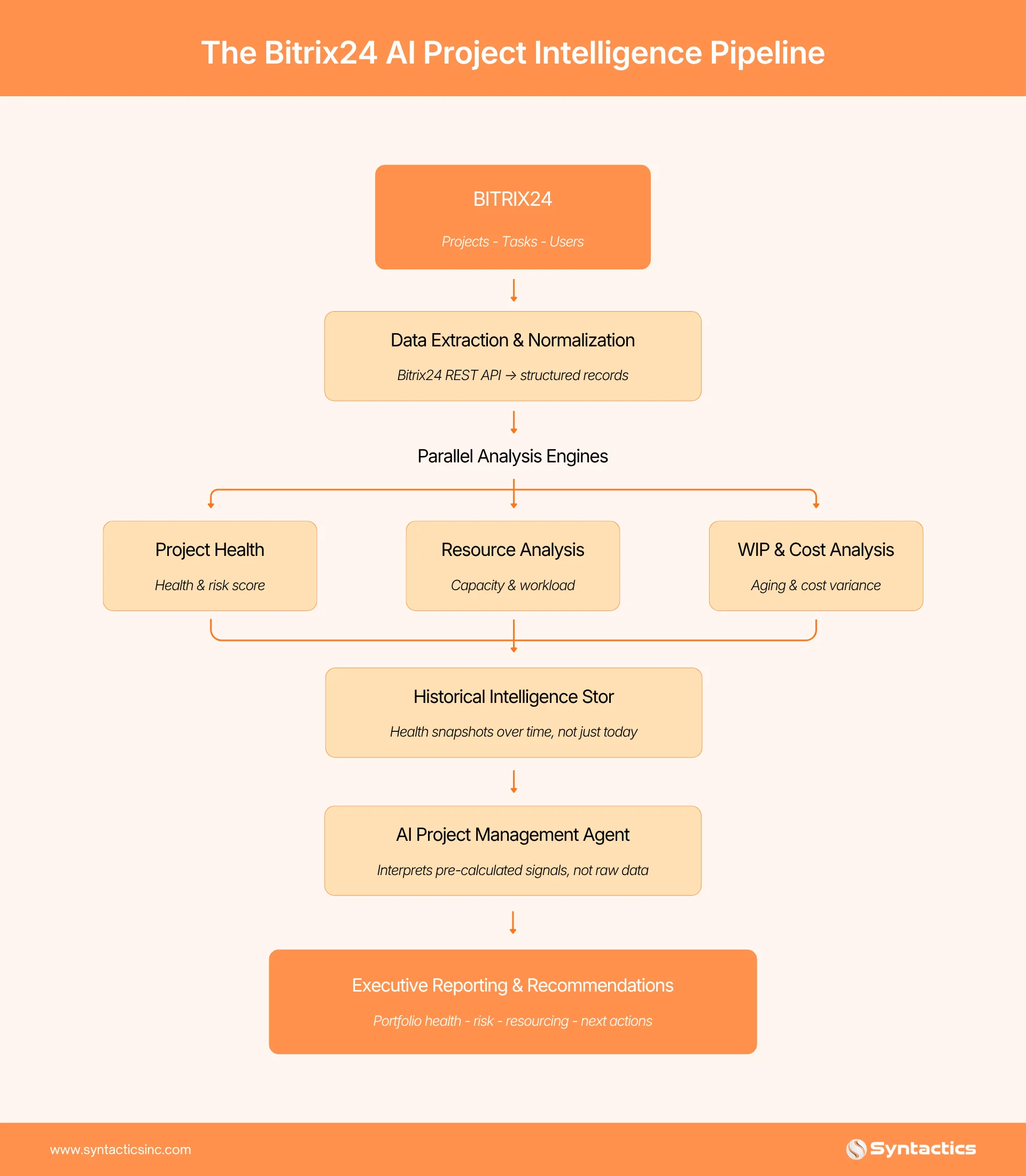
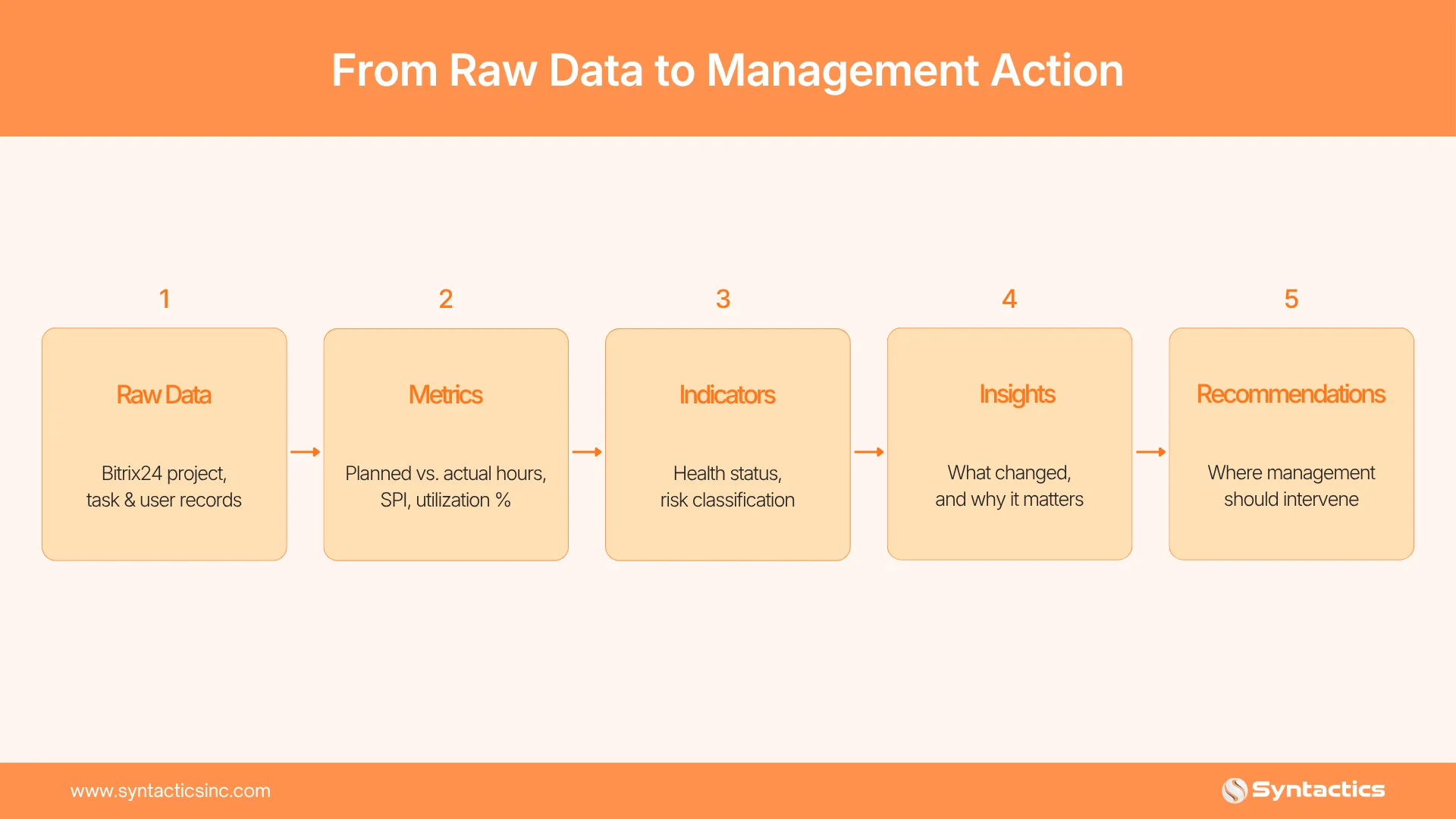
Our development team created an automated intelligence workflow for Bitrix24. It pulls project, task, user, deadline, workload, and time-tracking data via the Bitrix24 REST API, then organizes it into standard records.
The data goes through several analysis steps before the AI layer reviews the results and makes recommendations.
Project Health Scoring
The Project Health Engine evaluates each project using indicators such as:
- Planned versus actual hours.
- Completion rate.
- Late-task volume.
- Task age.
- Deadline proximity.
- Schedule performance.
- Resource utilization.
- Financial variance where data is available.
The engine assigns each project to one of four categories:
- Healthy: Performance remains within the expected range.
- Watch: Early warning indicators require monitoring.
- At Risk: Material schedule, workload, or delivery concerns are present.
- Critical: Immediate management intervention is required.
This rules-based scoring gives a steady foundation for analysis. The AI layer explains the signals and suggests actions, but it doesn’t change the basic calculations.
Schedule Performance and Forecasting
Counting tasks doesn’t always show real project progress. A project might finish many small tasks while major deliverables remain unfinished.
The system therefore compares earned progress with planned progress. Where the project uses formal earned-value terminology, the Schedule Performance Index (SPI) is commonly represented as:
SPI = EV / PV
where EV is earned value, and PV is planned value.
The system uses project logic to determine progress based on available task, effort, milestone, and completion data. It also predicts likely completion dates using current progress and past performance.
This gives managers earlier insight into projects that seem active but are moving more slowly than planned.
Resource and Capacity Intelligence
The system aggregates assignments by employee and compares planned workload with available capacity. It flags potential over-allocation before resource pressure affects delivery.
A 70–85% utilization range is often used as a capacity-planning guideline, leaving room for meetings, support work, unexpected requests, and problem-solving. The correct threshold depends on the employee’s role, business model, and how utilization is defined.
It also treats capacity alerts as management signals, not judgments about employee performance or wellbeing. Managers can use the alerts to review priorities, redistribute tasks, adjust timelines, or add support.
WIP Aging, Cost, and Historical Tracking
The system classifies open tasks into age bands such as Normal, Aging, At Risk, and Critical. This helps distinguish ordinary open work from tasks that have remained unresolved long enough to threaten delivery.
Where the required information is available, the system estimates actual labor cost against planned cost and identifies financial variance.
It also records periodic project-health snapshots. These historical records show whether a project is improving, deteriorating, remaining stable, or recovering after intervention.
AI Analysis and Executive Reporting
The AI Project Management Agent receives structured intelligence rather than raw Bitrix24 records. The analytical engines first calculate health, schedule, workload, aging, and cost indicators. The AI layer then interprets those signals and generates management-oriented recommendations.
For example, the system can spot when actual hours exceed plan, high-priority tasks approach their deadlines, a key employee is over capacity, or dependent tasks remain unresolved. It can then recommend a priority review, workload rebalance, dependency escalation, or schedule adjustments.
The system generates executive reports covering:
- Portfolio health.
- Schedule and deadline risk.
- Completion forecasts.
- Resource allocation.
- Task aging.
- Cost and financial variance.
- Historical project trends.
- Recommended management actions.
Results
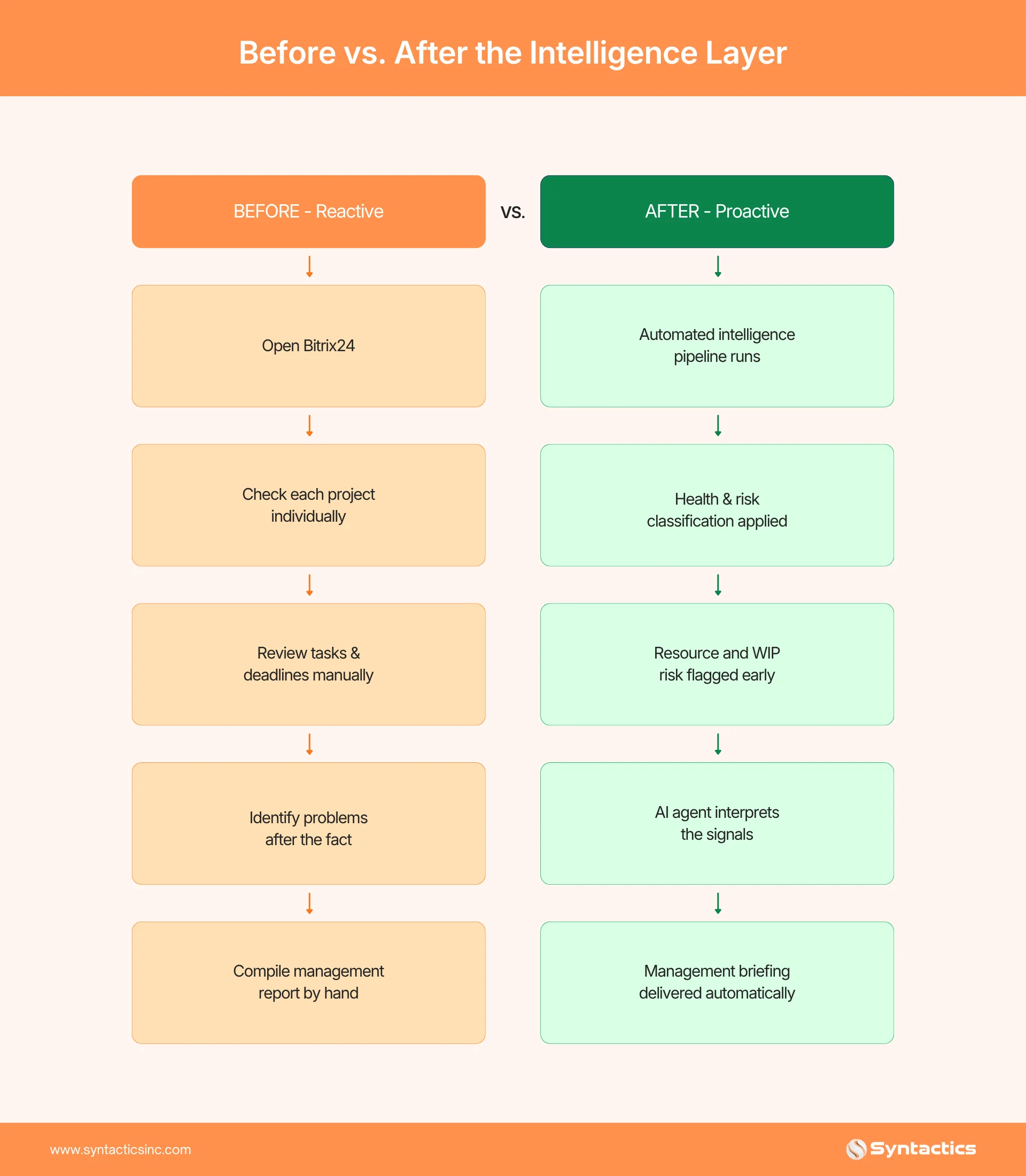
With this system in place, the client moved from just reacting to problems to taking action before issues arise.
Project managers now review a portfolio-level health summary instead of opening individual projects to determine their status. The system provides a consolidated view of risk, schedule performance, workload, task aging, and financial indicators.
The implementation produced these verified operational outcomes:
- Earlier visibility into project risks.
- Automated recurring status-reporting workflows.
- Faster identification of resource bottlenecks.
- Earlier detection of potentially overallocated staff.
- Historical tracking of project-health changes.
- Management recommendations based on structured project signals.
- Less dependence on manual project-by-project review.
- More time for managers to focus on intervention instead of data collection.
These results are specific to this client’s implementation. They match the general trends seen in AI-enabled project management research, but they aren’t direct results from the wider market or PMI studies.
Conclusion
This implementation demonstrates how Bitrix24 can evolve into a data-driven, AI-assisted management system without replacing the underlying application.
Bitrix24 still holds all the records, while the custom intelligence layer turns data into health scores, forecasts, trends, capacity alerts, and recommendations for managers.
The same architecture can be adapted to Jira, Asana, Monday.com, Salesforce, ERP systems, and custom internal applications, although each platform requires its own data mapping, permissions, API handling, synchronization process, and business rules.
Syntactics, Inc. is a custom software development partner in the Philippines that helps businesses modernize existing platforms through custom software, automation, data integration, and AI-powered systems. The result is faster, more informed decisions, fewer hours lost to manual reporting, and a platform that scales as your project portfolio grows.

Frequently Asked Questions
Does the intelligence layer replace Bitrix24?
No. Bitrix24 remains the system of record. The intelligence layer analyzes its data and adds custom scoring, forecasting, historical reporting, and recommendations.
Can it work with other platforms?
Yes. The architecture can be adapted to other platforms that provide the required data access and integration capabilities.
Does the AI make decisions automatically?
No. It interprets structured signals and recommends actions. Project managers remain responsible for reviewing recommendations and making final decisions.
How long does implementation take?
Timelines depend on data sources, business rules, reporting requirements, API complexity, and the depth of AI integration. Typical phases include discovery, integration, analytics development, AI implementation, testing, and deployment.