Sales teams don’t lose most of their time selling. They lose it finding businesses to call and checking whether those businesses even have a website. They lose it writing cold emails, watching an inbox for replies, and chasing down calendars to book a call. Add up all that work across hundreds of prospects, and salespeople spend more hours on research and admin than on actual conversations.
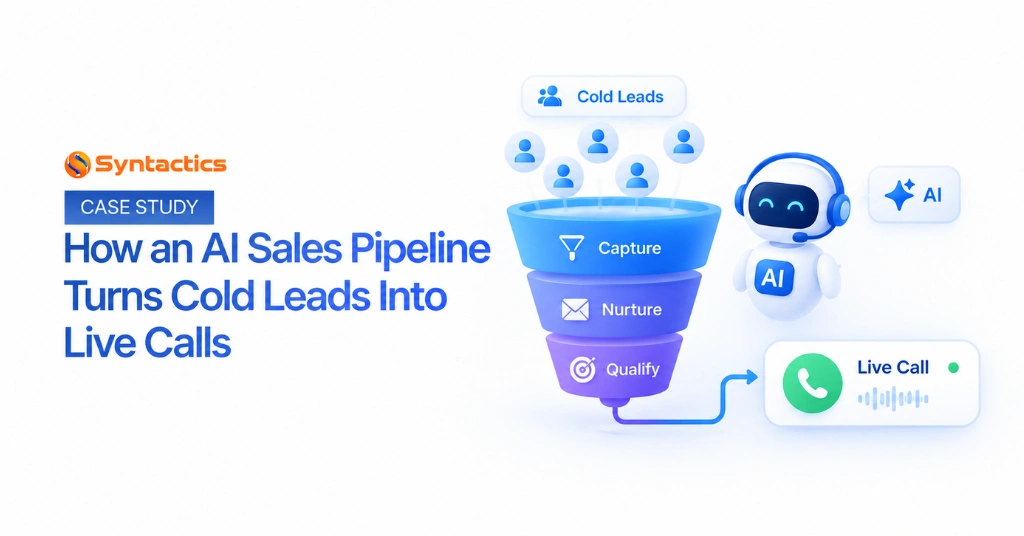
That was the problem behind a new outbound sales system built for digital agencies. Instead of adding more people to handle more leads, the system automates everything that happens before a salesperson picks up the phone. It finds businesses, checks whether they need help, and writes and sends outreach. Then it reads the replies, books the call, dials the prospect, and hands the live call straight to an available sales agent.
The salesperson only shows up once someone is on the other end of the line, ready to talk.
Source: Salesforce.
The Challenge
A typical outbound process for an agency looks like this. A salesperson picks a target market, say dental clinics in Australia that need a website and some SEO help. From there, they have to:
- Find businesses that match the target market
- Research each one to see if they’re a fit
- Check whether the business has a real website or just a Facebook page
- Build a prospect list from scratch
- Write and send cold emails
- Watch the inbox for replies
- Read each reply and figure out if the person is actually interested
- Schedule the call
- Remember to make the call
- Connect the prospect to a rep who’s free
Every one of those steps takes time. And every new prospect adds the same amount of work again. The math doesn’t scale. You can’t add prospects without adding people, and adding people costs money that eats into the margin on every deal you close.
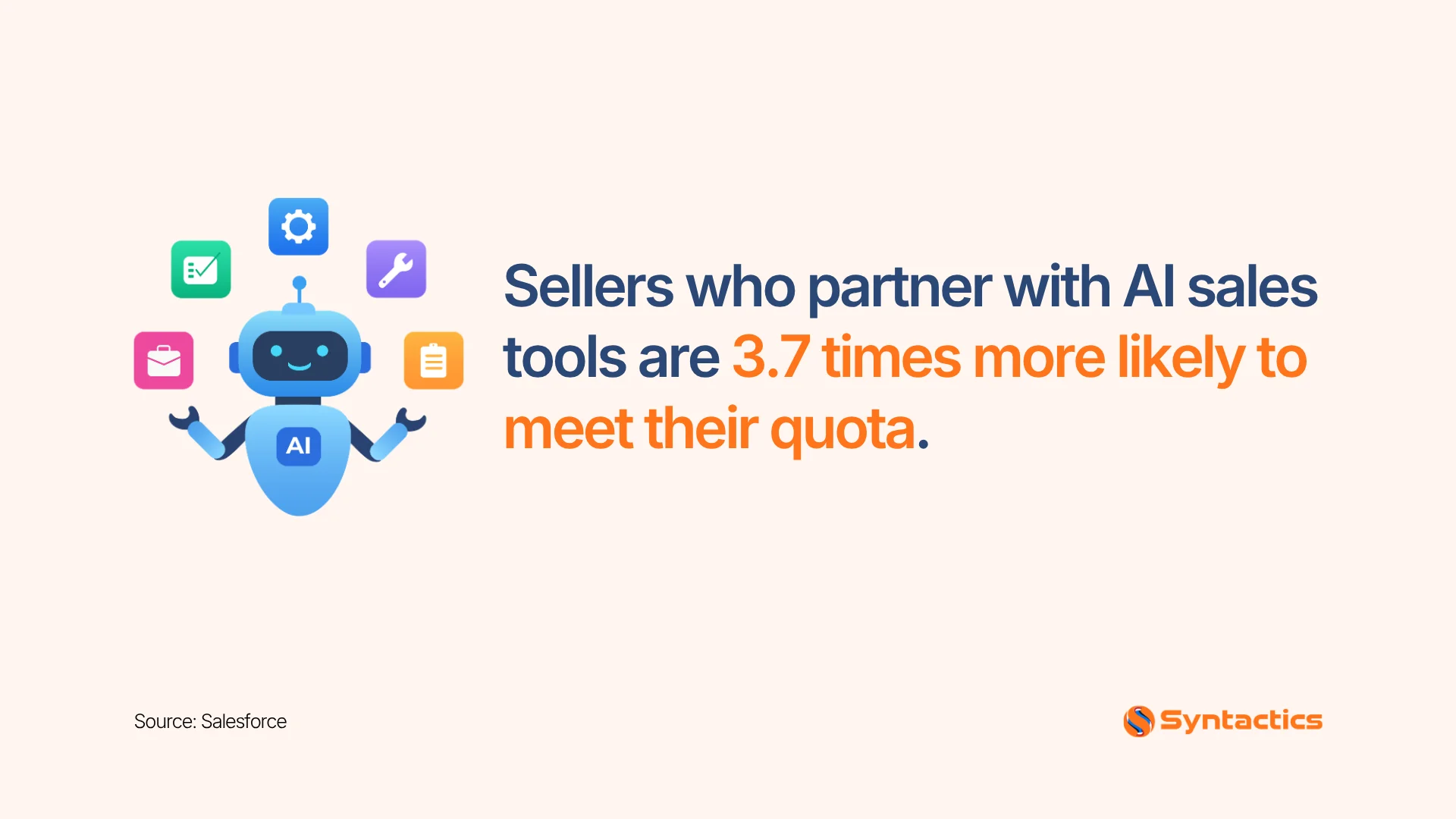
The Salesforce’s 2026 State of Sales study points out this problem. Salespeople spend 60% of their time on non-selling tasks, leaving only 40% for actual sales. The study also found that people who use AI tools are 3.7 times more likely to meet their targets than those who don’t.
The Solution: An Automated Pipeline With a Human at the End
The new system breaks that chain into stages and automates every stage except the one that actually needs a human: the sales conversation itself.
The diagram below shows the full path a prospect travels. It starts with the first search for a target business and ends when a live call lands with a sales agent.
Here’s what happens at each stage.
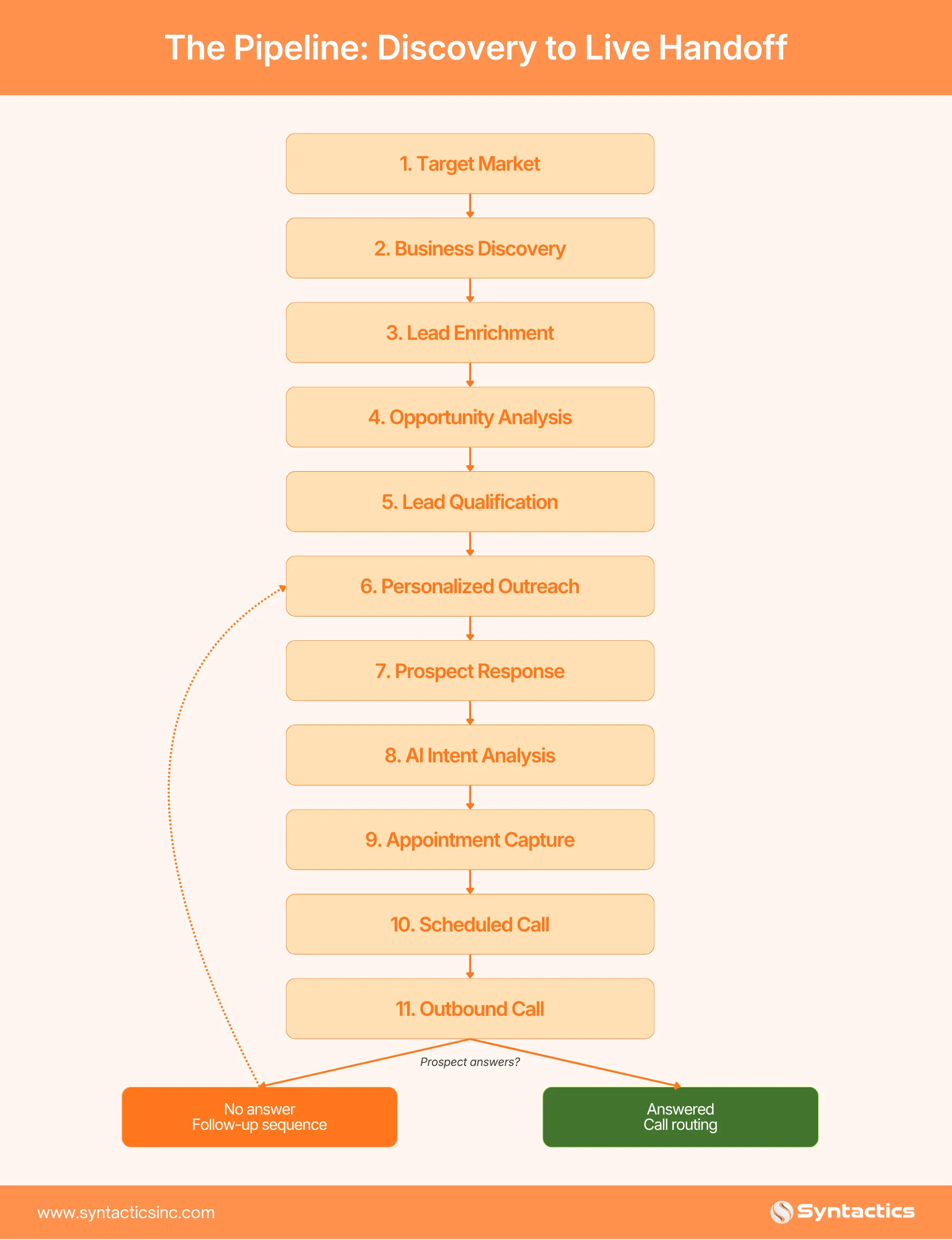
Target Market and Discovery.
The agency defines who to go after: an industry, a location, a service to sell, and the criteria that make a business worth pursuing. The system then searches for real businesses matching those criteria.
Lead Enrichment.
Each business gets checked and filled out with contact details, business information, and whether it already has a functioning website or relies on Facebook instead.
Opportunity Analysis and Qualification.
The system looks at what each business is missing and decides whether there’s a real opportunity to pitch. Prospects that don’t fit get filtered out here, before anyone spends time on them.
Personalized Outreach.
Emails go out based on what the system found about each specific business, not a generic template blasted to everyone on the list. That distinction matters more than it sounds.
According to Snov.io, more than 10 million cold emails were analyzed, and personalized emails reached a 20.79% open rate, compared to 14.96% for generic ones. Feeding real business context into every email is what separates a message that gets opened from one that gets deleted.
Response Detection and AI Intent Analysis.
When a prospect replies, the system reads the message and figures out what they actually mean. Are they interested? Do they have questions? Are they asking to be left alone? A human doesn’t need to sit and watch the inbox.
Appointment Capture and Scheduling.
If a prospect wants to talk, the system books the call and remembers it, so nothing falls through the cracks.
Outbound Call and Routing.
At the scheduled time, the system places the call. If the prospect answers, the call routes straight to an available sales agent. If they don’t answer, the prospect goes into a follow-up sequence instead of just disappearing.
The Result
The real benefit isn’t that the system can process more leads. It’s that it can process more leads without asking the sales team to do proportionally more work.
Here’s what that looks like in practice, starting from a batch of 1,000 prospects.
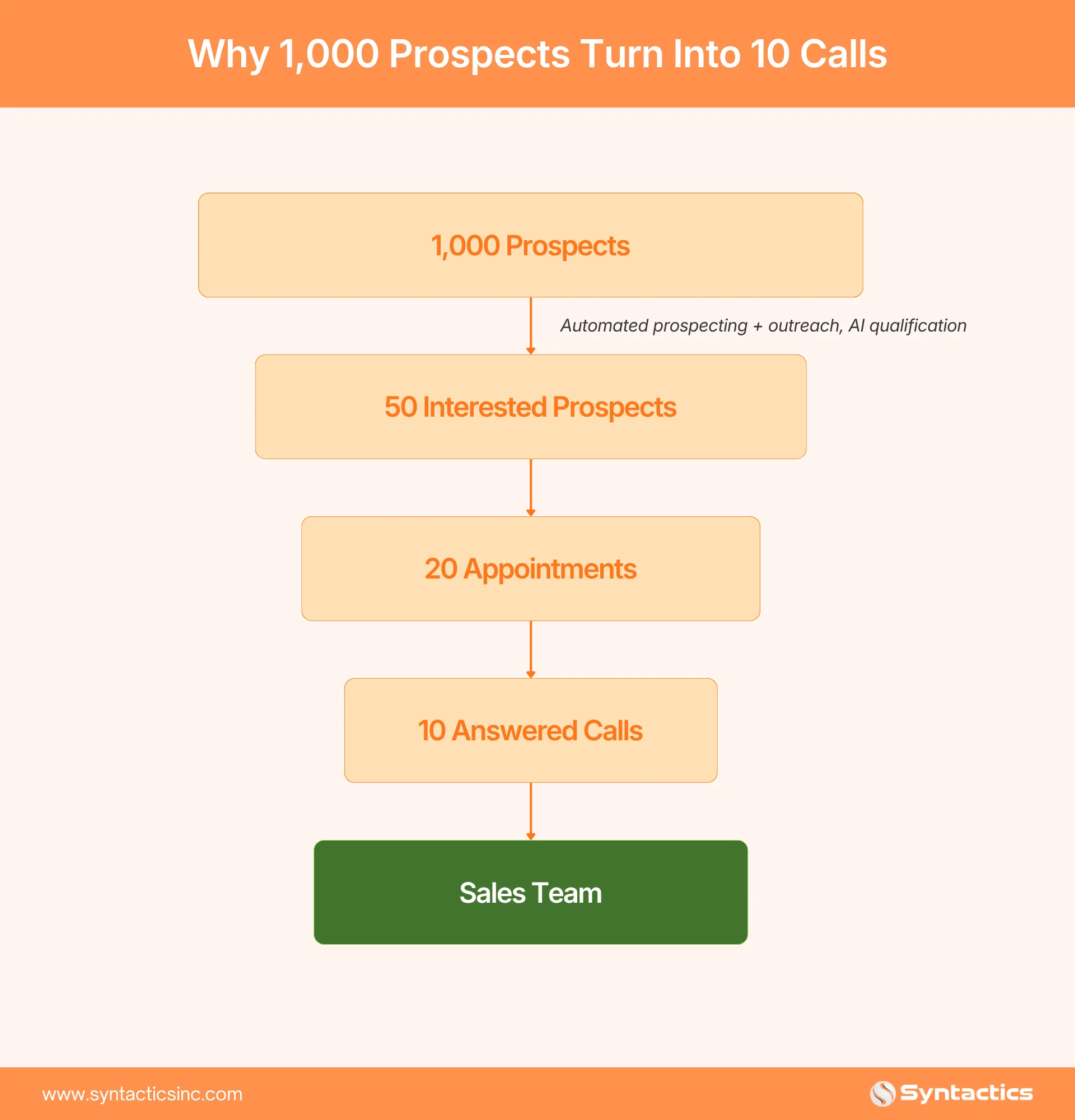
Out of 1,000 prospects, automated qualification narrows the pool to 50 genuinely interested businesses. That becomes 20 booked appointments. Of those, 10 calls get answered live and routed to a sales agent.
Notice what the sales team never had to do. They didn’t research 1,000 businesses, write 1,000 emails, sit refreshing an inbox. They talked to 10 people who were already qualified, already interested, and already expecting the call.
What Changes for the Team
The shift isn’t about replacing salespeople. It’s about changing what they spend their day doing.
- More prospecting capacity. The system can research far more businesses than a person could manually work through in the same time.
- Less admin. Salespeople stop building and maintaining spreadsheets of leads.
- Better context going into outreach. Every lead record is enriched before the first email goes out.
- Faster response handling. Replies get read and classified the moment they arrive, not whenever someone checks the inbox.
- Fewer missed appointments. The appointment itself drives the call, instead of relying on someone to remember it.
- More time on actual selling. Reps spend their hours talking to people, not chasing them.
The payoff for the sales team is measurable. A Gartner survey of 210 chief sales officers and senior sales leaders found that AI tools save sellers an average of 4.8 hours a week. Organizations that reinvest that time into high-value selling activity are 2.2 times more likely to exceed their customer growth goals.
Where This Pipeline Fits Best
Syntactics builds and runs this pipeline daily. It finds businesses that need a real website or a redesign, then hands qualified, interested prospects straight to a sales team ready to close.
An outdated template, or no real website at all, shows up clearly during discovery. Outreach can then speak to the exact gap on a prospect’s site instead of a generic pitch.
If your agency sells web design and development, Syntactics can build and run the same pipeline against your target market, with no added headcount. The same stages carry over just as well for SEO, hosting, or another service down the line.
Get Design and Functionality
Specific to your Brand!
- Build a website that's mobile-friendly and responsive.
- Custom designs aligned with your brand.
- Optimized for SEO and user experience.
- Scalable and feature-rich solutions.
Frequently Asked Questions
What services work best with this pipeline?
Web design and development lead the list. A missing or outdated website is easy to spot during discovery, and it gives outreach something specific to point to. The same pipeline also runs for SEO, hosting, e-commerce builds, and website security, since the underlying stages don’t change. Only the target criteria and the outreach angle do.
Does this replace my sales team?
No. It replaces the research, outreach, and scheduling work that used to sit in front of them. A person still runs the actual sales conversation. The pipeline’s job ends the moment a qualified prospect is live on the phone.
What happens if a prospect doesn’t answer the scheduled call?
They move into a follow-up sequence instead of falling off the list. No appointment gets left to chance just because a call went to voicemail once.
How does the system know a lead is actually qualified?
Every business gets enriched with real details, whether it has a working website, what’s missing, and whether it fits the target criteria the agency set. Prospects that don’t fit get filtered out before outreach, and AI reads replies to confirm real interest before a call gets booked.
How does Syntactics set this up for my agency?
Syntactics defines the target market and qualification criteria with you, then connects the pipeline to your outreach and calendar tools. From there, it configures the routing so live calls land with your available reps. The system then runs on its own, with your team stepping in only when a qualified prospect is ready to talk.
Ladymieh Naallatan is the Division Head of Design and Development at Syntactics Inc., leading a team of 40+ professionals. With over 16 years at Syntactics Inc., Ladymieh brings extensive expertise in team leadership, operational management, and organizational development, driving innovation and excellence locally and internationally.