

How to Lower Customer Acquisition Cost and Improve ROI
Customer acquisition cost, or CAC, is the amount a business spends on sales and marketing to gain a new customer. Every dollar spent on acquiring customers affects profit, and if CAC goes up, it can reduce profitability even when revenue seems strong.
Many people think of lowering CAC as simply cutting costs, like reducing ad budgets or pausing campaigns. But that approach misses the real goal. Companies that truly lower CAC focus on getting better leads, targeting the right prospects, converting more website visitors, and keeping the customers they gain. Lower CAC comes from improving the whole sales process, not just cutting expenses.
What Customer Acquisition Cost Means
Customer acquisition cost is the total sales and marketing spend divided by the number of new customers acquired in a given period.
CAC = Total Sales & Marketing Spend ÷ Number of New Customers Acquired
For example, if a company spends $50,000 in a quarter and gets 100 new customers, its CAC is $500. However, this number alone does not tell the full story unless you look at it in more detail.
CAC changes depending on the channel, campaign, and customer segment. For example, paid search usually has a different CAC than organic content, and referral programs often perform better than both. Industry CAC benchmarks show that referrals are usually the cheapest way to get new customers, while outbound sales and enterprise paid channels can cost much more, sometimes ten times as much.
Segment matters, too. CAC benchmarks by industry show that acquiring a small business customer costs far less and closes far faster than acquiring an enterprise account, with sales cycles stretching six to eighteen months. Treating CAC as one flat number, instead of channel-level and segment-level figures, is the first mistake most teams make.
Why High CAC Hurts ROI
A high CAC does more than just increase costs. It reduces profit margins, slows down how quickly you recover your investment, and makes your business growth less stable.
Higher CAC reduces margins and slows payback. If a customer takes eighteen months to pay back acquisition cost instead of six, the business carries churn risk far longer before that customer turns profitable.
Poorly tracked CAC hides wasted spend. Without channel-level attribution, teams keep funding channels that look fine in aggregate but are burning budget on leads that never convert or churn quickly.
Rising acquisition costs raise the stakes downstream. Google Ads cost data shows cost per click climbing across most industries year over year, which means conversion and retention now carry more weight in the ROI equation. A business that cannot convert or retain efficiently cannot outrun an expensive channel with more spend.
The link between acquisition cost and customer lifetime value, shown as the LTV to CAC ratio, is the best sign of a healthy growth model. HubSpot’s benchmark research suggests a good ratio is 3 to 1, meaning each dollar spent to get a customer should bring in at least three dollars over time.
Common Causes of High CAC
Most CAC issues come from a few main causes:
- Weak targeting. Casting a wide net across mismatched audiences wastes spend on leads that were never going to convert.
- Low conversion rates. Traffic that never converts is spend with no return, regardless of how cheap it was.
- Poor landing page experience. Slow load times and confusing forms push qualified visitors away.
- Inefficient paid media. Broad match keywords and stale creative inflate cost per click and cost per lead.
- Weak attribution. Without visibility into which channels drive customers, budget keeps flowing to underperformers.
- Overreliance on one channel. A single dominant channel leaves a business exposed when costs rise or algorithms change.
Strategies to Lower Customer Acquisition Cost
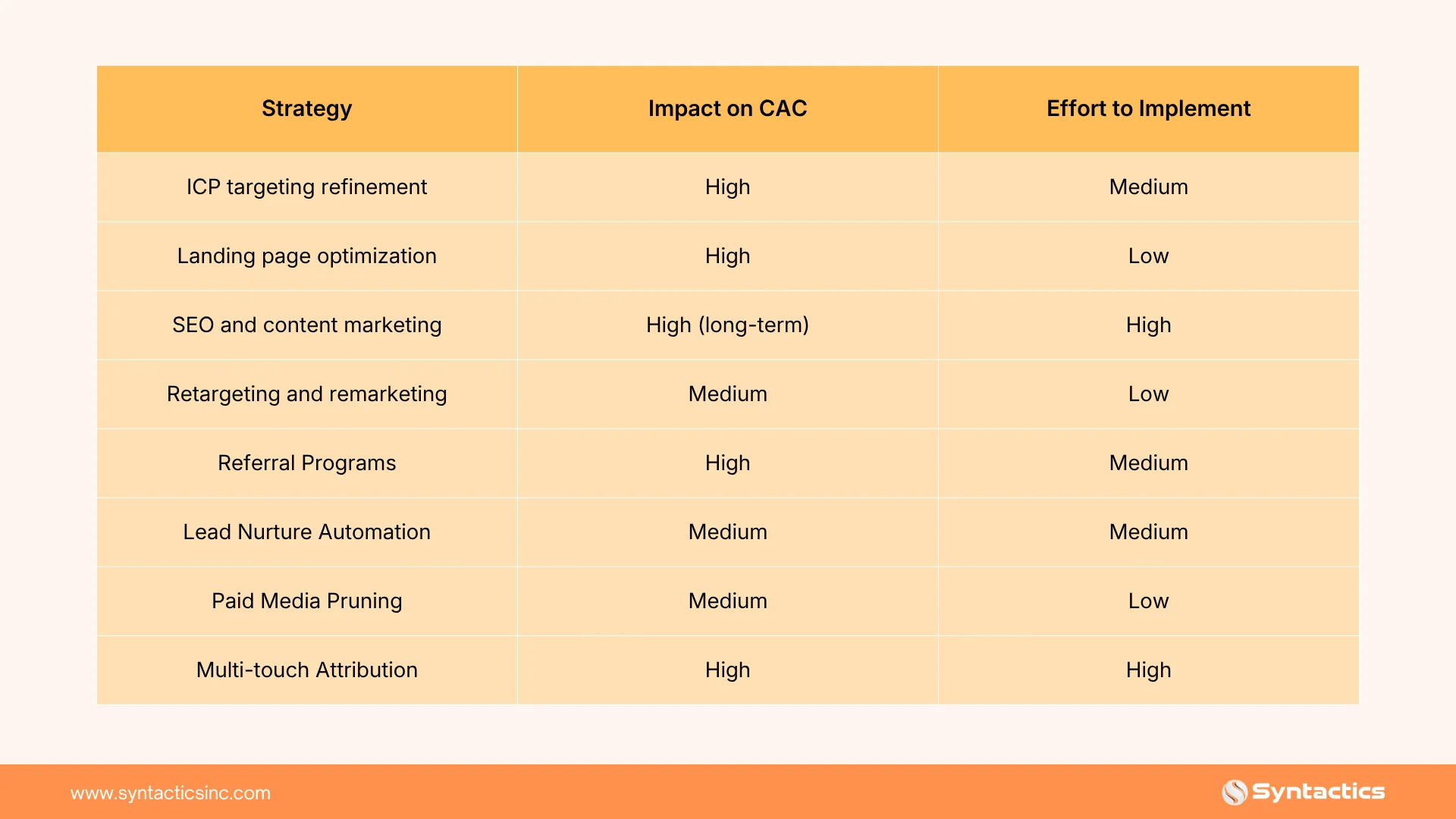
To lower CAC in a lasting way, you need to both find better prospects and convert them more effectively.
Improve audience segmentation and ICP targeting. Narrowing focus to accounts and personas most likely to convert and stay reduces wasted spend.
Optimize landing pages and conversion flows. Use clear headlines, make sure pages load quickly, and keep forms short. These changes can increase conversion rates and lower CAC without changing your ad budget.
Use SEO and content marketing for long-term efficiency. Organic channels cost more upfront but compound, typically landing at a lower CAC than paid channels once content matures.

Strengthen retargeting and remarketing. Warm audiences convert far better than cold traffic, making retargeting some of the most efficient spend in the budget.
Launch referral and partnership programs. Referral marketing data shows referred customers are among the cheapest to acquire and retain better, since they arrive with built-in trust. Separate research found referred customers carry 16% higher lifetime value and 18% lower churn.
Automate lead nurturing and follow-up. Many leads are lost from slow or inconsistent follow-up. Automated sequences keep prospects engaged without adding headcount.
Improve paid media efficiency through channel and keyword analysis. Pruning underperforming keywords and placements keeps spend concentrated where it converts. This is where a dedicated PPC management service earns its cost, since campaign-level pruning and bid strategy adjustments compound faster with ongoing account management than with occasional audits.
Use better attribution to identify high-performing channels. Multi-touch attribution reveals which channels genuinely drive customers, rather than crediting the last touchpoint alone.
Improve ROI Alongside CAC
Lowering CAC is just part of the picture. ROI grows fastest when you combine efficient acquisition with better customer value and retention.
Increase customer lifetime value. A customer worth more over time makes every acquisition dollar more productive, even if CAC stays flat.
Improve onboarding and retention. Customers who succeed early are far less likely to churn, protecting the payback on what it cost to acquire them.
Add upsell and cross-sell opportunities. Expansion revenue from existing customers is typically cheaper to generate than new acquisition, and it lifts LTV directly.
Focus on high-intent leads and qualified prospects. Fewer, better-fit leads convert higher and retain longer than a larger volume of loosely qualified traffic.
Reduce churn to make acquisition spend more sustainable. Small reductions in churn compound over time, extending the window in which acquisition spend pays off.
What Metrics to Track
A CAC optimization program needs consistent measurement across these metrics:
- CAC by channel, to see which sources are actually efficient rather than relying on a blended average.
- CAC payback period, or how long it takes a customer to generate enough revenue to cover acquisition cost.
- LTV to CAC ratio, the clearest single indicator of a sustainable growth model.
- Conversion rate, at each funnel stage, not just the final close.
- Retention rate, since acquisition efficiency means little if customers churn quickly.
- Cost per lead and cost per opportunity, to catch inefficiency before it reaches the CAC calculation.
Final Thoughts
Lowering customer acquisition costs is not just about spending less money. It is about spending smarter, finding the right prospects, converting more of them, and keeping the customers you already have. When you look at CAC this way, it becomes a powerful way to improve profit, payback time, and long-term ROI.
Businesses that succeed with CAC rarely make one big change. Instead, they track CAC by channel, test improvements at each stage of the funnel, and combine acquisition efficiency with retention and growth from existing customers. Paid channels are often where CAC rises fastest, so they are a good place to start. Review CAC for each channel, find the weakest part of your funnel, and test one change at a time before increasing your budget.
If paid media is where your CAC is climbing, a PPC management service from Syntactics, Inc. can audit your campaigns, cut wasted spend, and rebuild the account around the channels that actually convert.

Frequently Asked Questions
What is a good customer acquisition cost?
A good CAC depends on the LTV-to-CAC ratio, not just the dollar amount. For example, a $500 CAC is fine if the customer brings in $1,500 or more over time, but it is risky if their lifetime value is only $600. Benchmark data shows that CAC can vary a lot by industry.
How do you calculate customer acquisition cost?
CAC is calculated by dividing total sales and marketing spend by the number of new customers in the same period. For example, if a company spends $50,000 in a quarter and gets 100 customers, the CAC is $500. It is best to calculate this for each channel, not just as one overall number.
What is the difference between CAC and LTV?
CAC shows how much it costs to get a customer. LTV is the total revenue that customer brings in over time. The LTV-to-CAC ratio tells you if your acquisition spend is sustainable.
Why is my CAC increasing?
If your CAC is going up, it often means there is more competition raising media costs, your targeting is not as strong, your landing pages are converting less, or you are relying too much on one channel.
Does lowering CAC always improve ROI?
Not always. Cutting your budget can lower CAC but might also reduce the number of leads. ROI gets better when CAC drops because you are targeting better, converting more, or keeping customers longer.

About Jalou Batilong
Related News:

Loan Management and Seamless Digital Solutions









Comment 0