


The Future of Frontend Development with React
According to BuiltWith, React is dominating frontend development by powering over 37 million live US websites. This JavaScript library provides flexibility, seamless ecosystem, and well-organized architecture. Because of its features, teams can efficiently build complex applications while maintaining consistency and reliability across projects.
As entrepreneurs like you look ahead, understanding the future of ReactJS gives you an advantage, especially with its new updates. These enhancements promise speed, scalability, and developer productivity, ensuring your applications remain future-proof. Here’s how React empowers businesses to deliver engaging and high-performing user interfaces.
Key Takeaways
- 37 million websites in the US use React in front-end development. (BuiltWith)
- React is the second most used web framework in 2024. (Statista)
- React remains the front-end developers’ trusted choice for creating user-centered design interfaces for apps and websites.
- React 18 and 19 introduced built-in state management tools that simplify handling forms, asynchronous actions, and UI transitions.
- React’s AI-assisted development minimizes rendering and stabilizes server components, allowing developers to build features with fewer errors.
Why ReactJS is a Strategic Investment
React is the top choice for crafting a user-centered design interface trusted by front-end developers. Introduced in 2013, the open-source JavaScript library is reputed for its reliability and efficiency in building web application interfaces. Its continued adoption and ecosystem make it a forward-looking technology that supports long-term growth and innovation.
Here’s why ReactJS is trusted for the future web growth of businesses:
Proven Adoption
Software development professionals use React to build interactive web applications. Due to the library’s broad adoption, Noble Desktop reported that nearly 500,000 people are employed in utilizing this tool. Its versatility introduces wide opportunities for ReactJS developers and development services, proving its renowned applications across industries.
For a deeper insight, here’s a recent statistic on widely adopted web frameworks:
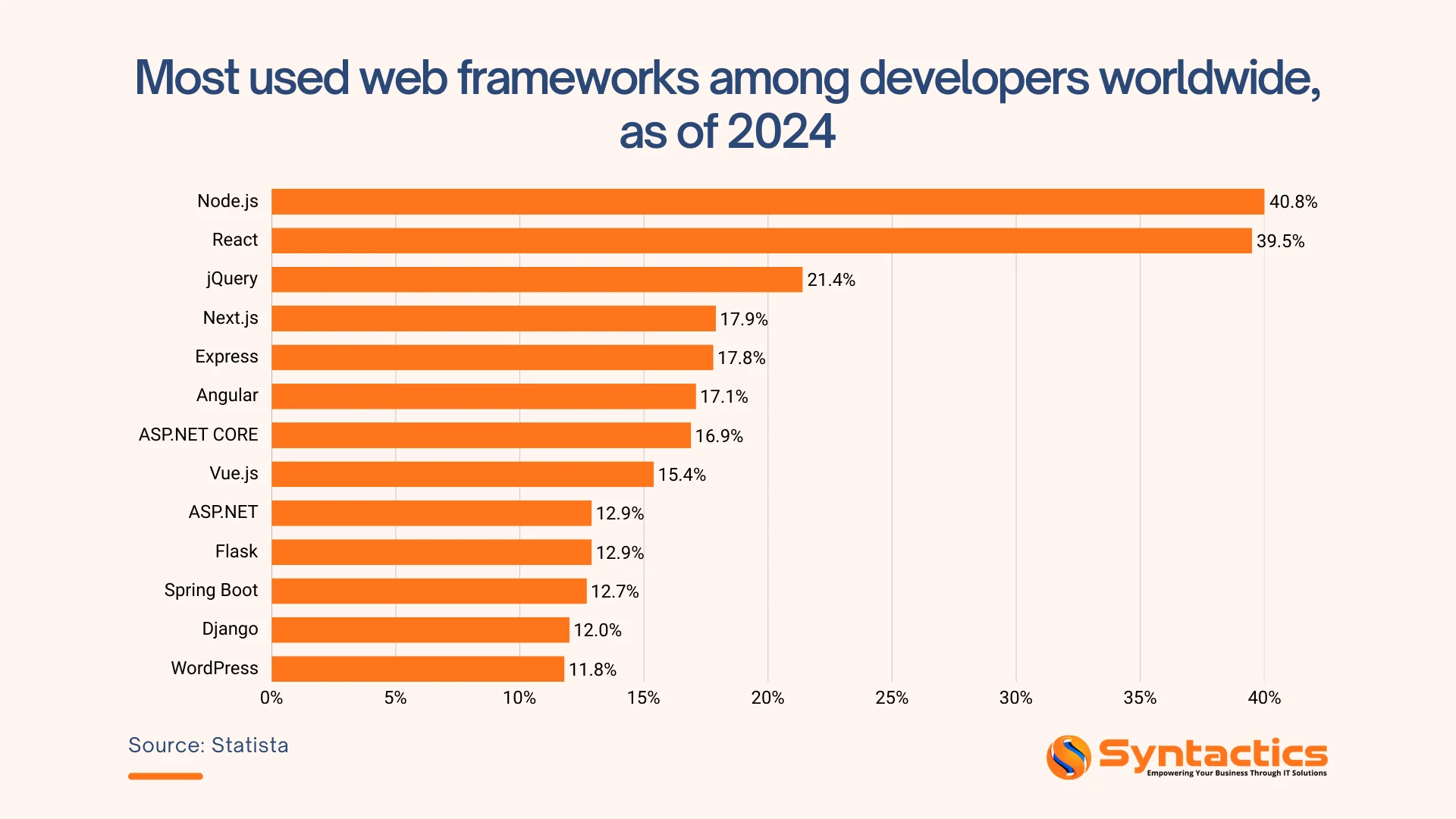
Source: Statista
Developer Ecosystem
React features a vast ecosystem of third-party libraries, plugins, and developer tools. It simplifies your team’s development process by quickly integrating new features without requiring the entire system to be rebuilt from scratch.
Component Reusability
React’s component-based architecture allows developers to build accessible apps using modular, reusable pieces of user interface (UI). This flexibility reduces development time and ensures consistency in design and functionality across projects. For businesses, the advantages are lower maintenance costs, faster feature rollouts, and a cleaner codebase that is easier to manage and scale.
Performance Benefits
React’s Virtual Document Object Model (DOM) helps deliver an efficient interface performance by tracking changes in the application easier. It functions by creating a virtual representation of the UI as a reference, and generating a new DOM with the changes made. React updates the Virtual DOM first by comparing differences and applying necessary updates to the actual DOM. This makes the UI faster and more efficient for apps with dynamic content.
For a comprehensive understanding, here’s a simple visual representation:
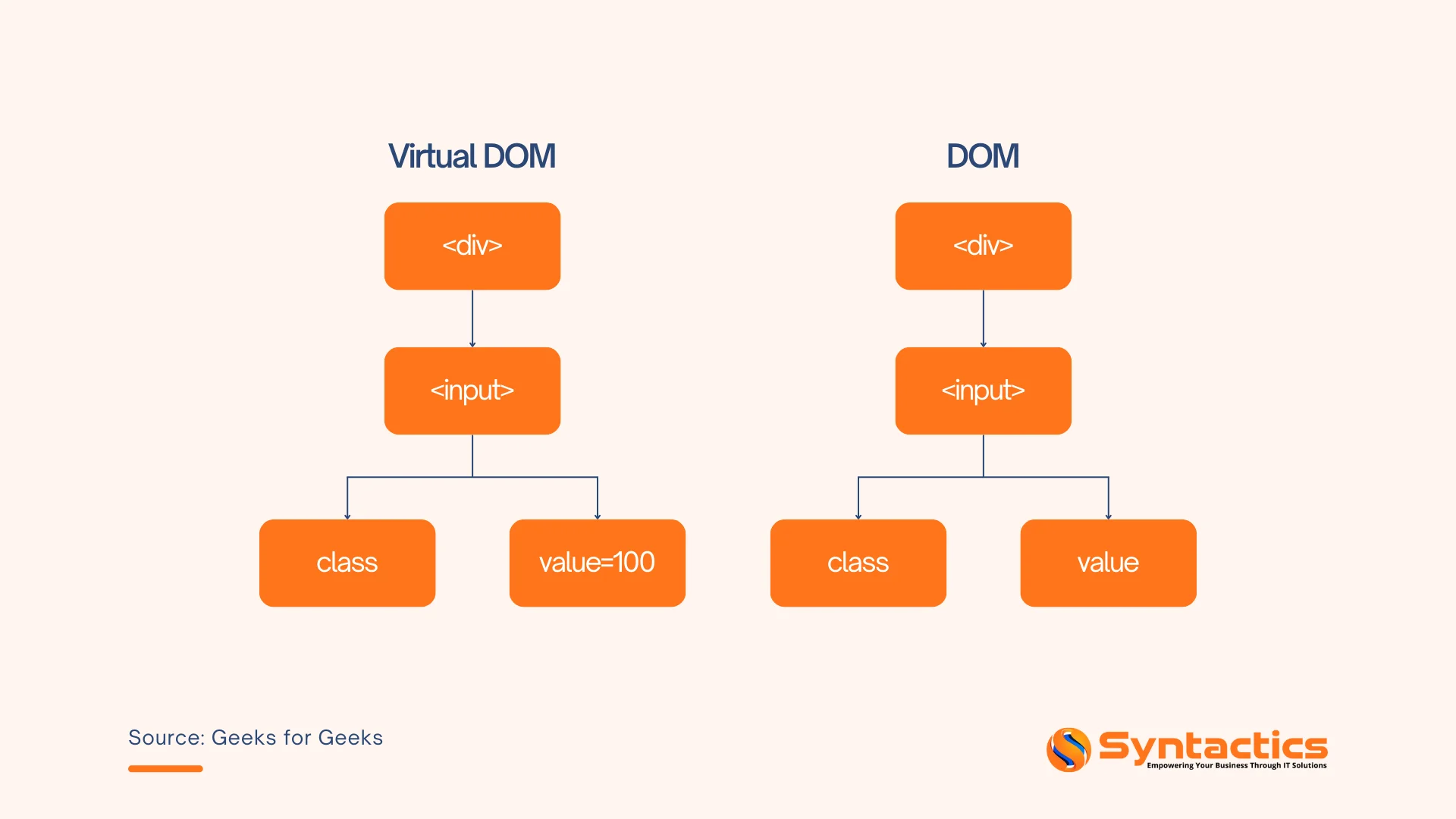
Source: Geeks for Geeks
React 18 and 19: More Efficient & Scalable
React’s updated versions unlocked significant performance and improved developer experience. Here’s a comparison of ReactJS 18 and 19, and how it’s reshaping the future of frontend development:
Server Components and Streaming UI
Front-end developers expect lighter apps and faster user-perceived performance on React. In version 18, rendering typically occurs on the browser, which makes the bundle heavy, resulting in slow page loads and longer waiting times. With React 19, components are rendered entirely on the server, addressing the constraints of the previous version. This means simpler setups for content-heavy sites such as blogs and large web apps.
For more insights, here’s our article on React Native for businesses:
WebAssembly Integration
React 19’s features integrate well with high-performing tools like WebAssembly. Developers are able to compile code written in C++, Rust, or Go into a compact binary format. This is advantageous for intensive features, such as image or video processing, allowing them to run much faster.
Concurrent Rendering Enhancements
Concurrent rendering was first introduced in React 18. It functions by allowing React to simultaneously prepare multiple versions of the interface and switch between them as needed. It is advantageous for front-end development frameworks to avoid UI freezes. React 19 improves this by refining the scheduling algorithm and extending batching. This means fewer manual tweaks and more efficiency in heavy applications.
Modern State Management
Front-end developers no longer need extra libraries to handle asynchronous data, form submissions, and state changes. React 19’s new built-in APIs and hooks have made modern state management much easier. With the right strategies, developers’ workflows are simplified through enhanced server-side rendering (SSR), streaming, and suspense features.
React Native’s Cross-Platform Advantage
React 18’s unified component model, hooks, and efficient rendering made the codebase for both iOS and Android become more consistent. This leverages improvements like concurrent rendering and automatic batching to keep the UI smooth and responsive across platforms. With this foundation, React 19 supports better scheduling, faster rendering, and improved cross-platform performance.
To know more, here’s how you can simplify your build with cross-platform solutions:

AI-Driven Development Acceleration
React’s broad ecosystem allows seamless integration of AI in web development. In React 18, features such as automatic batching and AI assistants analyze component behavior to minimize unnecessary rendering. Meanwhile, React 19 builds on the previous version’s frameworks by stabilizing server components and simplifying async workflows. These advancements make the development’s debugging, testing, and automation much easier.
Conclusion
ReactJS is strengthening the future of frontend development with its continuous improvements. The updates made in versions 18 and 19 support faster performance, smoother workflows, and more scalable application structures. These advantages give you faster load times, efficient rendering, and AI-assisted support.
Future-proof your interface with React frontend development strategies trusted by companies like yours. Syntactics Inc. is an experienced web design company in the Philippines that can transform your innovative ideas with an efficient user interface. We offer dedicated web design, landing page design, e-Commerce web design, and more.
Get Design and Functionality
Specific to your Brand!

Frequently Asked Questions (FAQs)
What is ReactJS?
ReactJS is a JavaScript library allowing developers to build dynamic and interactive user interface. It enables the creation of reusable components that enable efficient updates when data changes.
Is ReactJS better than HTML?
ReactJS works alongside HTML to structure content and add interactivity that instantly responds instantly to user actions.
Is React a UI or UX?
React primarily handles the user interface (UI) that users interact with. It allows faster, smoother, and more responsive interfaces that enhances the overall user experience (UX).

About Xenia Labis
Related News:



Why Businesses Need Influencer Marketing in 2021









Comment 0