

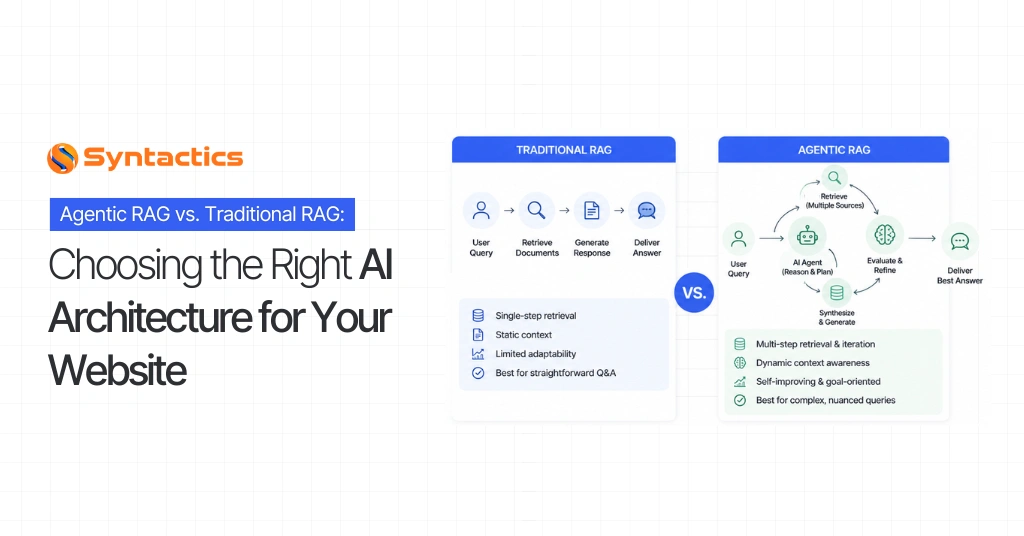
Agentic RAG vs. Traditional RAG: Choosing the Right AI Architecture for Your Website
AI-powered search and chat features can make websites more user-friendly, but not every project needs the same setup. Traditional RAG is great for straightforward content searches, while agentic RAG is better for tasks that need planning, several retrieval steps, tool use, or live business data.
The best option depends on the types of questions your visitors ask, the systems your website connects to, and how much speed, cost, control, and complexity your project can handle.
Key Takeaways
- Traditional RAG is a strong fit for FAQs, help centers, product documentation, and other bounded content-search experiences.
- Agentic RAG includes an extra layer that can plan tasks, pick tools, check results, and gather more information when necessary.
- Agentic RAG is useful for multi-step requests involving product comparisons, inventory, pricing, customer accounts, bookings, or other live systems.
- Agentic workflows usually need more development, monitoring, security measures, processing time, and cost per query.
- Many websites work best with a mix of both: using traditional RAG for simple questions and agentic workflows for more complex requests.
- The easiest way to pick the right setup is to look at the actual questions your visitors ask and figure out which systems are needed to answer them.
Why This Matters for Web Development
For a website visitor, traditional RAG and agentic RAG may look similar. Both can power a chatbot, natural-language search box, product finder, support assistant, or internal web application.
The main difference happens behind the scenes. Usually, the website’s frontend connects to a backend service, which then talks to a search index, CMS, database, language model, or external business API. For example, a React app can send a visitor’s question to the backend, which handles finding information, checking permissions, getting data, and creating a response.
This setup impacts more than just the AI feature. It also affects the user experience, content structure, API design, security, performance, analytics, and how much maintenance the site needs.
What Is Traditional RAG?
RAG means retrieval-augmented generation. Simply put, a RAG system finds relevant information from outside sources, then asks a language model to use that information to create an answer.
Imagine a visitor asking a support chatbot:
What is your return policy for sale items?
A traditional RAG system might search the company’s help center or CMS, find the right policy, and use it to create a helpful reply.
In its simplest form, traditional RAG uses a set retrieve-then-generate process. It can use methods like keyword search, vector search, hybrid search, query rewriting, or reranking results. But the process is usually fixed and does not change its approach on its own after checking results.
Traditional RAG is a good fit for questions with a bounded scope and a predictable answer source, such as:
- FAQs and help-center content.
- Product documentation.
- Return, shipping, and warranty policies.
- Blog and knowledge-base search.
- Internal document lookup.
- Basic product specifications.
The main benefits are that it’s predictable, fast, simpler to set up, and costs are more stable. It’s also easier to test because the process follows a clear, known path.
Traditional RAG isn’t limited to just one document or a single database search. A website can look through several indexes or use different search methods within a set process. The key point is that the system doesn’t plan its next steps on its own based on what it finds.
What Is Agentic RAG?
Agentic RAG adds an agent that manages the retrieval process. Instead of sticking to one set path, the system can look at the user’s request, figure out what information it needs, pick the right tools or sources, and keep gathering information as needed.
For example, a visitor to a travel website might ask:
What is the best option for a weekend trip in December if I want the lowest price and a hotel near the venue?
Answering that question may require the system to:
- Identify the destination and dates.
- Search available travel options.
- Compare prices and restrictions.
- Check hotel availability and location.
- Apply promotions or user preferences.
- Summarize the results in a useful format.
An agentic system can handle all these steps in a single user interaction. Microsoft says agentic RAG supports dynamic planning, multi-step reasoning, and gathering data on its own, instead of just following a fixed process.
Depending on how it’s set up, an agentic workflow might use one agent with several tools, a planner and a retrieval service, or several specialized agents. It doesn’t need multiple agents to count as agentic RAG. What matters is that the system can manage the retrieval and reasoning process in a flexible way.
Agentic RAG can be useful for:
- Product comparisons across multiple categories.
- Live inventory, pricing, or promotion lookups.
- Personalized customer-support conversations.
- Order, account, or subscription assistance.
- Booking and quoting workflows.
- Research across multiple business systems.
- Internal tools that combine information from several departments.
Agentic RAG can also be configured with conversation state or long-term memory. Memory is optional, however, and should be treated as a separate design decision involving privacy, consent, retention, and security requirements.
Agentic RAG vs. Traditional RAG at a Glance
The table below compares both architectures, showing differences in retrieval, speed, cost, and best use cases. You can use it as a quick reference before reading more details.
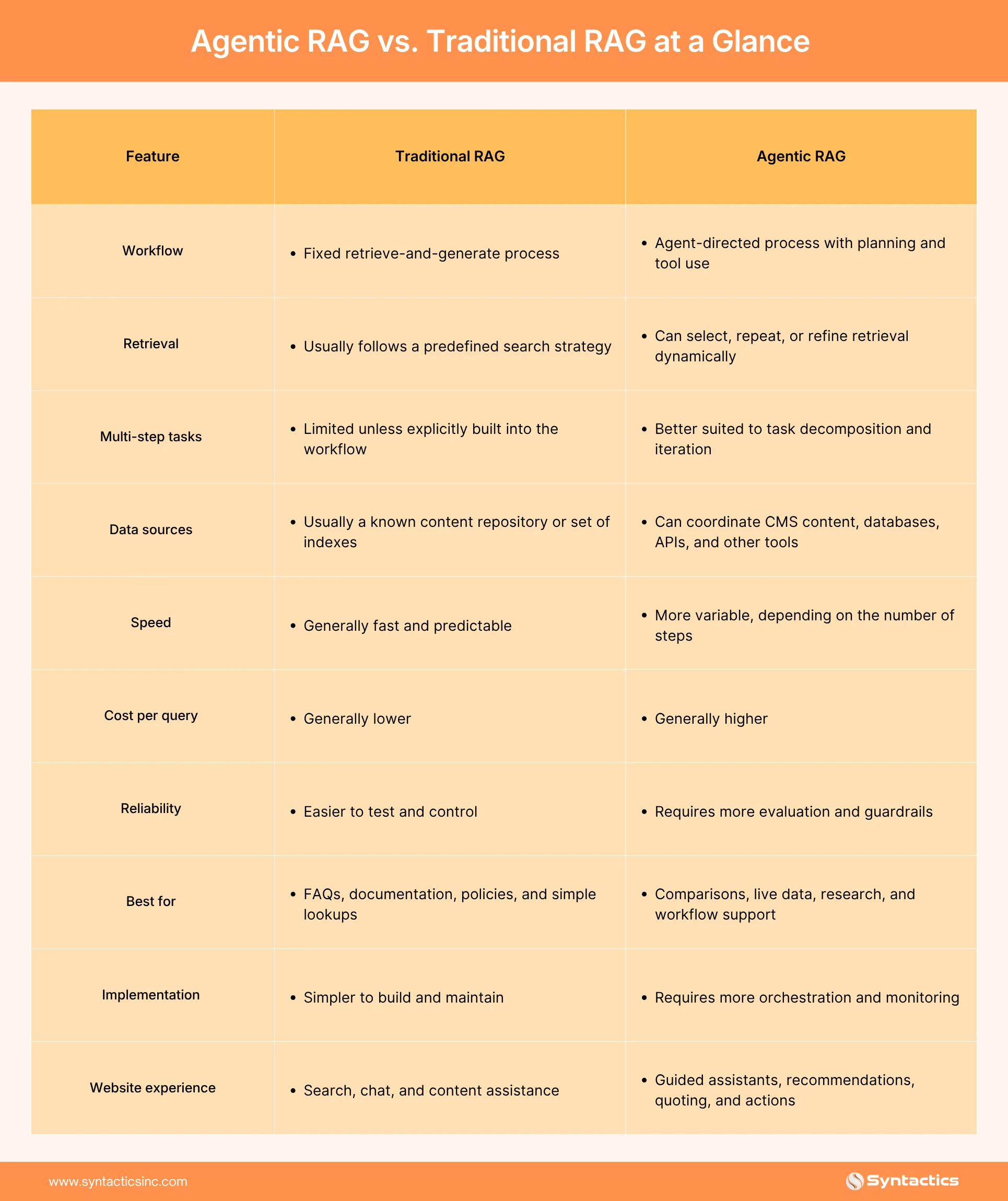
In summary, traditional RAG is usually best when your website needs quick, reliable answers from known content. Agentic RAG is better when you need to pull information from several sources, decide what to look for, or handle tasks with multiple steps.
How RAG Fits Into a Website
RAG isn’t just a frontend feature. The chat widget or search box you see is only one part of the whole system.
A typical website architecture looks like this:
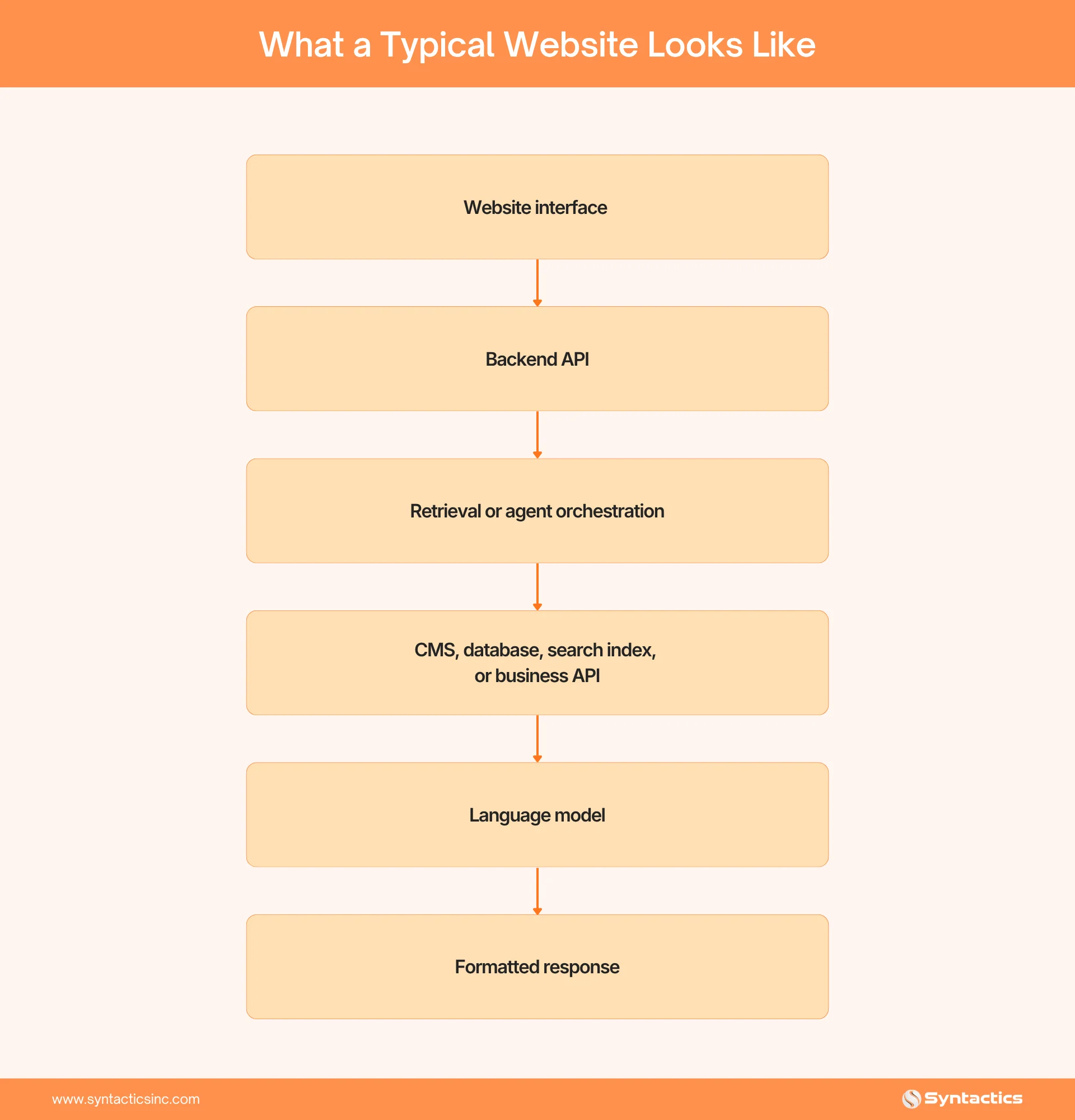
The frontend collects user input and shows the results. The backend takes care of sensitive tasks like handling model credentials, accessing databases, authentication, tool permissions, logging, and checking responses.
For a traditional RAG implementation, the backend might:
- Receive the visitor’s question.
- Apply authentication or rate limits.
- Search the relevant content index.
- Add retrieved content to the model prompt.
- Generate a grounded response.
- Return the answer and, where appropriate, source links to the frontend.
For an agentic implementation, the backend may also:
- Classify the request.
- Create a task plan.
- Select one or more tools.
- Query different systems.
- Evaluate the returned information.
- Refine the search or continue to another step.
- Format the result for the website interface.
- Stop when it has enough information or reaches a defined limit.
This means the web development team needs to plan both the user experience and how the application works behind the scenes.
Where Each Architecture Performs Best
Traditional RAG
Traditional RAG works best when answers are found in a stable, searchable set of content. Support pages, policy documents, or product specs are good examples.
It is especially useful for websites with:
- Well-structured CMS content.
- Stable documentation.
- A limited number of trusted data sources.
- High traffic and strict response-time requirements.
- A need for predictable operating costs.
- Questions that rarely require actions or live system access.
Agentic RAG
Agentic RAG works best when the answer requires connecting information from different sources or deciding what to do next.
It may be appropriate for:
- E-commerce sites comparing products, availability, and promotions.
- Service businesses creating quotes from several variables.
- Travel and booking platforms checking live options.
- Customer portals retrieving authenticated account information.
- Enterprise websites searching across multiple departments.
- Web applications that combine retrieval with approved actions.
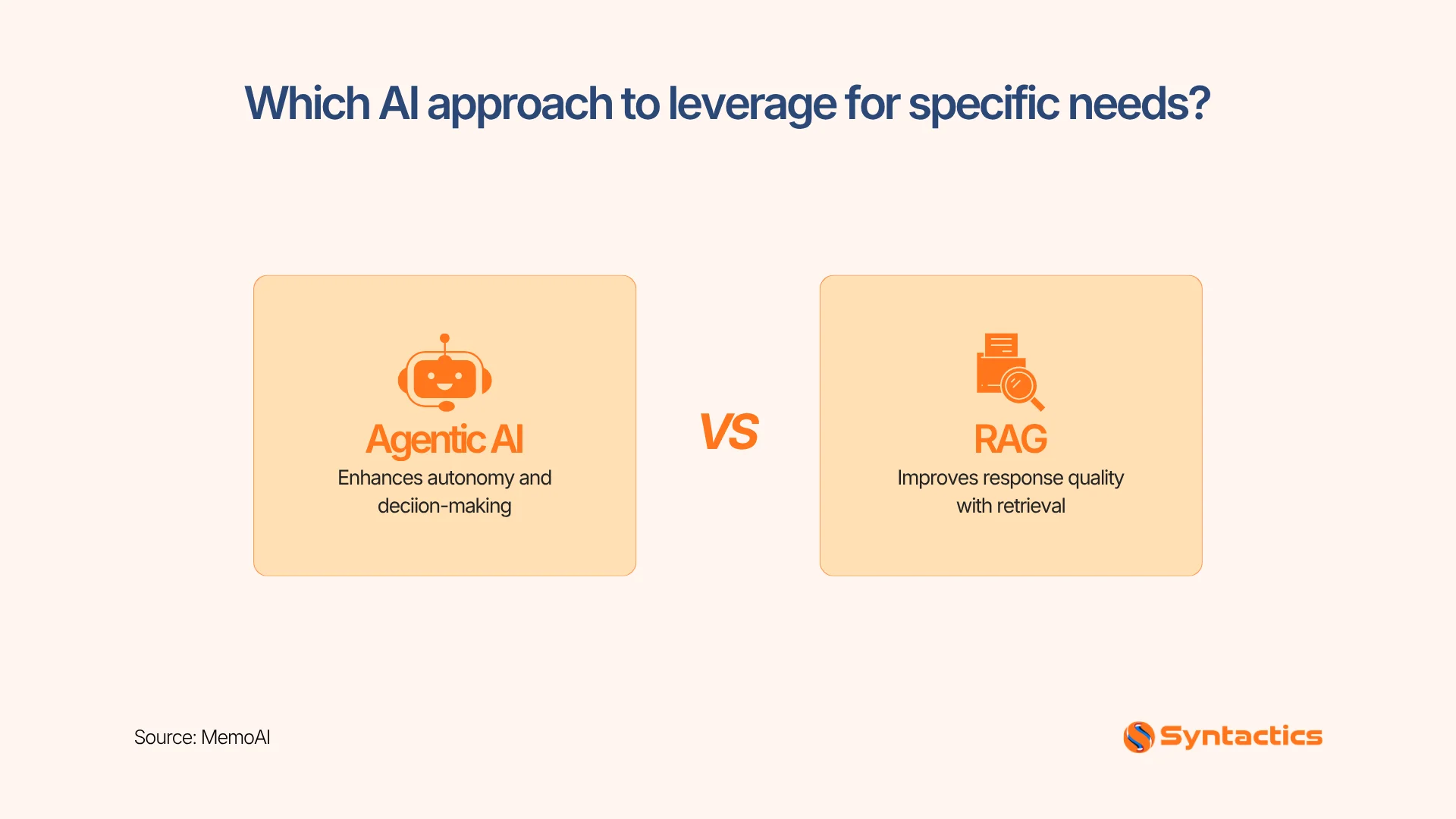
Agentic RAG does not automatically make every answer better. Poorly designed tools, outdated data, weak permissions, or uncontrolled iteration can create additional errors and costs. The value comes from matching the agent’s capabilities to a task that genuinely requires them.
Source: MemoAI.
The CMS and Content Strategy Connection
The quality of either architecture depends heavily on the website’s content and data structure.
Before implementing RAG, a development team should determine:
- Which CMS pages, documents, product records, and databases should be indexed.
- How often content changes and how quickly those changes must reach the search index.
- Which metadata should be attached to each record, such as language, category, region, date, or audience.
- Which content is public, restricted, unpublished, or intended only for internal users.
- Whether important information is better represented as structured data rather than page text.
For example, a product page may contain descriptive text that is appropriate for RAG, while current price and stock information should come directly from a live commerce or inventory API. Similarly, a customer’s order status should come from an authenticated account system rather than a general-purpose document index.
A modern CMS and clean data model can make the implementation easier. A legacy website with duplicated content, inconsistent fields, and disconnected systems may require content cleanup and integration work before an AI assistant can be reliable.
What a Well-Planned Build Requires
Adding RAG to a website involves more than just linking a language model to a chat widget. You should also think about the following points.
Frontend experience
The interface should account for loading states, delays, partial results, errors, retries, and questions the system cannot answer. If responses include products, pricing, citations, or booking options, the frontend should present that information in structured components rather than one long block of text.
Backend and API design
The backend should keep model credentials and privileged system access away from the browser. It should also manage rate limiting, request validation, authentication, response formatting, and connections to external tools.
Security and permissions
An agent should have access only to the tools and data required for its task. Customer accounts, orders, internal documents, pricing rules, and administrative systems require permission checks before retrieval or action.
Cost and performance controls
Teams should define limits for model calls, tool calls, retrieved content, processing time, and concurrent requests. Agentic systems should also have stop conditions and maximum iteration limits to prevent unnecessary work. Practical agentic RAG guidance commonly emphasizes tool constraints, iteration caps, and tracing for this reason.
Content synchronization
CMS updates, product changes, and policy revisions must reach the retrieval system reliably. A process for indexing, refreshing, deleting, and validating content is essential.
Monitoring and evaluation
Teams should monitor response quality, retrieval accuracy, latency, tool failures, fallback rates, user feedback, and cost per interaction. Testing should use real or representative visitor questions rather than relying only on sample prompts.
Human fallback
The system should know when to direct a visitor to a human, a contact form, a phone number, or a standard search experience. A useful fallback is better than an overconfident answer.
A Practical Decision Framework
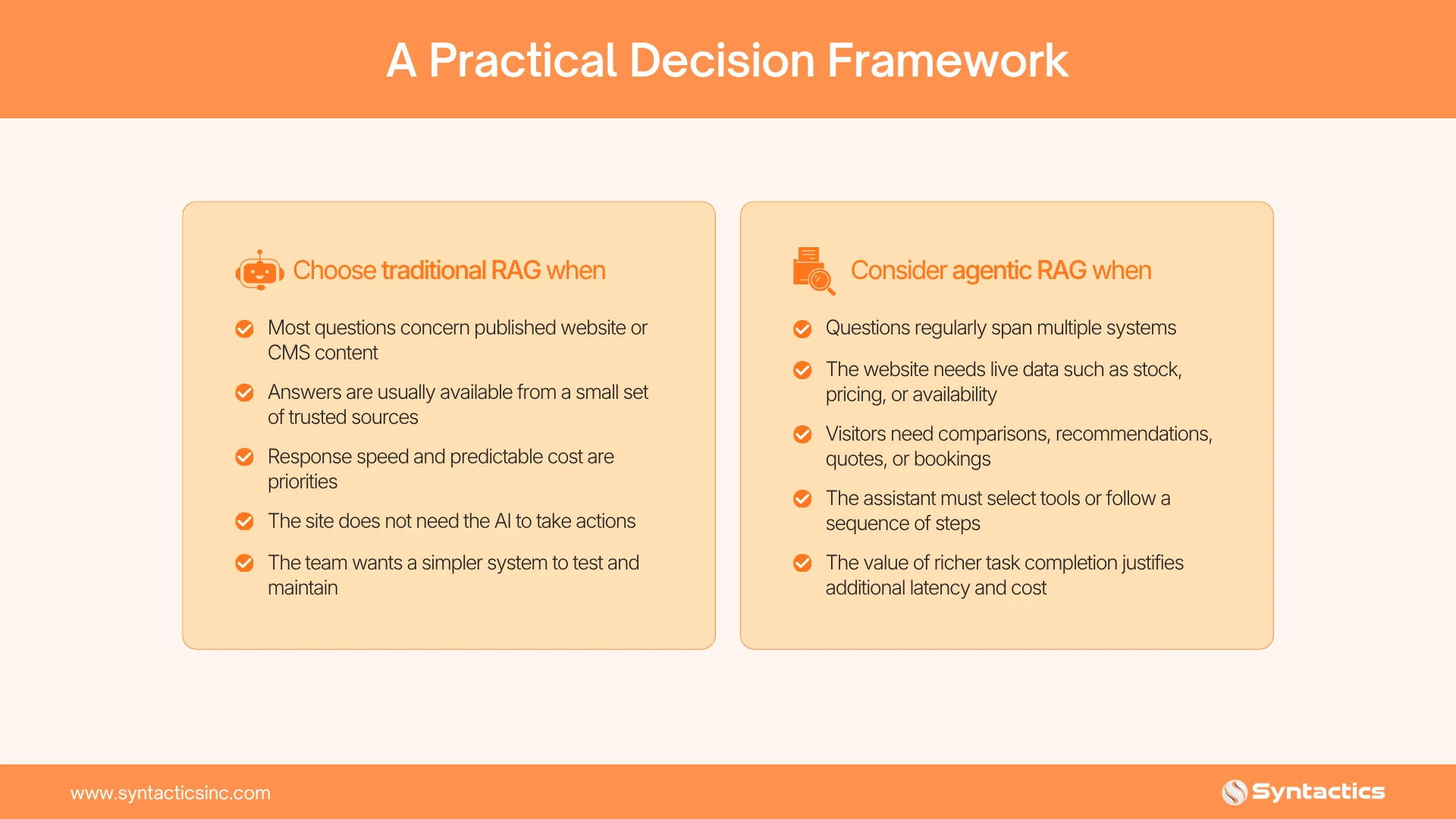
A hybrid architecture is often the most practical option. Routine questions can use a fast traditional RAG pipeline, while more complex requests are routed to an agentic workflow. This approach limits the use of expensive, less predictable processing to situations where it provides clear value.
Choosing the Right Website Architecture
Choosing between traditional RAG and agentic RAG isn’t about picking the best technology for everyone. It’s about finding the right fit for your website’s content, integrations, user experience, security needs, and business goals.
Use traditional RAG when your visitors need quick and dependable answers from known content. Consider agentic RAG when your website plans, compares, retrieves from multiple systems, or coordinates a more involved task.
For many web projects, the best solution is to use both: a fixed RAG process for common questions and an agentic workflow for requests that really need extra reasoning or tool use.
A skilled web design and development team from Syntactics, Inc. can evaluate your CMS, frontend experience, and backend integrations. Our web experts also weigh permissions, performance goals, and maintenance needs to recommend the right approach for your website.
Get Design and Functionality
Specific to your Brand!
- Build a website that's mobile-friendly and responsive.
- Custom designs aligned with your brand.
- Optimized for SEO and user experience.
- Scalable and feature-rich solutions.

Frequently Asked Questions
What is the difference between RAG and agentic RAG?
Traditional RAG generally follows a predefined process for retrieving relevant information and generating an answer. Agentic RAG adds an orchestration layer that can plan tasks, choose tools or sources, evaluate results, and retrieve additional information when needed.
Does my website need agentic RAG?
Not necessarily. Traditional RAG is usually sufficient for FAQs, documentation, policies, and other questions answered from known website content. Agentic RAG is more useful when requests require live data, multiple systems, comparisons, or multi-step workflows.
Can RAG work with an existing website or CMS?
Often, yes. The implementation may connect to the CMS through an API, export content into a search index, or synchronize content through a custom integration. The amount of work depends on the CMS, content quality, authentication model, data structure, and external systems involved.
How do we know which architecture fits our project?
Start by reviewing real visitor questions and grouping them by complexity. Identify which questions can be answered from CMS content, which require live APIs or authenticated data, and which require multiple steps. That analysis will usually show whether traditional RAG, agentic RAG, or a hybrid approach is the best fit.

About Ladymieh Naallatan
Related News:








Comment 0