

Claude’s Invisible Watermark Explained: What It Is, How It Works, and What It Means for Your Content
Anthropic now adds an invisible, machine-readable watermark to text created by new Claude models. This mark stays with the text when you copy and paste it. Readers won’t notice it, and it doesn’t affect how the text looks or reads. The watermark helps with compliance, but it can’t show if a human wrote, edited, or reviewed the content.
Key Takeaways
- All Claude models released on or after August 2, 2026 automatically add an invisible watermark to every response.
- The watermark complies with Article 50 of the EU AI Act, but Anthropic applies it to all users worldwide, not just those in the EU.
- If a watermark is found, it shows that Claude interacted with the text. It doesn’t mean Claude wrote the entire piece.
- Heavy editing, paraphrasing, or translation can weaken or remove the signal entirely.
- Generated files carry separate, C2PA-based provenance metadata rather than a text watermark.
- A public detection API is coming, though pricing and access details remain unpublished.
Source: Claude.
What Exactly Is Claude’s Invisible Watermark?
The watermark is a statistical pattern built into the word choices as Claude creates a response. It’s not a hidden tag added later. Anthropic says the mark is part of the text itself, invisible to readers, and doesn’t change the meaning, quality, or readability.
How the Mark Gets Applied
- The model adjusts its word choices slightly during generation, creating a pattern that specialized software can detect later.
- The watermark is built into the model itself, so it stays with Claude’s output wherever it goes.
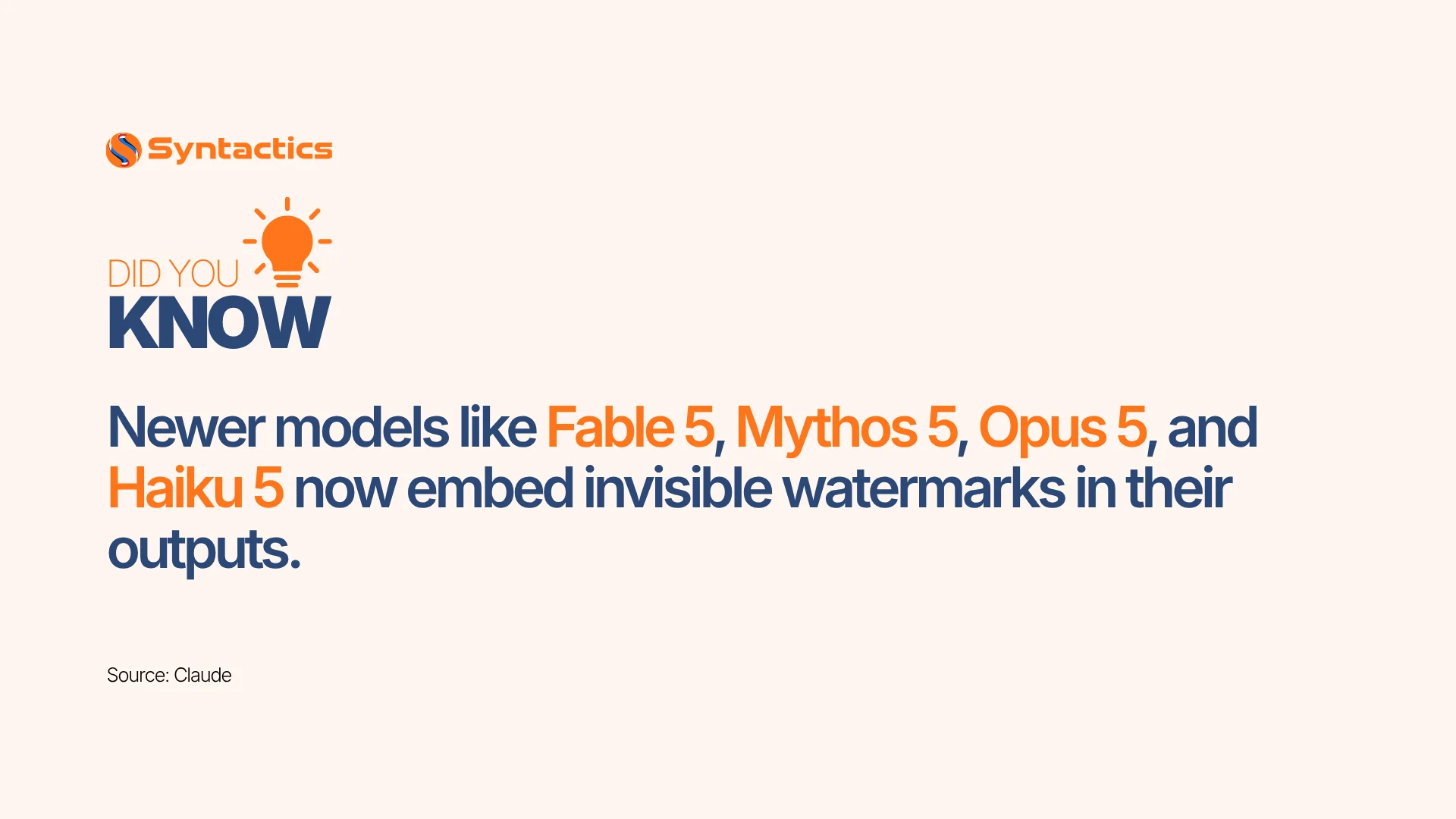
- Coverage spans Claude Platform, Claude.ai, Claude Code, Claude Cowork, and Claude Tag. Specifically, newer models with invisible watermarks are Fable 5, Mythos 5, Opus 5, and Haiku 5.
What Survives, and What Doesn’t
- The watermark stays with the text even if you copy and paste, reformat, or convert it to plain text.
- Small edits usually leave enough of the watermark for detection.
- A heavy rewrite, a full paraphrase, or translation into another language can knock the mark out, according to Fortune’s reporting.
The Second Layer: Signed Provenance for Files
Text and files are handled differently. Images and other supported files get digitally signed metadata using the C2PA open standard, which is widely used in the imaging industry.
Metadata can be removed more easily than an embedded watermark. Taking a screenshot, re-encoding, or changing the file format can erase it, so file-level tracking is less reliable than the text watermark.
Why Anthropic Is Doing This
This effort started in Europe. Anthropic signed the EU’s Code of Practice under Article 50(2), which sets rules for transparency in AI-generated content. Regulators want a layered approach, using signed metadata, invisible watermarking, and fingerprinting or logging as a backup, since no single method is sufficient on its own.
Anthropic was not the only company involved. By July 2026, almost 200 companies, including Meta, Microsoft, and OpenAI, had signed the Code of Practice. Not following the rules can be costly, with fines up to €15 million or 3% of global annual turnover, whichever is higher.
Why This Applies Outside Europe Too
Anthropic decided to use the same watermarking system everywhere, instead of creating separate systems for EU and non-EU users. Right now, Claude does not produce unmarked text in any region.
What a Detected Mark Actually Proves
This is where content teams often get confused. If a watermark is detected, it only means a Claude model worked on the text at some point. It does not prove who wrote it.
A watermark hit can appear when Claude:
- Drafted the content from scratch.
- Proofread or lightly edited human-written copy.
- Translated an existing document.
- Summarized or reformatted a source that a person wrote.
Axios pointed out that content can show a watermark even if Claude was only used to proofread, format, or translate text written by a person. The opposite is also true: the absence of a watermark does not prove a human wrote it. The text could be from an older Claude model, another AI, or edited so much that the watermark was lost.
Technical and Practical Limitations
Agencies and businesses should keep three main limitations in mind when using this signal:
- Fragility under editing. Major rewrites, paraphrasing, or translating the text can remove the pattern before anyone has a chance to check for it.
- No universal reader. Common AI detection tools used by schools and platforms cannot find Claude’s watermark. You need Anthropic’s own system to verify it.
- False confidence risk. Detection tools are getting better, but they will never be perfect at telling AI writing from human writing. Relying on them too much can lead to mistakes.
Implications for Marketing, Agencies, and Content Teams
Compliance and Disclosure
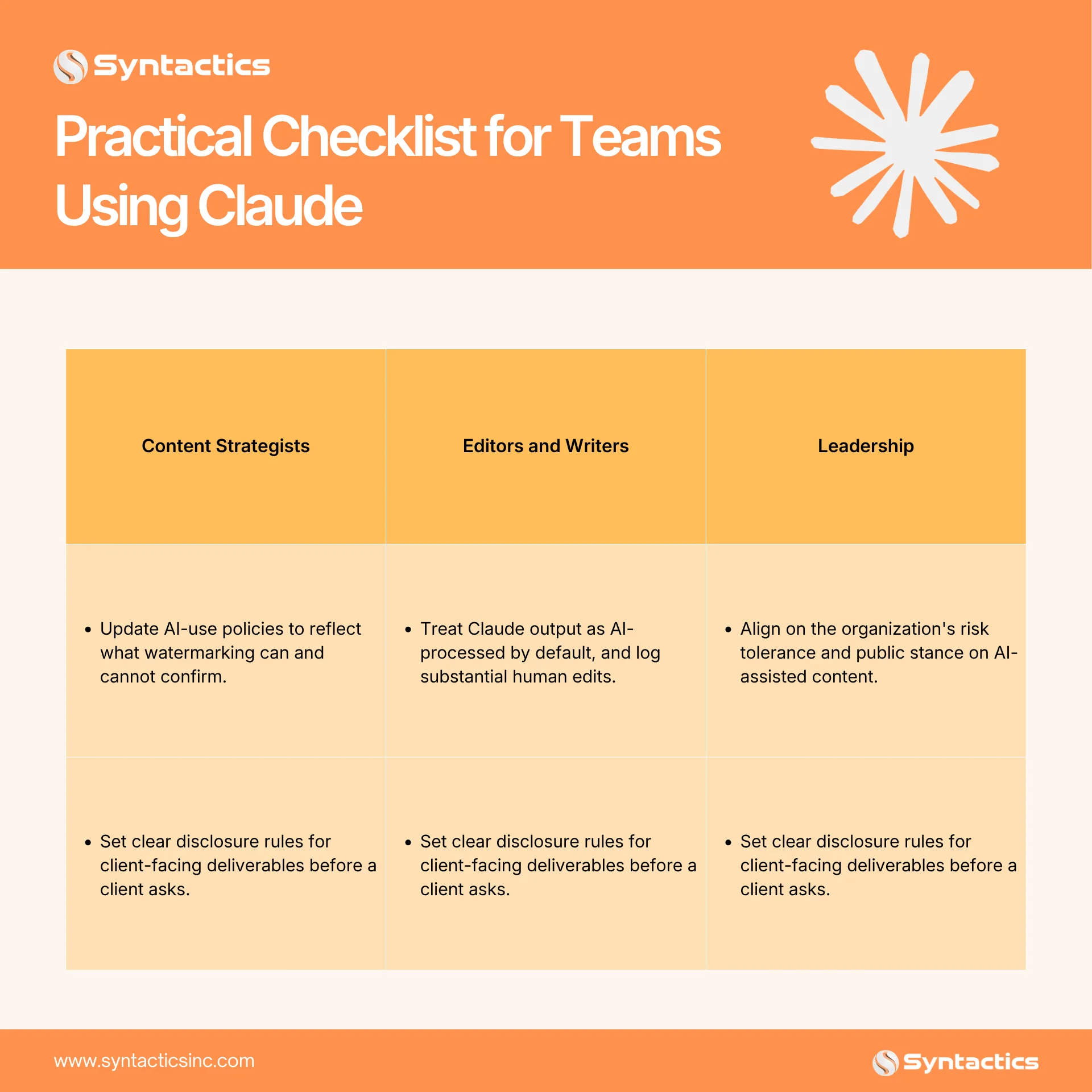
Client contracts, platform rules, and internal AI guidelines should treat watermarking as a standard part of using Claude, not as a rare exception.
Workflow Adjustments
- Decide early on whether a piece should be written only by a human or if AI will help create it.
- Keep a record of how much AI was involved, especially for regulated or sensitive projects.
- Set up a clear process for content that combines human writing with AI editing or research.
Brand and Trust
Not disclosing AI use is riskier. If a client discovers it later through a watermark check, they will trust the agency less than if they were told from the start.
What to Expect Next
Anthropic has said a public detection API is on the way. This will let customers and third parties check for Claude’s marks directly, instead of using general AI detection tools.
As of now, pricing, rate limits, and full technical details have not been released. Over time, expect this to be built into content management systems, moderation tools, and enterprise platforms as the technology develops.
Here’s a checklist to consider when using Claude:
Final Thoughts
Most professional content is already a mix of drafting, editing, and review, with both human and AI input. The question of whether something is AI is too simplistic. The watermark gives teams a clue about the process, not a final answer about who deserves credit.
Watermarking changes how we detect AI use, but it doesn’t affect what makes content successful with readers or search engines. Strategy, original research, and editorial judgment still determine if a piece ranks, gets cited by AI, or turns a reader into a client.
For over 26 years, Syntactics has helped brands in Australia, the US, the UK, and Asia-Pacific create content that meets both human and AI standards, from AEO-optimized blogs to technical audits and schema markup. If your business needs a team skilled in both areas, consider our content marketing services in the Philippines.

Frequently Asked Questions
Does a Claude watermark mean the content was entirely AI-written?
No. A detected watermark only confirms a Claude model processed the text at some point. It cannot tell you whether Claude wrote the whole piece or simply proofread a human draft.
Can the watermark be removed?
Heavy rewriting, paraphrasing, or translation can weaken or remove the signal. Anthropic has not published a method for intentional removal, and circumventing it can conflict with client contracts or platform disclosure rules.
Does the watermark apply outside the EU?
Yes. Anthropic applies the same marking system worldwide, even though the requirement originates from the EU AI Act.
Do generated images carry the same watermark as text?
No. Files use separate C2PA-based provenance metadata instead of the text watermarking technique, and that metadata is easier to strip through screenshots or re-encoding.
How should agencies handle disclosure if Claude was used?
Log the actual level of AI involvement for each piece, from light proofreading to a full first draft, rather than treating every Claude-touched file the same way.

About Jalou Batilong
Related News:

Top Trends in Software Development This 2022

Designing Social Media Post Images Using Adobe

Learn the Five SEO Basics for Bloggers

Choosing a Custom Software Development Company







Comment 0