

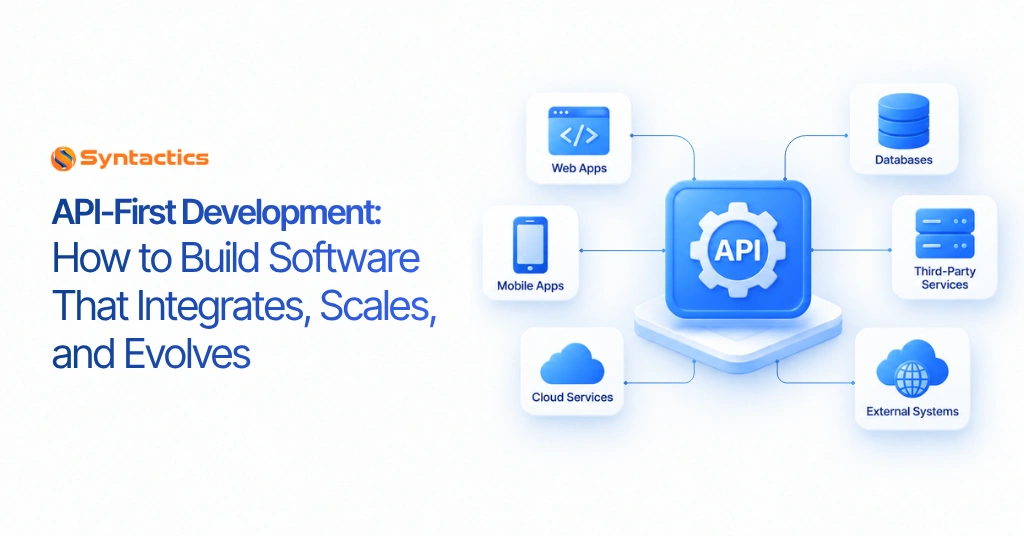
API-First Development: How to Build Software That Integrates, Scales, and Evolves
Software rarely operates alone. For instance, your website may need to communicate with a CRM, payment processor, inventory system, mobile app, or AI tool, and poor integration decisions can make those connections difficult to maintain.
As businesses adopt new technologies, they need software that can connect to new tools without requiring major changes to existing systems. The U.S. Census Bureau found that 18% of U.S. firms used AI in at least one business function during the November 2025 to January 2026 reference period, with adoption expected to reach 22% within six months.
API-first development addresses this need by defining how systems communicate before implementation begins, making it easier to build software that can support new integrations over time.
Key Takeaways
- 94% of IT leaders believe AI adoption will need IT architecture to be more API-driven, while 96% say AI agent success depends on cross-system integration (Salesforce).
- Design API contracts before implementation so teams agree on how systems will communicate.
- Treat APIs as reusable interfaces that support multiple applications, channels, and integrations.
- Use contract design, security reviews, testing, and documentation throughout development.
- Build governance around authentication, versioning, monitoring, ownership, and data protection.
What API-First Development Means
API-first development is a software development approach where you design and agree on how applications will communicate before completing the underlying implementation. An API acts as an interface that allows applications to exchange data or access specific functionality without exposing the entire system behind it.
The API contract defines what consumers can request, what information they can send, and what the system will return. It can also document authentication requirements, error responses, data formats, compatibility expectations, and versioning rules.
This approach gives your development team a shared reference before implementation begins. This way, developers can build against agreed specifications instead of creating separate assumptions about how different systems will interact.

API-First, Contract-First, API-Led, and Code-First Compared
These terms often appear together, but they describe different concepts:
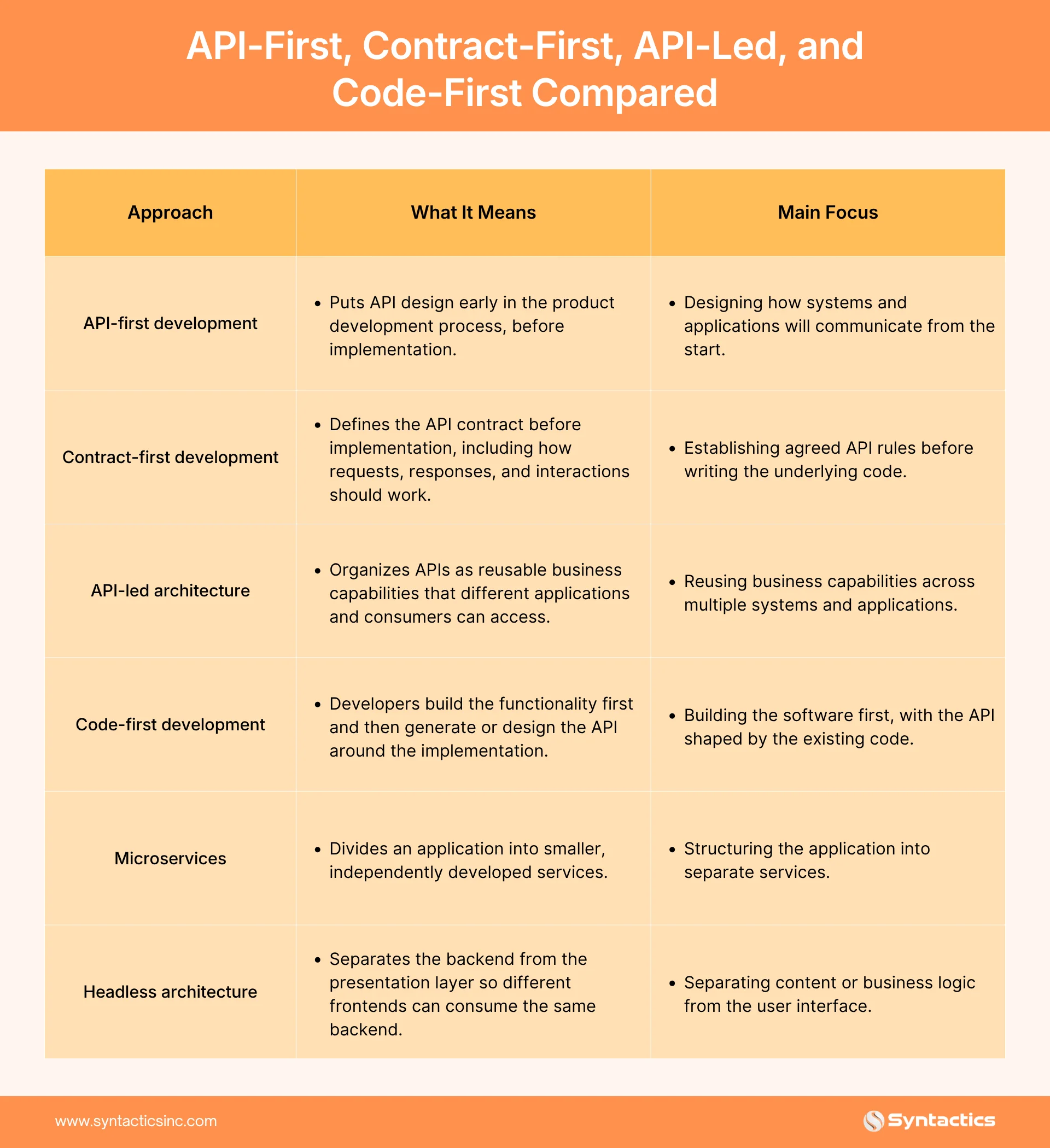
In a nutshell, API-first development, contract-first development, API-led architecture, and code-first development describe development or API design approaches. Microservices and headless architecture describe architectural patterns. You can use API-first development with either microservices or headless architecture, but neither architecture requires an API-first approach.
The Business Benefits That Matter
Once you define your interfaces early, you can coordinate development more effectively and reduce integration surprises. The benefits extend beyond engineering because reusable APIs can support new products, channels, and partnerships.
Teams can work in parallel when they have an agreed contract to build against. You can also identify incompatible data structures, missing requirements, and error-handling issues before they become expensive implementation changes.
Reusable APIs can also make it easier to introduce new applications or connect third-party services without rebuilding existing functionality. A mobile app, customer portal, internal tool, or partner platform can access the same business capabilities through defined interfaces, reducing the need for separate integrations.
Integration can also affect how effectively employees use new technology. According to Gallup’s 2026 U.S. Workforce Survey, 86% of employees who strongly agreed that their organization’s AI technology integrates well with their existing systems were frequent AI users.
That said, an experienced custom software application company in the Philippines can help you assess which capabilities deserve reusable APIs and which functions can remain internal to a specific application.
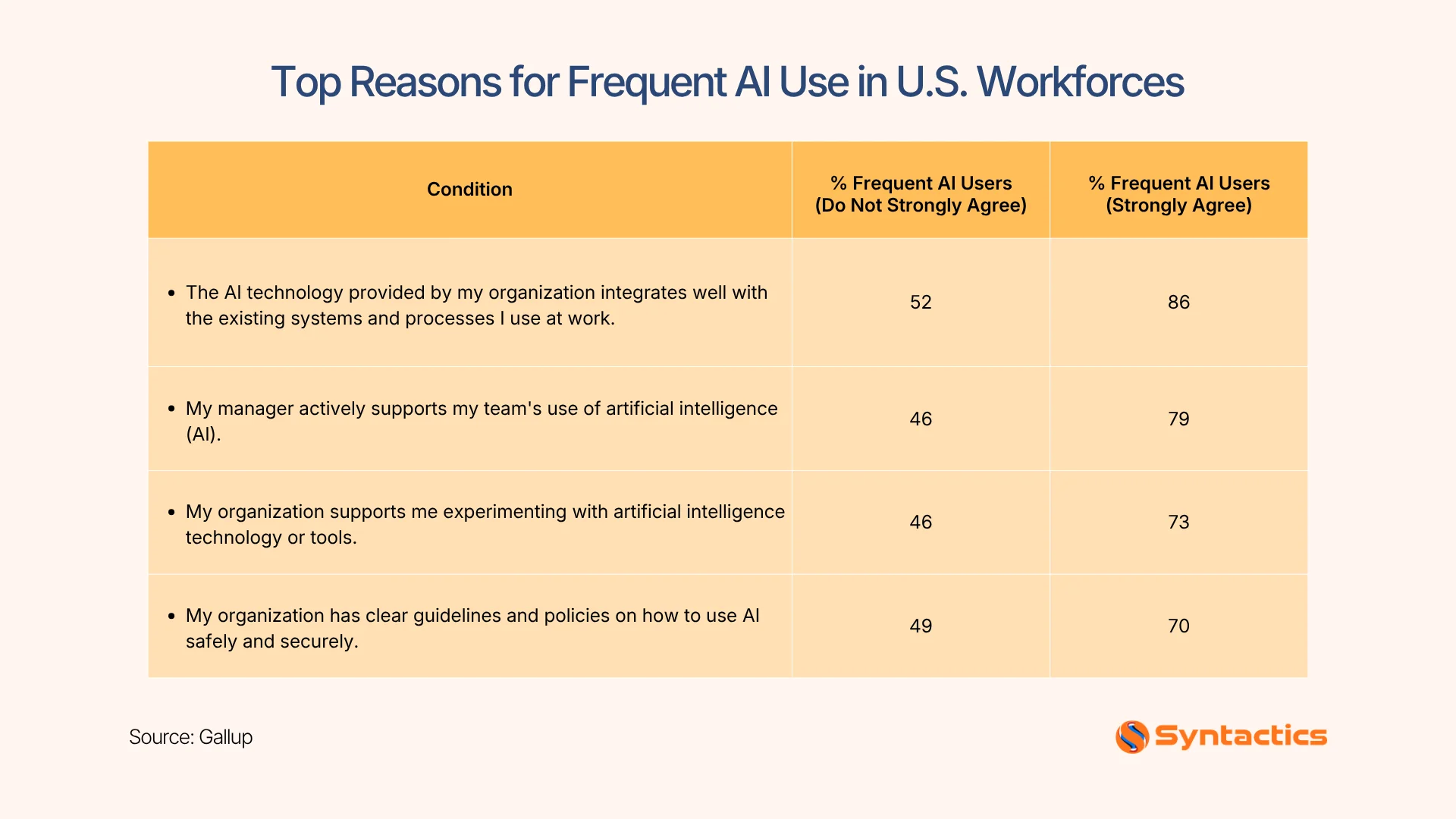
Source: Gallup
What API-First Looks Like in a Real Business Stack
Consider a business that operates a website, CRM, payment platform, inventory system, warehouse, and customer application. Instead of creating separate custom connections for every interaction, you can expose defined capabilities through APIs.
For example, your customer application requests product information from the inventory API. The website can send an order to the order API, which can then communicate with payment and fulfillment services. The CRM can then receive customer and order information without requiring direct access to the underlying database.
This structure gives each system a defined way to exchange information. It also reduces the need to duplicate business logic across individual connections. A reputable custom software application development team in the Philippines can help you design these integrations around your specific business requirements.
The value of connected architecture becomes more apparent as businesses add more applications and digital tools. Salesforce reports that 94% of IT leaders believe AI adoption will require IT architecture to become more API-driven, while 96% say AI agent success depends on cross-system integration.
For businesses managing multiple applications, APIs can provide a consistent way to connect systems, share data, and control how different services access existing capabilities.
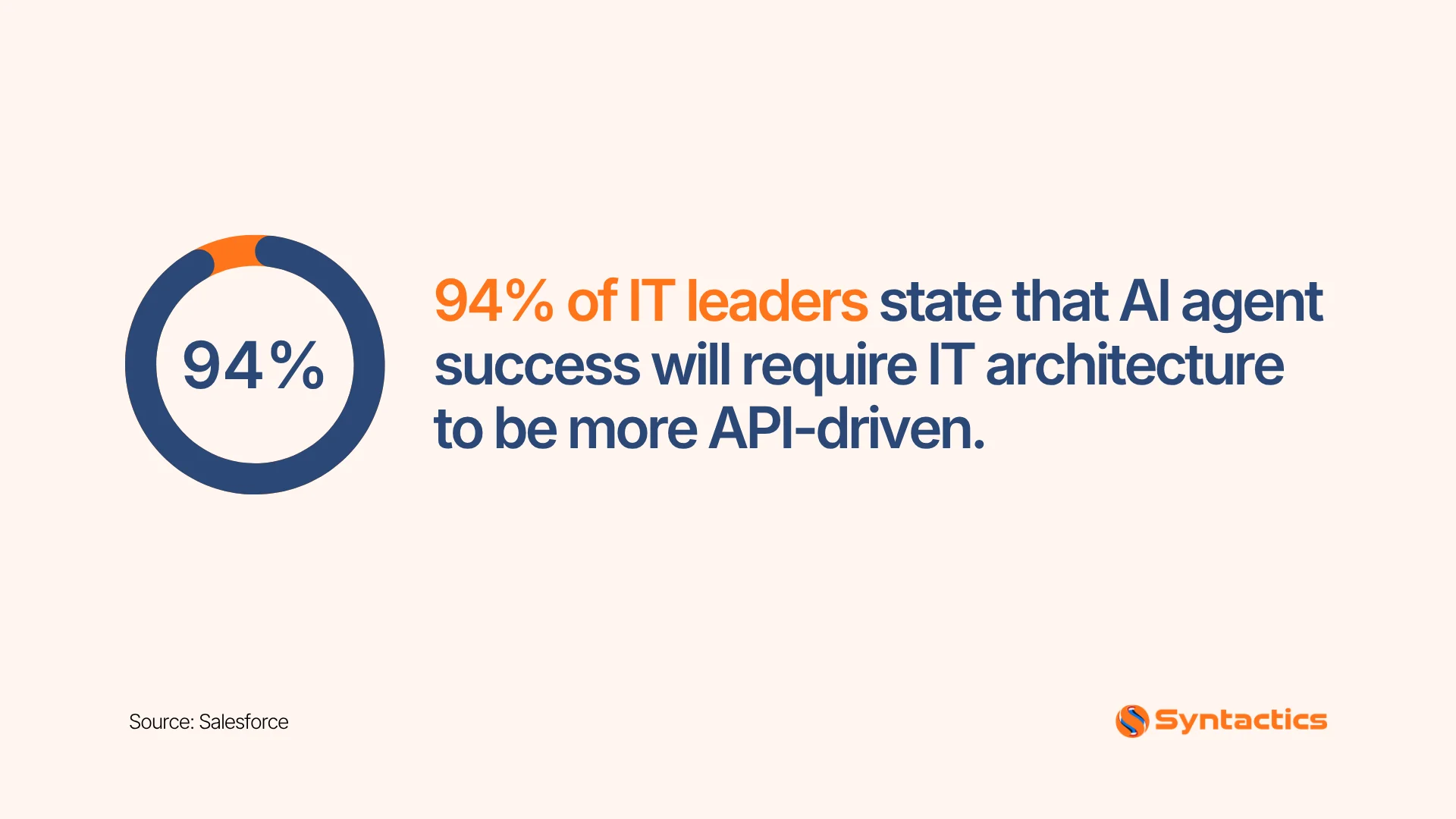
Source: Salesforce
The API-First Development Workflow
A structured workflow helps you move from business requirements to dependable APIs without treating integration as an afterthought.
- Identify API consumers: Determine which applications, teams, partners, or services will use each API.
- Define business capabilities: Identify the functions and data that need to be exposed.
- Model the domain: Establish consistent resources, relationships, data types, and business rules.
- Design the contract: Define endpoints, requests, responses, authentication, errors, and compatibility requirements.
- Review security: Determine authorization, sensitive-data handling, encryption, and access controls before implementation.
- Create mock responses: Let frontend and consuming teams test the contract while backend development continues.
- Implement the API: Build the underlying functionality according to the approved contract.
- Automate validation: Test requests, responses, error handling, security rules, and contract compliance.
- Test compatibility: Confirm that new versions do not unexpectedly break existing consumers.
- Document and monitor: Maintain usable documentation and monitor performance, errors, traffic, and unusual activity.
This workflow gives your teams opportunities to find integration problems before they spread across the application.

Security and Governance Requirements
A reusable API also needs clear controls. Authentication verifies who is making a request, while authorization determines what that user or application can access.
You also need encryption, input validation, rate limits, audit logs, sensitive-data controls, and monitoring. Versioning and deprecation policies help you introduce changes without unexpectedly breaking applications that depend on an existing interface.
Governance also requires ownership. Someone needs to maintain the API contract, approve changes, review security requirements, monitor usage, and keep documentation current.
These practices become more relevant as organizations manage larger API environments. IBM describes API sprawl as the uncontrolled, fragmented proliferation of APIs, which can lead to security vulnerabilities, redundant functionality, developer confusion, and unexpected costs.
A reputable web design and development team in the Philippines can also help ensure your APIs work securely and consistently across the customer-facing applications that depend on them.
Common API-First Mistakes
Several design decisions can make an API harder to maintain even when you adopt an API-first development process.
- Designing around database tables: APIs should represent business capabilities rather than simply exposing your database structure.
- Treating documentation as the contract: Documentation explains an API, but the contract needs defined behavior that development and testing teams can validate.
- Ignoring errors: Consumers need predictable error responses so they can handle failures appropriately.
- Delaying security decisions: Consider authentication and authorization during design.
- Releasing breaking changes: Existing consumers can fail when you change fields, responses, or behaviors without a compatibility strategy.
- Creating too many services: Splitting every function into a separate service can increase operational complexity.
- Leaving ownership undefined: Every production API needs a team responsible for its lifecycle.
You also do not need to rewrite your entire application to adopt these practices. You can introduce API-first principles around new capabilities or gradually modernize existing integrations.
When API-First Is and Is Not Appropriate
API-first makes sense when several applications, teams, channels, partners, or future integrations will depend on the same business capabilities. It can also fit organizations that expect to expand into mobile applications, partner integrations, AI tools, or new digital channels.
As such, a small internal tool with one user group and a short expected lifespan may not need the same level of API planning. You can still use clean interfaces and documented data structures without creating a large API ecosystem.
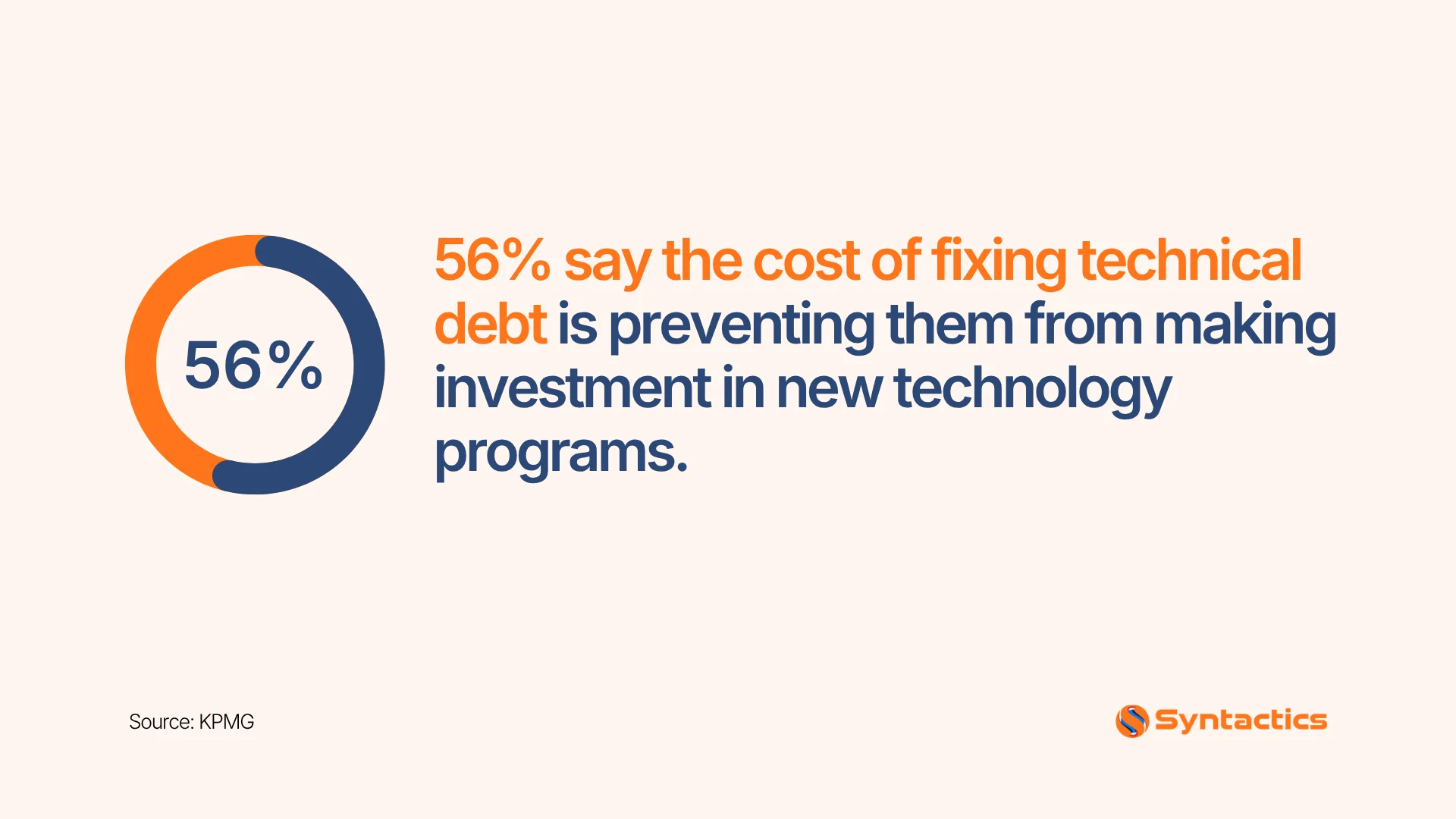
The cost of poorly planned architecture can also affect future technology investments. KPMG’s 2026 Annual U.S. Technology Survey found that 56% of U.S. organizations said the cost of fixing technical debt is preventing them from investing in new technology programs.
When you expect software to grow or connect with additional systems, API-first planning can help you establish reusable interfaces early rather than adding costly integrations after implementation.
Source: KPMG
How Syntactics Builds Integration-Ready Software
Your software architecture can support today’s requirements while giving you practical options for future integrations. You can connect the customer-facing experience with the APIs, services, and systems operating behind it to create a more cohesive software environment.
Syntactics, Inc. brings 26 years of experience and a global client portfolio to software projects involving business discovery, domain modeling, API contract design, integration, security, testing, documentation, modernization, and monitoring.
Through custom software development services in the Philippines, our experienced team can apply API-first development to help you build software that connects with the systems you already use and adapts to future requirements.

FAQs About API-First Development
How to design great APIs using API-first development?
Define API contracts early, focusing on clear endpoints, consistent data structures, security, and predictable error handling. Then, test and refine the API design with developers and stakeholders before implementation to reduce integration issues later.
Can API-first development work with legacy software?
Yes. You can introduce APIs around selected legacy capabilities without replacing the entire system. This can provide a controlled path toward modernization.
How long does an API-first project take?
The timeline depends on the number of systems, consumers, integrations, and security requirements involved. A defined scope and early contract design can help your team estimate the work more accurately.

About Ladymieh Naallatan
Related News:


Elevate Your Brand with Dedicated Web Designers

8 Design Trends That Will Define Your Brand in 2026

Visually Appealing Websites and How They’re Designed







Comment 0