

API Engineering: What It Takes to Build Better Integrations
API engineering is about designing, building, and connecting the interfaces that let different software systems talk to each other. For instance, your website might use an API to get payment data, or your app could sync with a CRM.
Today, APIs handle more than 70% of web traffic in large enterprises. In 2025 alone, 65% of organizations made direct revenue from their API programs. This guide walks through the architecture choices, security basics, and AI-readiness steps that separate a reliable API from a risky one.
Key Takeaways
- APIs now carry over 70% of web traffic inside large enterprises.
- 65% of organizations earned revenue from APIs in 2025, and 74% of those earned at least 10% of total revenue that way.
- REST is the most common way to build APIs, used by roughly 83% of public ones. A newer approach called GraphQL now runs in production at 61%+ of organizations, up from under 10% in 2021. [DigitalApplied]
- A simple API runs $8,000 to $20,000 to build. Enterprise builds run $50,000 to $100,000+.[ZTabs]
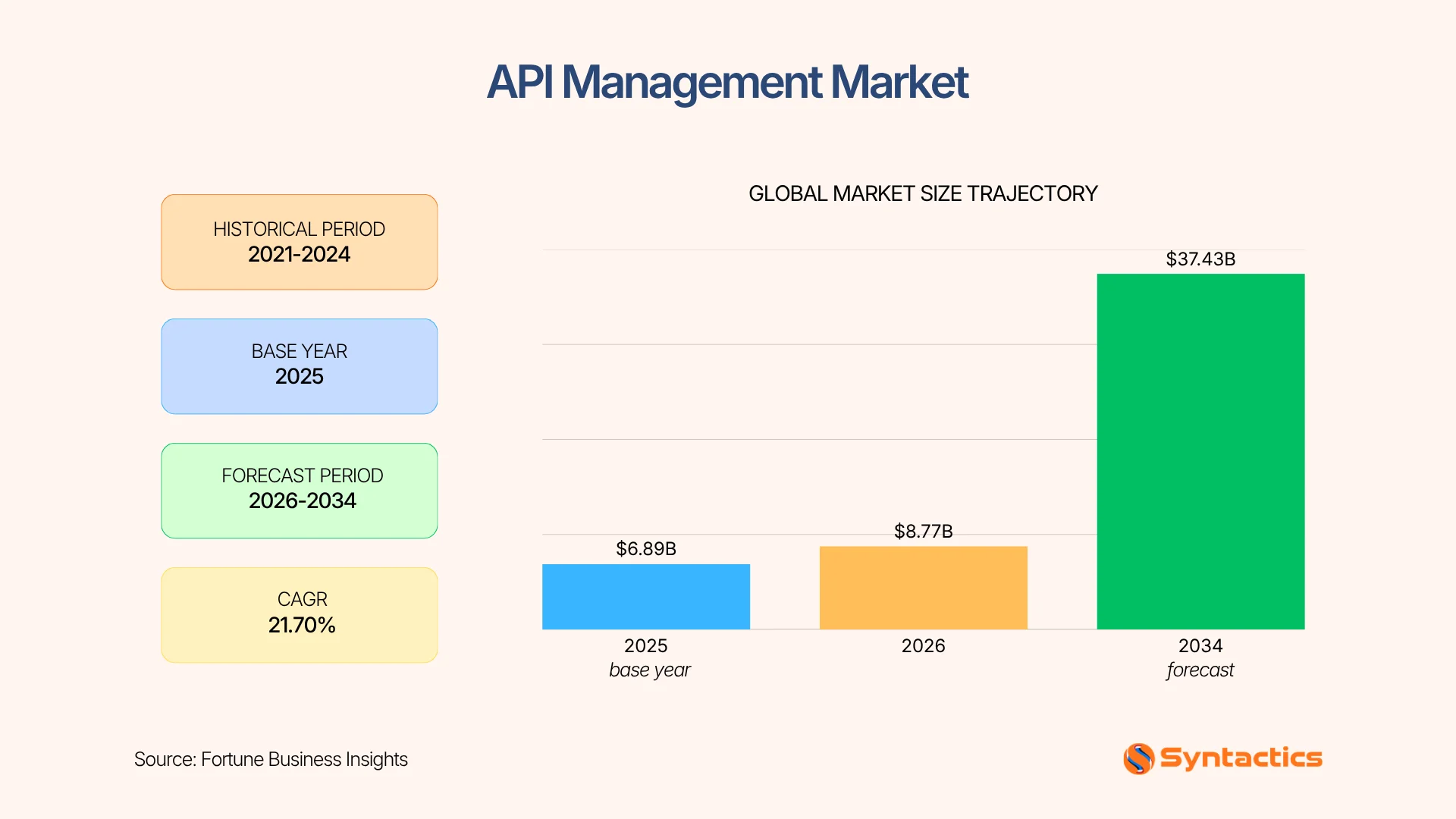
Source: Fortune Business Insights.
What Good API Engineering Does for Your Business
APIs are no longer just a backend detail anymore. They support every checkout, every mobile app update, and every system your business connects with partners. When APIs are poorly built or unmanaged, businesses see security gaps, slower integrations, and rising maintenance bills.
For agencies, this impacts how fast you can launch a client project and how much support you will need later. Companies that manage their APIs as products have fewer outages and can integrate with partners more quickly. This means clear ownership, strong documentation, and early API planning from the start.

How API Engineering Changed in 2026
If you are planning a digital project this year, there are some important changes to know. AI tools now depend on well-built APIs to get data and take action for your business.
Security standards are even higher, too. Every request is checked, instead of being trusted just because it comes from inside the network. Leaders also watch API performance and costs closely, since slow or overloaded connections can increase cloud bills and slow down customers. Because unmanaged APIs can pile up quickly, more companies now keep a clear list of their APIs.
3 Common Ways to Build an API
Many APIs today are built using one of three main methods. Each one works best for a different kind of project.
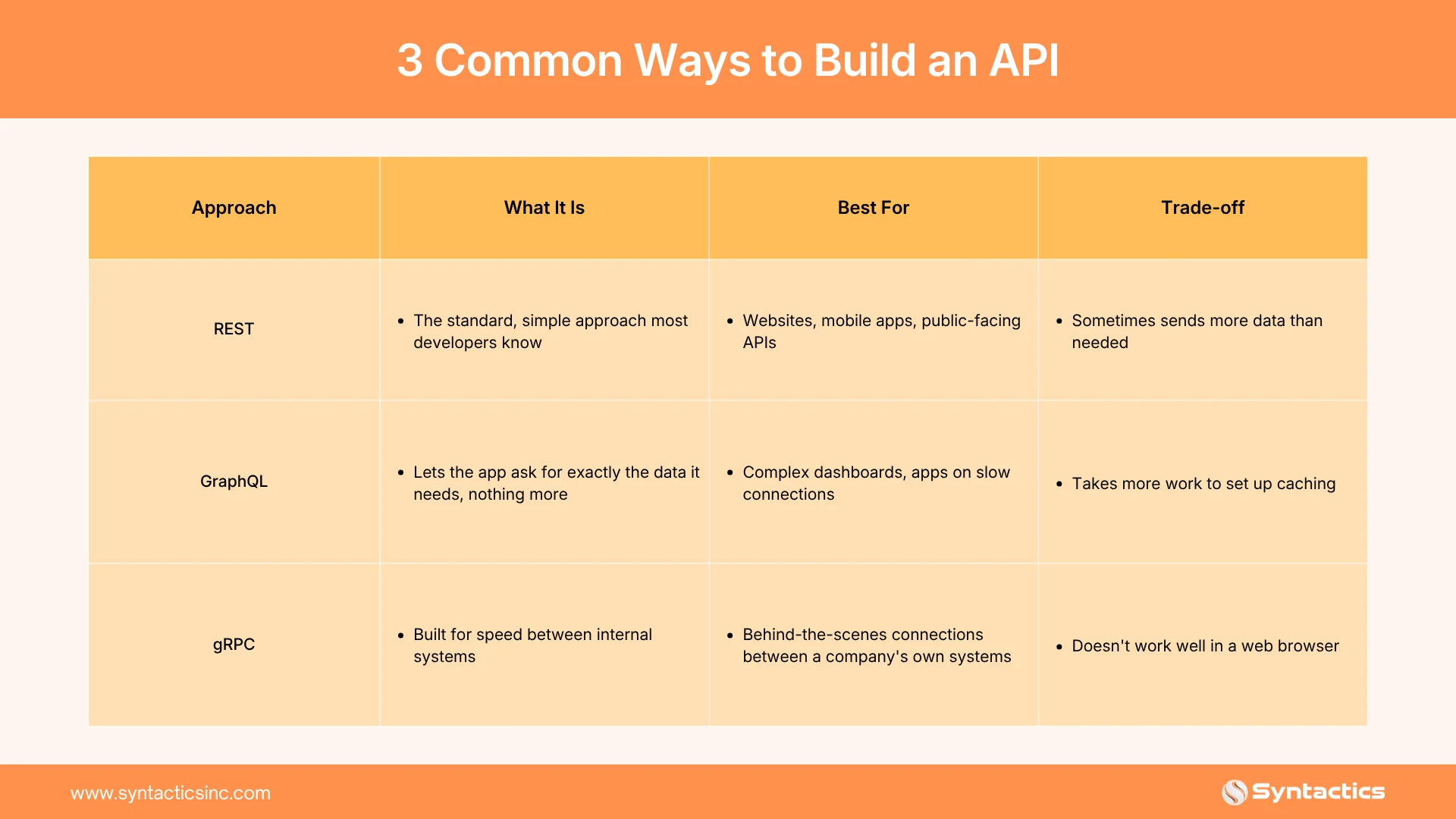
Usually, REST is the safest choice for most business projects. It is simple, well-known, and most developers are comfortable using it.
Meanwhile, GraphQL is a good choice when an app needs to get data from several sources at the same time, like a dashboard. It also helps when you need to save bandwidth on mobile devices.
Also, gRPC works best behind the scenes, connecting a company’s internal systems where speed matters most.
What Makes an API Production-Ready
A working demo is not the same as a reliable, production-ready API. Here are the basics that make the difference:
- Login and access controls. Every request should prove who is asking before it gets any data. Use a standard login system, not a single shared key.
- Traffic limits. Without a cap on how many requests one user can make, a single misbehaving client can slow the system down for everyone else.
- Version control. As your business needs change, your API will need to change too, but it should not break every connected app. Planning for this from the start helps you avoid expensive fixes later.
- Clear error messages. When something goes wrong, the system should say exactly what happened and how to fix it, not just show a blank failure.
- Documentation should always stay current. Instructions made directly from the API’s definition stay accurate, while those written separately and updated by hand often become outdated.
- Speed and load handling. Caching frequently requested data and loading large lists one page at a time keeps things fast as usage grows.
- Monitoring. Once an API is live, someone should watch its speed and failures. Otherwise, customers may be the first to notice problems.
Keeping an API Secure
APIs are now one of the most common ways businesses get breached, so security is highly required. A solid checklist covers:
- Encrypt every connection, with no unencrypted fallback allowed.
- Limit how many requests any one user or app can make per minute.
- Check every piece of incoming data before using it, and don’t trust it blindly.
- Build database queries safely so attackers can’t sneak in extra commands.
- Restrict access to the specific websites and apps that should be allowed to connect.
- Use login sessions that expire quickly and refresh automatically, so a stolen key doesn’t stay valid for long.
- Log who accessed what and when, without storing sensitive data like passwords or full card numbers.
For most customer-facing apps, a standard login system called OAuth, paired with short-lived access tokens, covers these needs well and typically takes one to two weeks to set up properly.

Designing APIs That Work With AI Tools
AI tools like Claude, ChatGPT, and coding assistants can now connect directly to a business’s API, read its structure, and use it on their own. If the structure is incomplete, the AI has to guess, and a wrong guess can lead to real costs, like charging a customer twice. We cover this pattern in more detail in our guide to building AI agents.
A few basics help make an API ready for AI tools:
- Publish a machine-readable description of the API (called an OpenAPI spec) at a stable, public URL that does not require login to fetch.
- Add an llms.txt file, a short plain-language summary of what the API does, so AI tools don’t have to guess or crawl an entire site to understand it.
- Make sure repeat requests don’t cause repeat charges. If an AI tool retries a payment request, the system should recognize the retry and not bill the customer twice.
- Give AI tools only the access they need. A tool that only needs to read invoices should never be able to issue a payment.
What It Costs to Build an API
Cost depends on the project’s complexity, security needs, and where the development team is based.
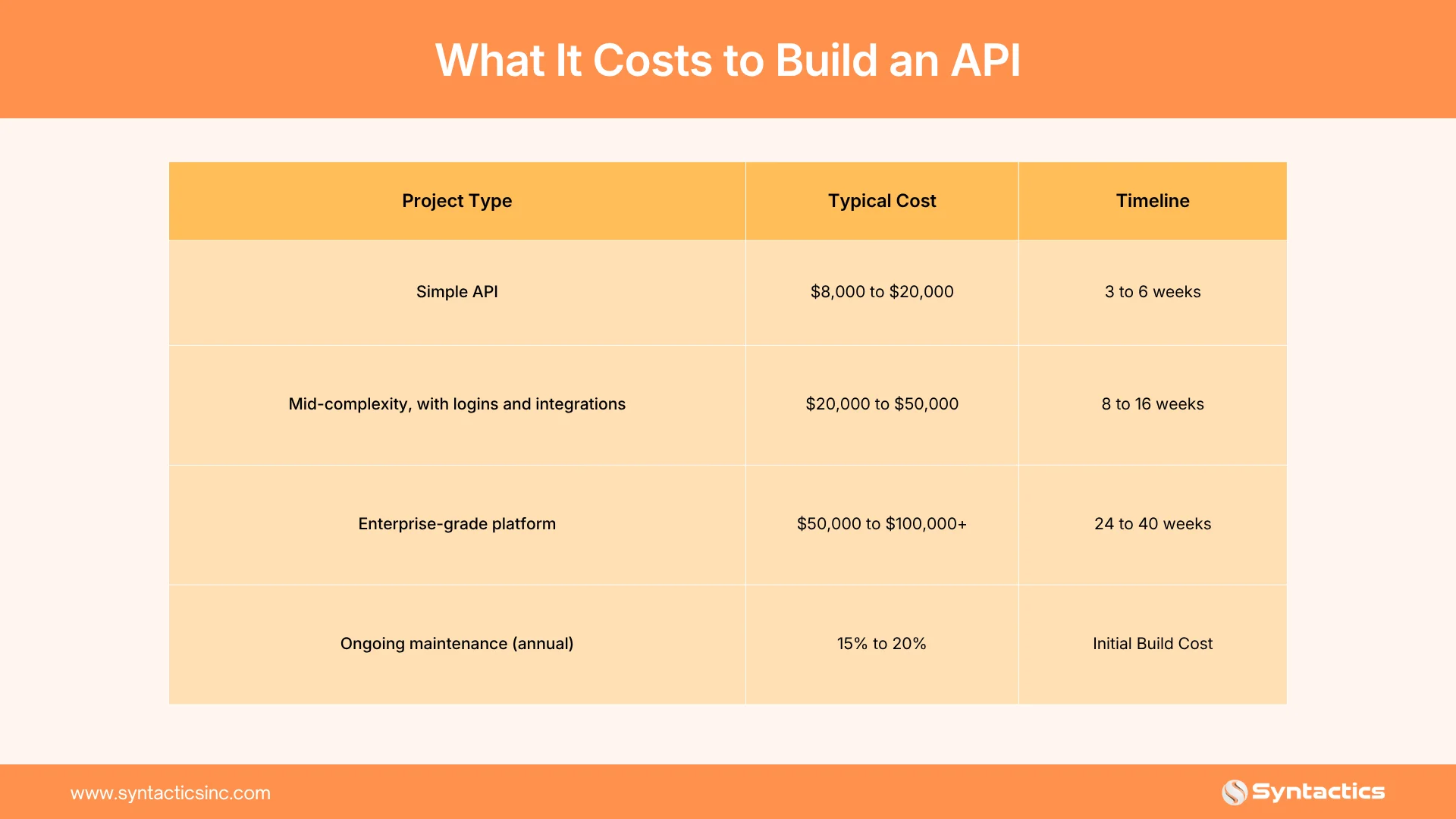
These are US-buyer benchmarks for a mid-complexity project with standard login security, integrations, and monitoring included. Many quotes only cover the basic build. Security, documentation, and ongoing maintenance are often quoted separately, so check what is included before comparing vendor prices.
Common Mistakes to Avoid
- Building the API around the database instead of the business. When an API mirrors internal database tables instead of what customers actually need, it becomes rigid and hard to change later.
- Skipping a plan for future changes. Making changes without a version plan breaks the apps and partners already relying on the API.
- Using different login methods across different systems. Inconsistent security creates gaps that are easy to miss and easy to exploit.
- Removing something without warning. Quietly changing or removing fields other systems depend on breaks trust with every partner using it.
Final Thoughts
An API is basically a product your business depends on, and it deserves the same care as any product your customers use. Plan early, secure it from the start, and keep it well maintained after launch.
Good API engineering takes more than picking REST over GraphQL. It takes a team that understands how the pieces fit together, from login security to AI readiness, and builds with your specific integrations in mind rather than a one-size-fits-all template.
At Syntactics, our custom software development team handles day-to-day work, building and connecting the systems behind a client’s website, app, or internal tools. The best time to get a new integration right is before you write the first line of code. Bring in the right team early, and you get an API that handles real traffic, stays secure, and scales as your business grows. Start the conversation now, while there’s still time to shape it well.

Frequently Asked Questions
How long does it take to build an API?
A simple API takes 3 to 6 weeks. A mid-complexity build with logins and integrations takes 8 to 16 weeks. Enterprise platforms take 6 to 10 months or more.
Is REST or GraphQL better?
REST is the safer default for most public APIs and simple apps. GraphQL is worth the extra setup when an app needs to pull data from multiple sources at once or needs to save bandwidth on mobile.
How much does it cost to build an API?
A simple API runs $8,000 to $20,000. A mid-complexity build with logins and integrations runs $20,000 to $50,000. Enterprise platforms run $50,000 to $100,000 or more.
What does an API need to work well with AI tools?
It needs a clear, machine-readable description of what it does, a short plain-language summary file, protection against duplicate charges, and access limits so an AI tool can only do what it’s meant to do.

About Ladymieh Naallatan
Related News:


Fundamental Content Writing Tips to Spark Action


Outsource Web Developers: Dedicated vs Project-Based









Comment 0