

Google June 2026 Spam Update: What Site Owners Need to Know
Google announced the June 2026 spam update on June 24, 2026. The rollout started around 9:00 a.m. PT, affects all languages worldwide, and is expected to take a few days. This update matters because it signals another round of spam enforcement across Google Search.
This is the second spam update from Google in 2026. The previous one, in March, was the fastest spam rollout Google has ever confirmed, setting up the comparison with this rollout.
Quick Facts
- Name: Google June 2026 Spam Update
- Released: June 24, 2026, around 9:00 a.m. PT
- Scope: Global, all languages
- Rollout time: A few days, per Google’s announcement
- New policies: None announced alongside this update
- Excludes: Link spam and site reputation abuse remain outside this update’s scope
What Google Said
Google kept its Search Status Dashboard announcement brief. The company said the June 2026 spam update applies worldwide and may take a few days to finish. On LinkedIn, Google used the same message, describing it as a routine update rather than a policy change.
There was no blog post with the dashboard note. As usual, Google did not say what percentage of searches the update affects.
How Spam Updates Differ From Core Updates
Core updates change the main systems Google uses to rank and review content. Spam updates, on the other hand, improve the automated tools that catch manipulative tactics, especially SpamBrain, Google’s AI spam detector. Google’s documentation says spam updates are upgrades to these automated systems.
SpamBrain has run continuously since 2022. A spam update signals that Google adjusted the system’s parameters to catch spam tactics it may have missed before, or to catch newer variations of tactics it already knows.
What This Update Targets
Google keeps its wording intentionally vague, saying only that sites breaking spam rules may see ranking changes. Still, early feedback from the SEO community suggests a clearer pattern.
This update appears to target large amounts of templated content, such as mass-produced pages and spun content designed to rank rather than help readers. The early signal is clear: networks using templated location pages saw ranking drops, and some top pages disappeared from results within the first 24 to 48 hours.
What this update does not touch, based on Google’s own framing:
- Link spam
- The site reputation abuse policy
- Several other narrower spam categories Google has excluded from past updates
How This Compares to Recent Spam Updates
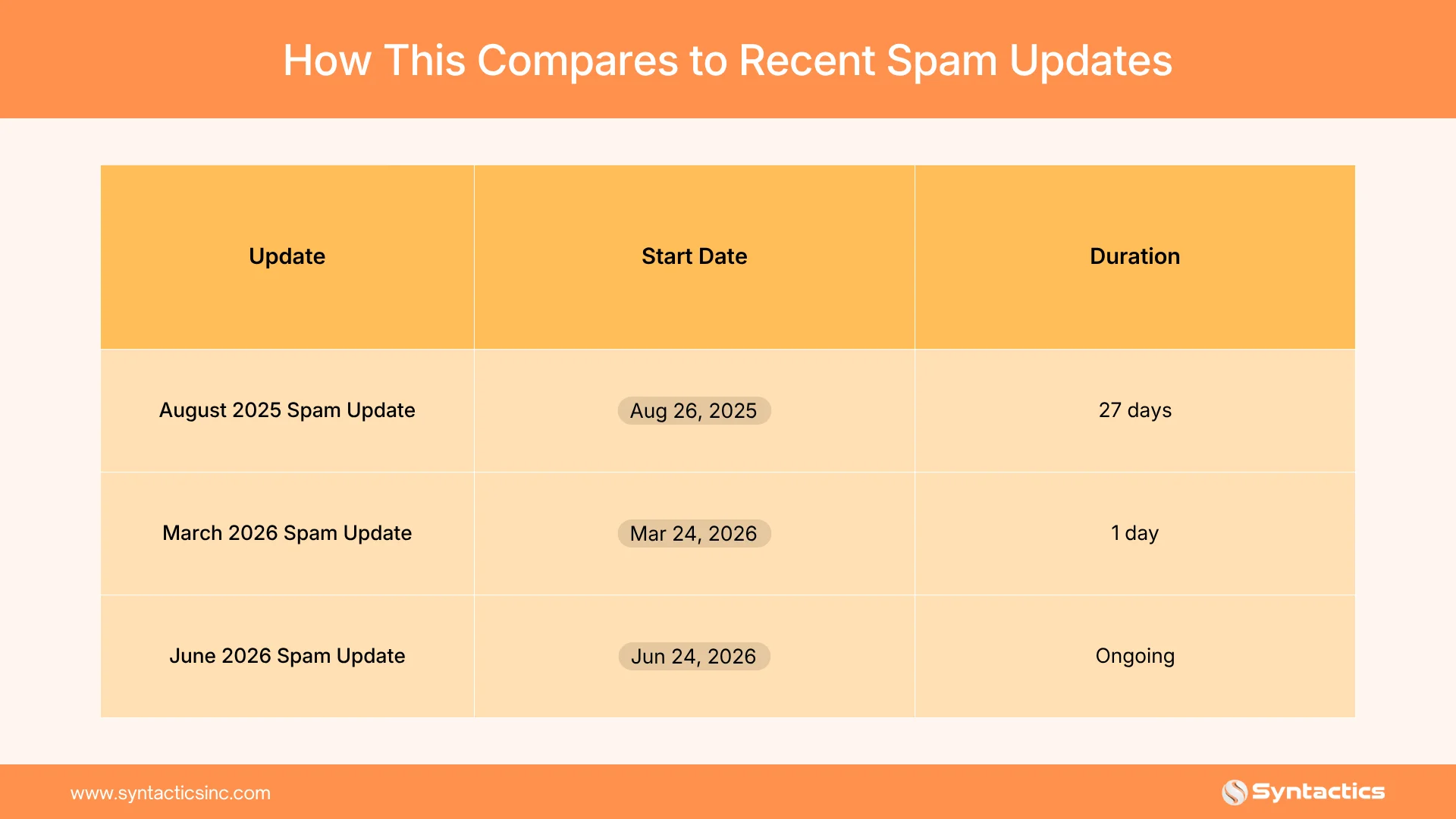
The March 2026 update finished in less than 24 hours, making it the fastest spam rollout on record. By contrast, the August 2025 update lasted almost four weeks. This range shows that when Google says “a few days,” it is not always exact.
Unlike in March, when a spam update and a core update happened at the same time, the June update is rolling out on its own. This separation helps site owners see what changes are caused by this update.
Context: A Busy Year for Search Enforcement
The June update comes during a busy period for Google ranking changes. There was a Discover core update in February, a spam update and a core update in March, and a core update in May that lasted less than 12 days but caused more volatility than March.
Two policy changes led up to the June update:
- May 2026: Google updated its spam policies page to state that attempting to manipulate AI responses in Search counts as spam.
- April 2026: Google published a back-button-hijacking spam policy, with enforcement starting June 15, 2026, nine days before this spam update went live. Google hasn’t confirmed a direct link between the two, but the timing is close.
In late April, Google reversed a previous change to its spam reporting process. Now, spam reports with personal information will not be processed.
What to Do If Your Rankings Shifted
A few practical steps apply here, the same ones that apply to most spam and core updates.
- Wait before reacting. Ranking data during the rollout can be unreliable. Mark June 24 in Google Search Console to isolate the effects of this update once the dust settles.
- Check your site for common spam issues. These include expired domain abuse, PBNs, cloaking, doorway pages, and mass-produced filler content. If your site uses original content and real link building, you likely have nothing to worry about.
- Be realistic about recovery. If your rankings dropped due to spam issues, it can take months for Google to confirm your site now follows its rules. Recovery from link-based spam is different. Once Google removes the value from those links, it does not come back.

Looking Ahead
Google hasn’t announced anything beyond this rollout. The broader pattern across 2026 is worth watching, though. Four major ranking updates rolled out over roughly 13 weeks between February and June, a faster cadence than in prior years.
The main trend is that content made solely to rank, rather than to help readers, is getting more attention from Google. This now covers content meant to influence AI-generated answers, not just regular search results. The June 2026 spam update is part of this shift.
For most site owners, the main job is not to react to every update. Instead, focus on building strong content and a solid technical foundation that can handle any changes Google makes. This is what Syntactics, Inc., a digital marketing agency in the Philippines, does: SEO strategy, content for both readers and AI, and technical audits to find issues before an update does.
Elevate Your Brand In the Digital Landscape!
- SEO: Boost your rankings and drive organic traffic.
- Content Marketing: Engage your audience with content that converts.
- Social Media Management: Build your brand and connect with the right people.
- Paid Ads: Maximize ROI with data-driven advertising campaigns.

Frequently Asked Questions
What is the Google June 2026 spam update?
This is a global ranking update from Google, released on June 24, 2026. It targets sites that break Google’s spam rules. The rollout covers all languages and should take a few days.
What does it target?
This update does not cover link spam or site reputation abuse. Early signs indicate it primarily targets large volumes of templated content, such as mass-produced or spun pages.
Is a spam update the same as a core update?
No. Core updates change Google’s main ranking systems. Spam updates fine-tune automated tools like SpamBrain that find and penalize manipulative content.
My rankings dropped after June 24. What should I do?
Wait for Google to confirm the rollout is finished before making any decisions. Check your site against Google’s spam rules and mark the date in Search Console.
Can a site recover from a spam update penalty?
Yes, for most issues, your site can recover once Google sees it follows the rules again, but this can take months. For link spam, recovery is different. The ranking boost from those links doesn’t come back after removal.

About Jalou Batilong
Related News:

Measuring Success in Real-Time Marketing

Google Search Console Gets AI Performance Report








Comment 0