

Schema Markup for SEO: How AI Decides to Cite Your Business
Many service businesses appear in search results but are missing from AI-generated answers. Even though Google can see their pages, they are not cited when someone asks ChatGPT, Perplexity, or Google’s AI Overview the same questions. One main reason for this gap is the lack of schema markup for SEO.
Schema is hidden code that helps search engines and AI systems understand what your content means, not just what it says. It works like a product label, telling the system what the item is, who made it, and its category. Without a schema, crawlers have to guess. With it, everything is clear.
TABLE OF CONTENTS
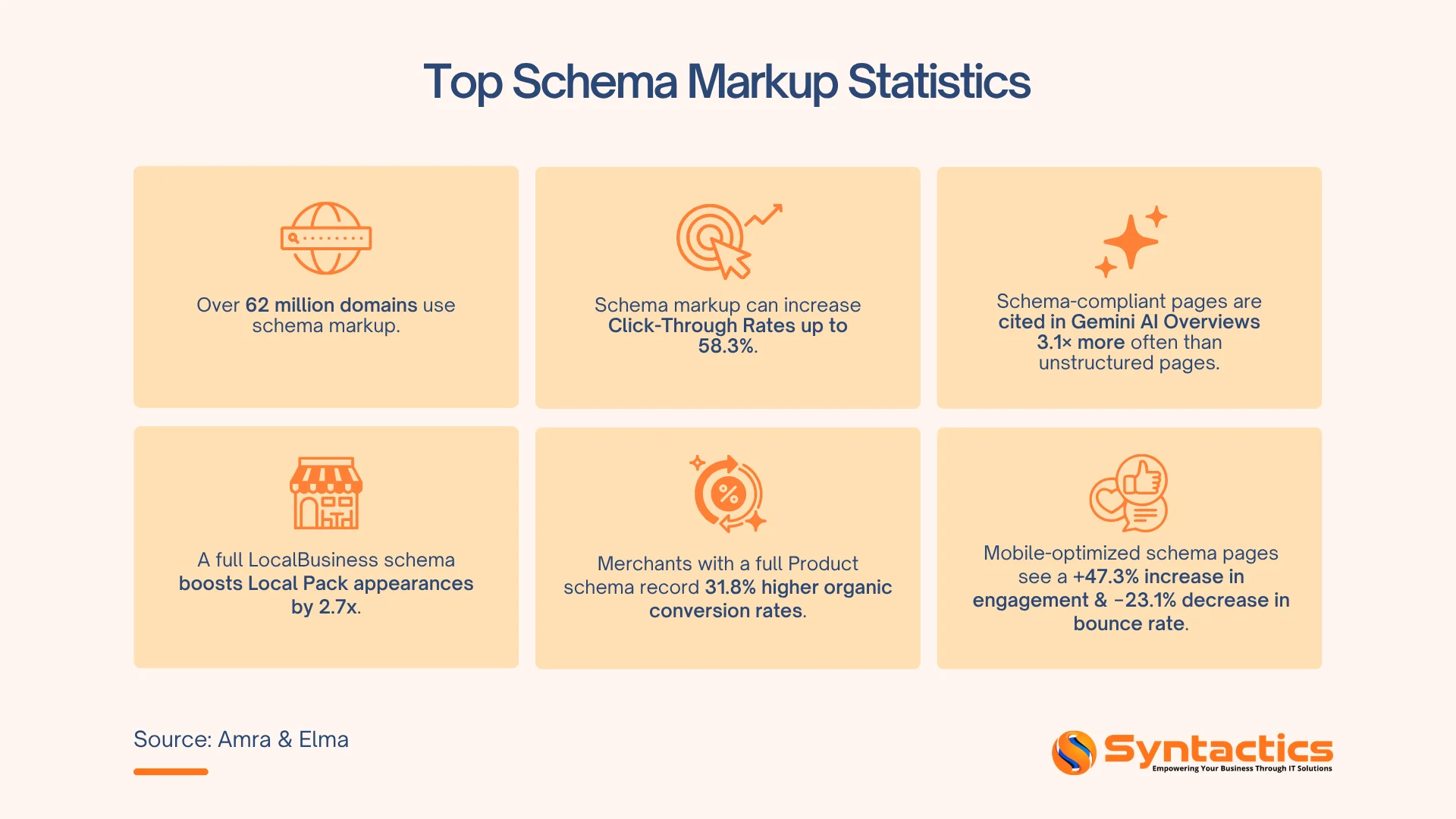
Source: Amra & Elma.
What Schema Does and Why It Matters Now
Schema markup answers questions crawlers would otherwise have to infer:
- Is this a step in a process or a general paragraph?
- Who wrote this?
- What service does this page describe?
When crawlers have clear answers, they accurately extract and attribute content. That accuracy determines whether your answer gets cited in an AI response or a competitor does.
A controlled experiment by Search Engine Land tested three nearly identical pages with schema as the only variable. Only the page with a well-implemented schema appeared in a Google AI Overview and ranked in the top three. The page with no schema was not indexed at all. Multiple AI SEO studies reinforce this, pointing to a 30–40% increase in AI citation visibility for pages with properly implemented schema.
The stakes have grown. According to an Ahrefs study of 863,000 keyword SERPs, only 38% of pages cited in Google AI Overviews rank in the top 10 of traditional results. That figure was 76% in mid-2025. AI systems are pulling from pages well outside the first page. Those cited pages also earn 35% more organic clicks on average. Ranking and being cited are two different outcomes. Schema is one of the clearest levers for the second one.
Schema Types That Matter for Service Businesses
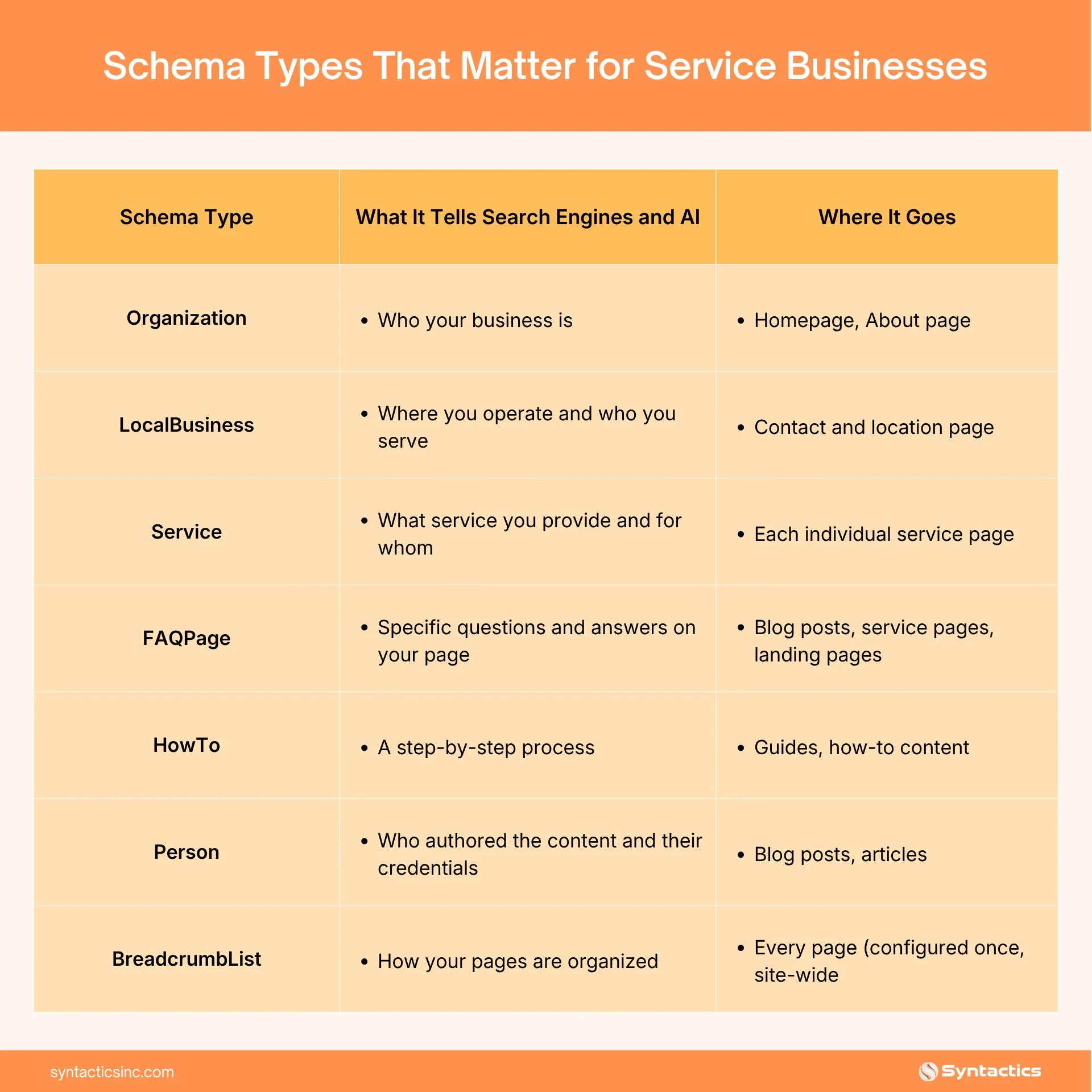
Most service businesses that use schema have only the Organization type, which only identifies the business. This is only the first step, not a full strategy. Six other types can make a real difference in whether your content is found, ranked, and cited.
If you want a general overview of schema markup types used in marketing, read that first. The next sections focus on the types that matter most for service businesses and how they affect AI citations.
Here is a summary before the details:
Organization Schema: Your Business Identity Card
The organization schema is the foundation and the basis for everything else. All other schema types refer to it. The sameAs field lets you link to your LinkedIn, Google Business Profile, and review sites, giving AI systems a way to confirm your business across platforms.
When your brand appears in many places, AI is more likely to cite you than a business found only on its own site.
LocalBusiness Schema: Your Operating Context
The LocalBusiness schema extends the organization schema to include location and business details, such as your service area, hours of operation, and coordinates. Even remote-first companies can use it. Connecting your business to real-world details helps build trust in Google’s system.
Service Schema: What You Actually Offer
Service schema is often missed by service businesses. It tells Google what you offer, who it is for, and who provides it. Add this schema to each service page, not just your homepage.
FAQPage Schema: Still the Highest-Return Type for AI Citation
As of May 7, 2026, Google removed FAQ rich results from traditional search entirely. The expandable dropdowns are gone. What remains is the AI citation signal: pages with FAQPage schema are 3.2 times more likely to appear in Google AI Overviews than pages without it.
ChatGPT, Perplexity, and Gemini all use FAQ structured data as a main source. Keep your answers between 40 and 80 words, write questions the way buyers search, and include three to seven question-answer pairs per page.
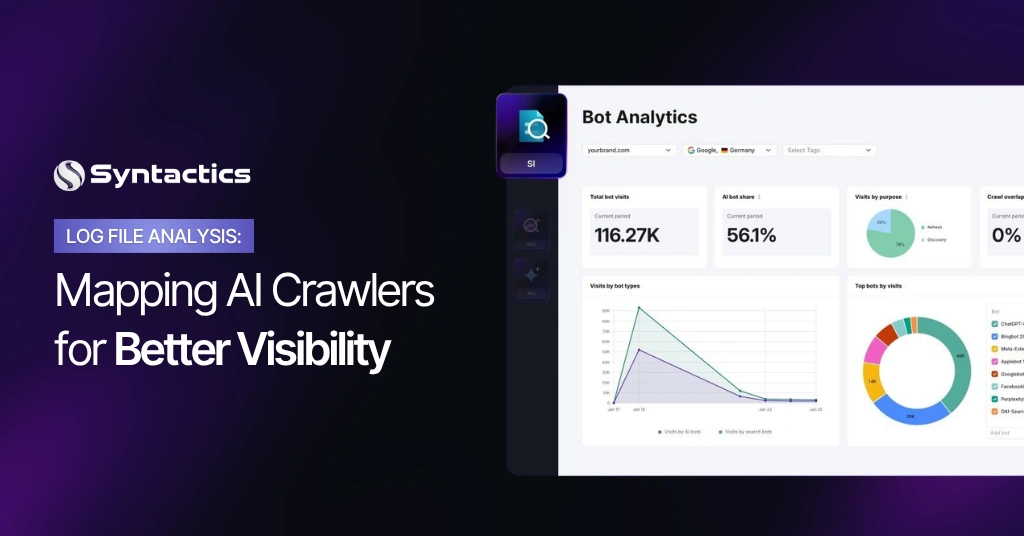
Find out how AI Crawlers fetch your structured data through log files.
HowTo Schema: Visibility at the Step Level
The HowTo schema lets AI systems extract individual steps from your content, not just the whole page. Even if your page ranks fifth or sixth, a step from your guide can still show up in an AI answer.
Person Schema: Authorship as a Trust Signal
Person schema marks each article’s author with their name, credentials, and professional profiles. This supports E-E-A-T. Articles with named, verified authors are cited more often than those with generic team bylines.
BreadcrumbList Schema: Your Site’s Table of Contents
The BreadcrumbList schema tells crawlers how your pages are organized relative to one another. It is the structural equivalent of a table of contents for your website. Set this up once at the template level, and it will apply to every page on your site. It takes little effort and covers your whole site, making it one of the most efficient schema options.
How to Check That Your Schema Is Actually Working
Here is a common mistake. A developer views the page’s raw source code, finds no schema, and reports it is missing. The page actually has a schema. The tool just could not see it.
Many SEO plugins add schema using JavaScript after the page loads. If you check the raw code, you might not see the schema yet because it hasn’t loaded. Use these tools instead:
- Google Rich Results Test renders the full page as a browser would, detects all schema, including JavaScript-injected markup, and flags errors by field. Run this on every page before marking implementation complete. Note that FAQ rich result validation will be removed in June 2026, but the FAQPage schema continues to be detected as a valid type.
- Schema.org Validator checks your schema against the official specification. Use it to confirm every property is correctly structured after the Rich Results Test passes.
- Google Search Console, Enhancements Section shows schema detected across your entire site after Google recrawls. Use this for ongoing monitoring post-launch.
It is important to note that if your schema is missing required fields, it may not just miss out on rich results. Sometimes, it can signal low technical quality to crawlers. Always validate your schema before publishing.
One Setting That Can Cancel All of This
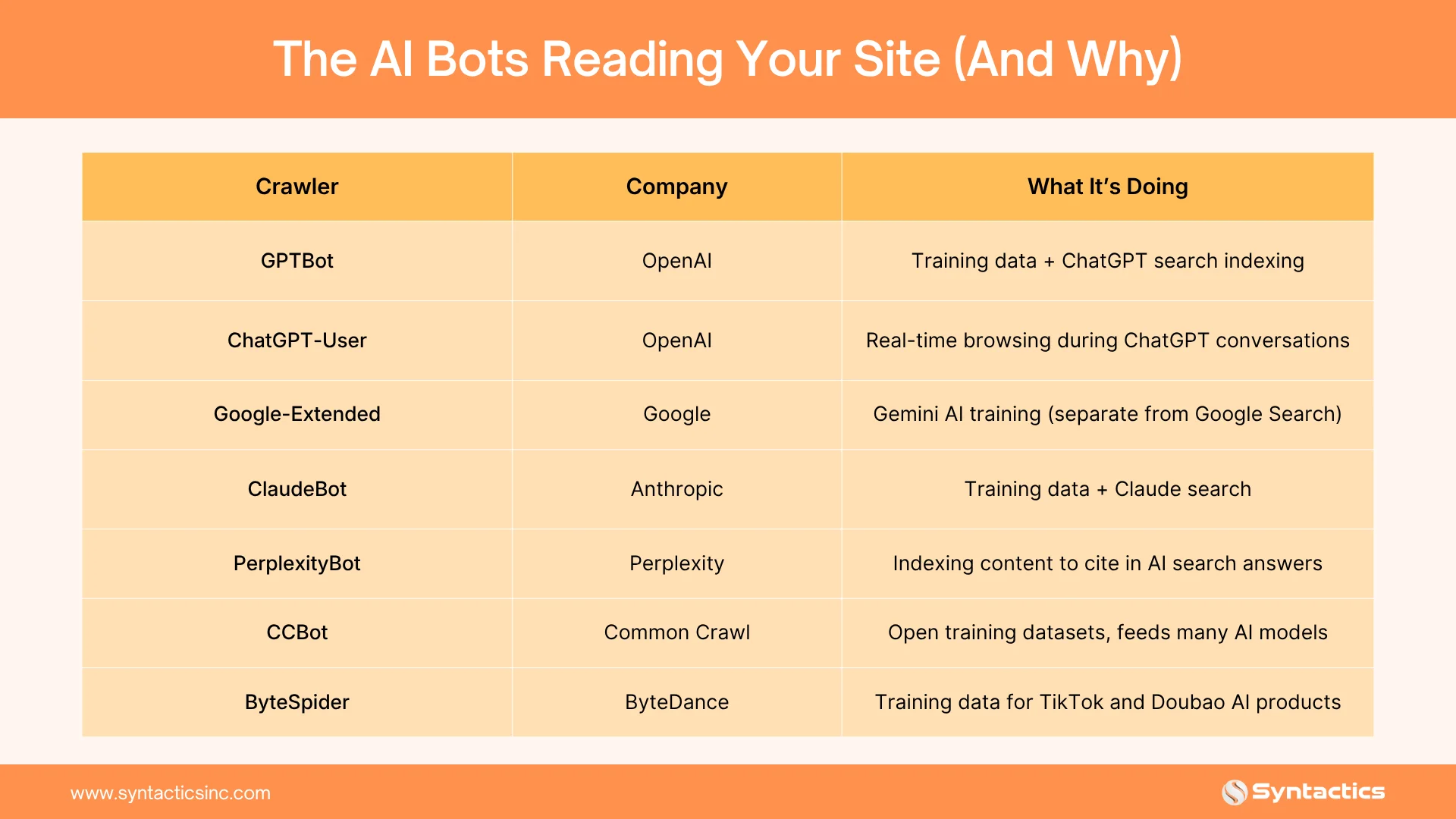
Every website has a file at yourdomain.com/robots.txt that tells crawlers which pages they can visit. Some sites block AI crawlers here, often by accident. When an AI crawler is blocked, the schema becomes irrelevant. It cannot get in.
Every website has a robots.txt file that tells crawlers which pages they can visit. Sometimes, sites block AI crawlers here by mistake. If an AI crawler is blocked, your schema will not matter because it cannot access your site.
Check your robots.txt file for any “Disallow” rules that block these crawlers. If you see any, those platforms will not be able to cite your site. For most service businesses, removing these blocks is the first step before doing anything else.
Where to Start: A Practical Priority Order
More than 45 million web domains have already implemented schema markup, which is about 12.4% of all registered domains worldwide. This number keeps growing as businesses realize that structured data is now essential for search engines and AI systems to decide what content to show and cite.
For a service business implementing a schema for the first time, or reviewing an existing setup, work through this sequence:
- Organization schema on the homepage. This establishes your business identity. Every other schema type references it.
- BreadcrumbList schema at the template level. One setup covers every page on the site.
- FAQPage schema on your top service pages and best-performing blog posts. This delivers the highest schema markup AI citations return for the time invested.
- Person schema on all blog and article content. Configure it at the author template level, so it applies automatically to new content.
- Service schema on each individual service page.
- HowTo schema on any step-by-step or process-driven content.
- LocalBusiness schema on your contact and location pages.
The first three steps have the biggest impact in the shortest time. Finish these before moving on. Schema benefits also grow over time as Google recrawls your pages. If you start with your highest-traffic pages, you will see results faster.
Final Thoughts
Schema markup for SEO is one of the few technical measures that simultaneously improves accessibility in both regular search results and AI-generated answers, and you usually only need to set it up once. The benefits increase as crawlers revisit your pages and AI systems use your well-structured content.
Establish your entity identity, tag your answers, identify your authors, and label your services. Each step closes a gap that is currently costing you citations you have already earned for the content.
Close your schema gaps faster with Syntactics, Inc. Our SEO services in the Philippines include a free technical SEO audit. We identify what is holding your site back and map the highest-impact fixes first.

Related reading:
- What’s Behind Ranking, Converting, and Winning Organic SEO
- The Google E-E-A-T Principle: A Guide
- How to Align Your SEO with Google AI Overviews
Frequently Asked Questions About Schema Markup for SEO
What is schema markup in simple terms?
Schema markup is hidden code that tells search engines and AI systems what your content means. It does not change what visitors see. It changes how accurately crawlers interpret and attribute what they find, directly affecting whether your pages are cited in AI-generated answers.
Do I need a developer to add schema markup?
For most WordPress sites, no. Plugins like Yoast SEO, RankMath, and AIOSEO automatically handle common schema types. The FAQPage schema is added through a standard editor block. Service schema and custom configurations may need a developer, but those are one-time setups.
Does schema markup guarantee that AI cites my business?
Schema improves the citation probability, not certainty. It is one of the factors that AI systems weigh alongside content quality, authority, and third-party mentions. Think of it as making your content eligible for citation. Pages with a well-structured schema regularly outperform equivalent pages without it.

About Jalou Batilong
Related News:
How to Create Facebook Ad Campaign

Outsource Web Developers: Dedicated vs Project-Based

The 7 Principles of Conversion Centered Design
What are Rich Snippets in SEO and How to Make Them








Comment 0