

Topical Authority and AI Search Visibility: How to Make Your Content Easier to Retrieve, Understand, and Cite
Search visibility now extends beyond earning a blue-link position in Google. Your content can rank in traditional search, appear as a source in an AI-generated answer, earn a direct citation, or get mentioned without a link.
The shift matters because AI-assisted search is already part of how Americans find information. A Pew Research Center survey found that 60% of U.S. adults say they have read AI summaries at the top of search engine results.
However, traditional SEO still matters, but AI systems can evaluate and retrieve information differently. Building topical authority can help you create deeper coverage around relevant subjects, giving search and AI systems more context to understand your expertise and the questions your content addresses.
No content strategy can guarantee that ChatGPT, Perplexity, or Google AI Overviews will cite your website. You can, however, build content that is easier to discover, understand, verify, and potentially retrieve as a source.
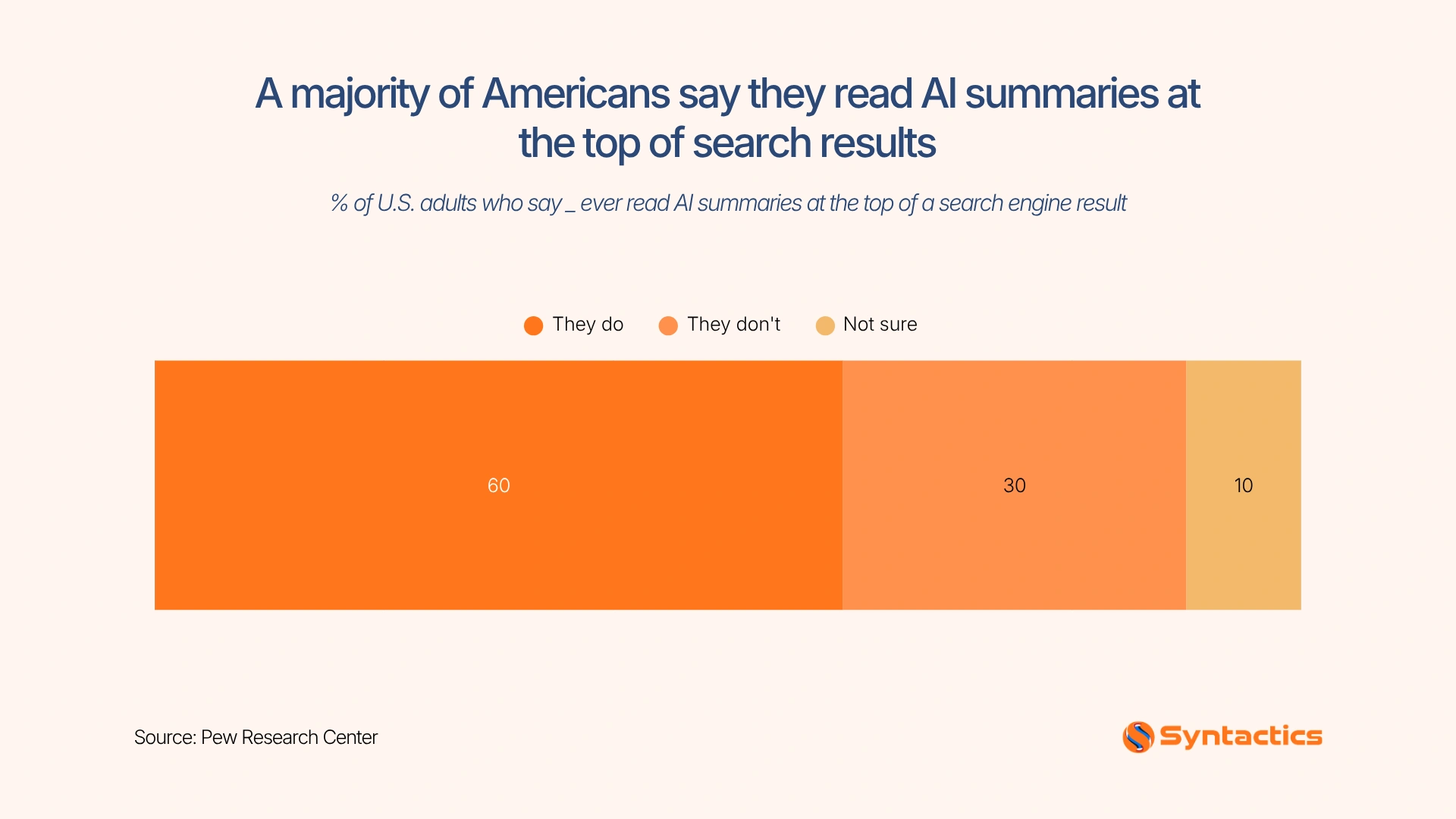
Source: Pew Research Center
Key Takeaways
- Brands were cited in 74% of AI appearances within categories closely tied to their expertise, compared with 50% in more distant categories (Semrush).
- Build depth around topics that matter to your audience instead of publishing disconnected articles.
- Use direct answers, definitions, statistics, sources, and logical headings to make important information easier to interpret.
- Connect related pages through a clear content architecture and internal linking structure.
- Measure AI visibility through consistent prompts, citations, mentions, linked pages, referral traffic, and conversions.
What Topical Authority Means
Topical authority refers to the depth and consistency of your website’s coverage of a particular subject. You build it by publishing useful, relevant content that addresses different questions, search intents, and stages of the customer journey, while supporting key claims with credible evidence.
For example, a website targeting business cybersecurity might publish a foundational guide, articles about threat detection and access controls, implementation guides, and service pages. Each piece covers a distinct need while contributing to a broader subject area.
This broader coverage matters as AI becomes part of the research process. A HubSpot survey of more than 3,000 CRM purchase decision-makers found that 42% used AI search during their evaluation. This shows that buyers are turning to AI when researching products and services.
That said, topical authority differs from domain authority, which is an SEO concept associated with a website’s overall backlink profile and perceived ability to rank. It also differs from brand authority, which relates to how recognized and trusted a company is, and subject-matter expertise, which refers to knowledge held by people or organizations.
The goal is not to publish the largest possible number of articles. You want your content to demonstrate meaningful depth around the subjects your business is associated with.
What Makes Content More Citable
Clear, evidence-based content gives search systems more defined information to retrieve and evaluate. Start by answering the primary question directly, then provide the supporting explanation, examples, data, and context.
Useful characteristics include:
- Clear definitions: Explain technical terms before using them extensively.
- Direct answers: Address specific questions in the opening sentences of relevant sections.
- Named sources: Identify the organizations, researchers, reports, or datasets behind important claims.
- Specific statistics: Include the date, population, sample size, and source when available.
- Original insights: Add your own analysis, examples, observations, or first-party research.
- Logical headings: Organize information into sections that clearly signal what each part covers.
- Defined entities: Use consistent names for companies, products, concepts, locations, and people.
A Semrush study illustrates why topic relevance deserves attention. The study analyzed 1,094 U.S. categories tracked monthly in ChatGPT, covering 283,215 domain-category citation observations and 76,493 brand-mention observations.
In categories closely related to a brand’s core expertise, the brands analyzed were cited in 74% of appearances, compared with 50% in distant categories. Semrush describes these as findings from its specific dataset, not a universal citation rate or guarantee.
That finding supports a practical approach: build depth around subjects that genuinely connect to your expertise rather than chasing unrelated topics simply because they have search demand.
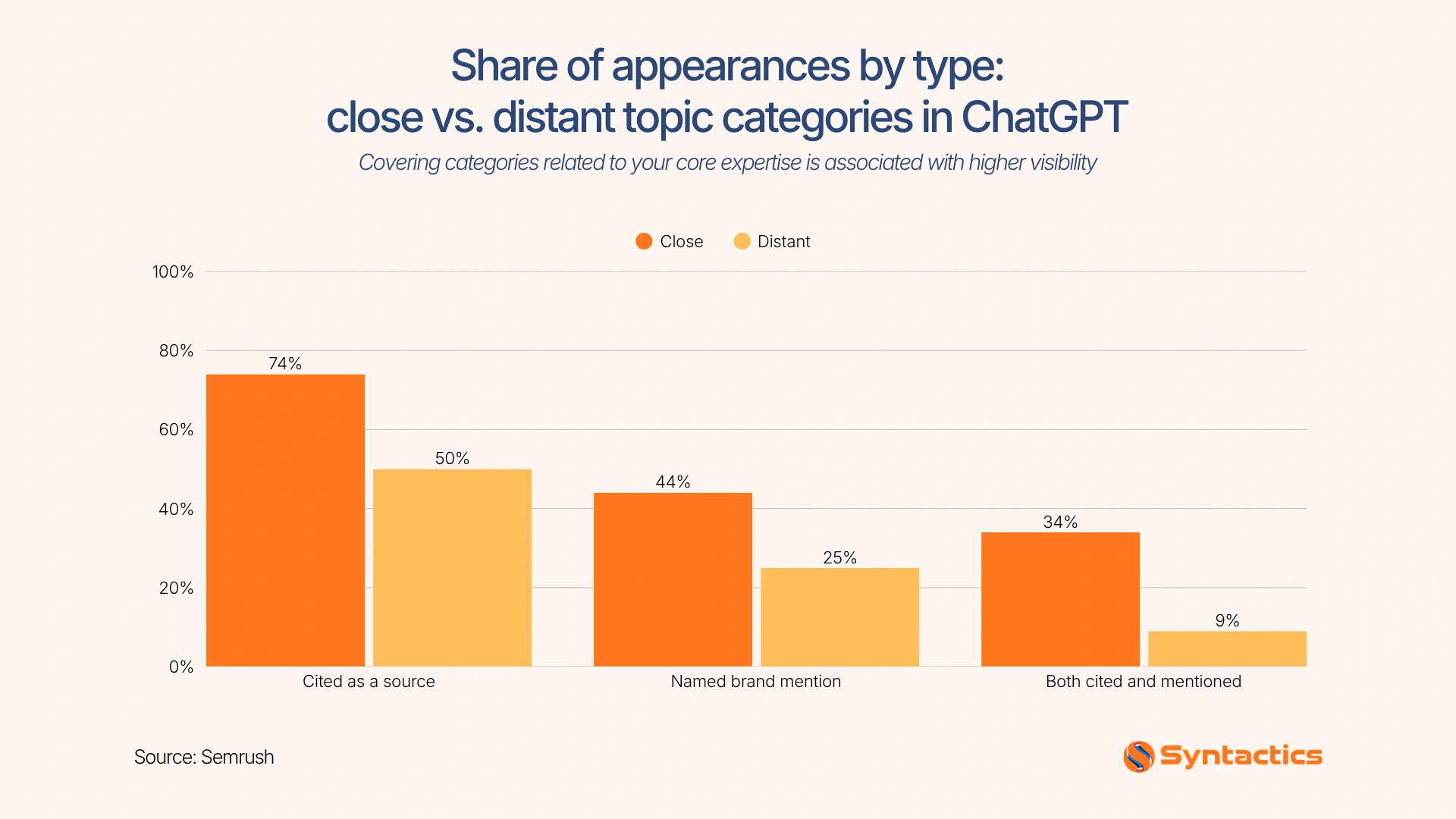
Source: Semrush
Content Blocks That Improve Comprehension
Content structure affects how easily people can scan and understand a page. It can also give search systems clearly defined passages to interpret, although formatting alone does not guarantee AI citation.
The need for useful, well-organized content is also growing as AI increases the volume of information people encounter online. A Gartner survey found that 49% of U.S. consumers said generative AI has made the quality of available content worse, reinforcing the need for content that is clear, credible, and genuinely useful.
With that in mind, use different content blocks based on the information you need to communicate:
- Definition blocks work well for unfamiliar concepts. Give the meaning first, then explain why it matters.
- Comparison tables help readers distinguish related concepts, products, approaches, or services. Keep each row focused on one meaningful difference.
- Step-by-step instructions make processes easier to follow. Number each action and explain what the reader should expect at each stage.
- Statistic blocks can isolate important data from surrounding commentary. Include the source and date so readers can verify the figure.
- Frequently Asked Questions (FAQs) provide concise answers to questions that may not deserve full sections. Write each answer independently so it remains useful when viewed outside the surrounding page.
This structure also helps you avoid burying important information inside long paragraphs. Your goal is to make every section understandable on its own while maintaining a logical flow across the entire page.
Building a Topical Authority Map
A topical map shows how your content connects around a subject. Start with a pillar page that provides broad coverage, then create supporting articles that address specific questions and related subtopics.
Your structure might include:
Pillar page → Supporting articles → Commercial pages → Case studies → Glossary → FAQs
Each page should have a clear purpose. Supporting articles can answer informational questions, and commercial pages can address service or product intent. Meanwhile, case studies can demonstrate real-world applications and glossaries can explain terminology.
Internal links then connect these pieces. Link from broader pages to detailed resources and from supporting articles back to relevant pillar or commercial pages. Use descriptive anchor text that helps readers understand what they will find after clicking.
Moreover, a content-gap audit can reveal questions your existing coverage does not address. It can also identify overlapping articles that compete for the same intent, orphaned pages with few internal links, and outdated content that no longer supports the broader topic.
Overall, you can use this process to build a content ecosystem instead of treating every article as an isolated SEO asset.
Technical and Editorial Signals
Strong content still needs to be accessible. Make sure search engines can crawl important pages, index the URLs you want discovered, and follow your internal links.
Review your XML sitemap, canonical tags, indexation controls, robots.txt directives, and site architecture regularly. These elements help search engines understand which pages are available and how they relate to one another.
Editorial signals matter, too. Include author information where appropriate, review important claims, identify publication or update dates, and maintain accurate references. An article that contains outdated statistics or unsupported claims can lose usefulness even if its original structure was strong.
Relevant structured data can help search engines interpret specific types of content, but schema markup does not guarantee AI visibility or citations. The same applies to robots.txt access. Making a page accessible is different from convincing an AI system to select it as a source.
If you manage a large content library, an experienced SEO specialist in the Philippines can help audit technical accessibility alongside content quality and internal linking.
Measuring AI Search Visibility
Set up a monthly process that tracks the same prompts across the AI search platforms most relevant to your audience. Start with a fixed prompt set covering informational, commercial, comparison, and brand-related queries. Record whether your brand appears, which pages are cited, whether the citation includes a link, which competitors appear, and how the answer changes over time.
AI visibility platforms such as Otterly AI, Peec AI, and LLMrefs can help monitor mentions and citations. Combine that information with Google Search Console data, referral traffic, branded searches, qualified leads, and conversions to understand whether increased visibility translates into meaningful business activity.
According to a YouGov survey, AI assistants are becoming a bigger part of how people find information online, while traditional search engines remain an important part of the research process. The study examined how consumers use AI assistants alongside search engines and where AI fits into their search journey.
That makes AI visibility worth tracking alongside traditional organic performance. You can use trusted SEO services in the Philippines to develop a measurement framework that looks beyond rankings and tracks how your content appears across different search experiences.
Conclusion
Your content needs to serve people first while remaining accessible to systems that retrieve and summarize information. Strong subject coverage, useful page structures, and credible evidence can strengthen topical authority and improve discoverability across traditional and AI-assisted search. A focused strategy also helps you build a connected content system that supports search visibility, user experience, and business goals.
Syntactics, Inc. can help through SEO services in the Philippines that bring together SEO, AEO, GEO, content strategy, technical optimization, and performance measurement. Our team can map your topics, strengthen content architecture, improve existing pages, and track your brand across search and AI platforms.
With 26 years of experience and a global client portfolio, Syntactics, Inc. can turn your content library into a structured resource that supports discovery, earns trust, and expands your search visibility.

FAQs About Topical Authority
Do you need topical authority to appear in AI overviews?
Topical authority can improve your chances of appearing in AI Overviews, but it is not a requirement. Clear, relevant, trustworthy content that directly addresses a search query can also be surfaced.
How long does it take to build topical authority?
Building topical authority is an ongoing process rather than a one-time project. The timeline depends on your existing content, subject coverage, competition, publishing consistency, and the depth of your resources.
Can a small website build topical authority?
Yes. A smaller website can focus on a narrow subject area and build meaningful depth around the questions most relevant to its audience. Focused coverage can be more practical than trying to publish about a broad range of unrelated subjects.

About Jalou Batilong
Related News:

Best SEO-Friendly CMS for Your Website: Top Picks

Optimizing Web Apps with API-First Development




Comment 0