

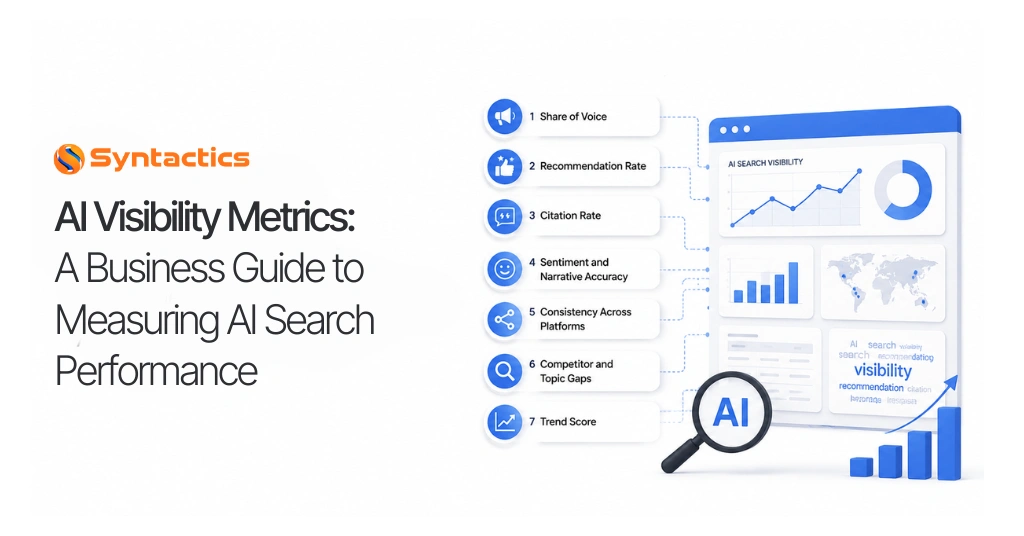
AI Visibility Metrics: A Business Guide to Measuring AI Search Performance
AI visibility metrics measure how often, how accurately, and how favorably a brand appears in AI-generated answers across platforms such as ChatGPT, Gemini, Perplexity, and Google’s AI search features. They complement traditional SEO metrics by measuring brand presence and influence inside AI answers, including activity that may happen before or without a website click.
Key Takeaways
- AI visibility metrics track brand presence and influence inside AI-generated answers, capturing value that may happen before a website visit.
- Core metrics include share of voice, recommendation rate, citation rate, sentiment, factual accuracy, platform consistency, prompt coverage, and competitor gaps.
- A stable prompt set, GA4 referral analysis, and Google Search Console’s branded-query filter form a practical, low-cost measurement setup.
- Direct attribution remains difficult, so the strongest business case comes from testing relationships among AI visibility, branded search, qualified traffic, and conversions over time.
- A monthly reporting cadence, supported by a deeper quarterly review, gives leadership enough data to identify meaningful trends without creating unnecessary reporting noise.
Source: Pew Research Center.
Why Traditional SEO Metrics Fall Short in AI Search
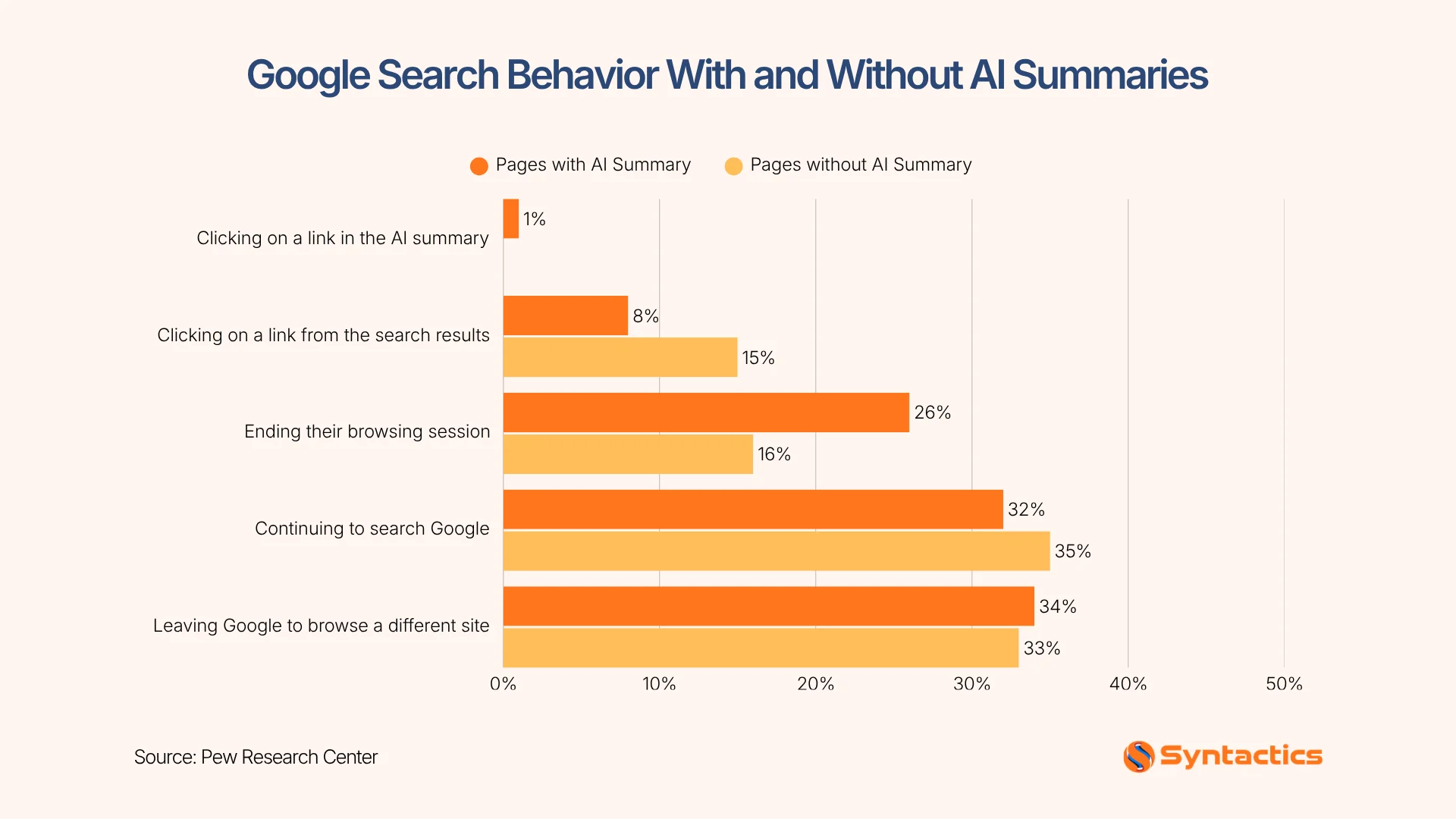
Buyers increasingly use AI tools for some category research, comparisons, and shortlist formation before they open a browser tab. An AI answer can sometimes satisfy a buyer’s question without requiring a visit to the cited website. The visit that would previously have appeared in Google Analytics may happen later, through another channel, or not at all.
This creates a measurement gap. Rankings, impressions, and click-through rates still matter, but they describe mainly the part of the journey that happens within or after a search result. AI visibility metrics add another measurement layer by tracking whether a brand appears, how it is described, whether it is recommended, and whether it earns a place on the buyer’s shortlist.
According to Search Engine Land, effective AI search reporting should connect access, visibility, referrals, downstream demand, pipeline, and revenue. It treats activity before a website visit as a measurable stage rather than an entirely invisible part of the buyer journey.
7 Core AI Visibility Metrics Worth Tracking
There is not yet one universally accepted industry standard for AI visibility measurement. However, several emerging commercial and agency frameworks use a similar group of signals. The seven below provide a practical starting point for business reporting.
Share of Voice
Share of voice measures the brand’s prominence in AI answers relative to a defined competitor set.
The term can refer to two different calculations, so reports should state the definition clearly:
- Response share: The percentage of tracked AI responses that mention the brand.
- Mention share: The brand’s total mentions divided by all tracked brand mentions across the selected competitor group.
For mention share:
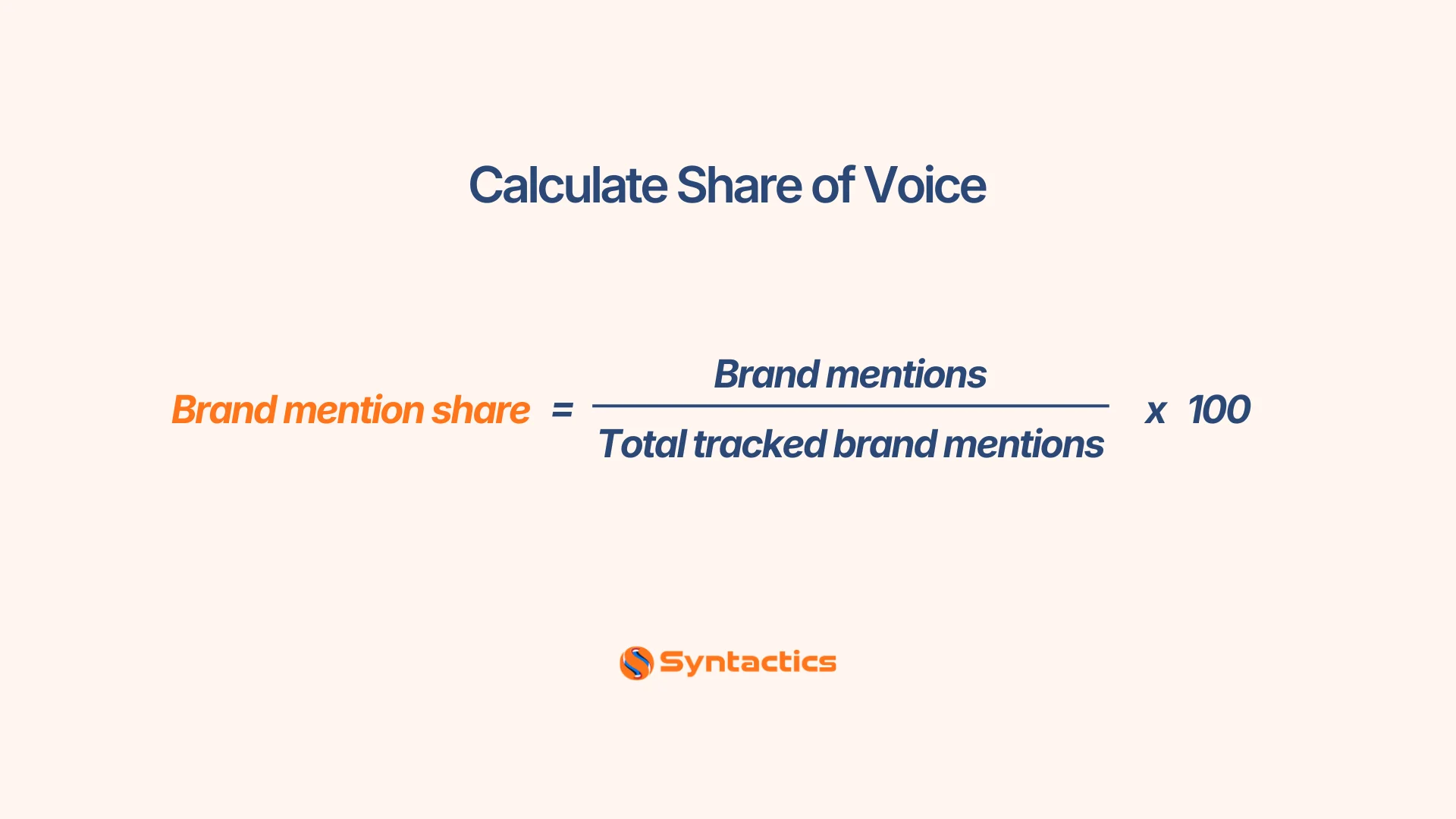
Total tracked brand mentions
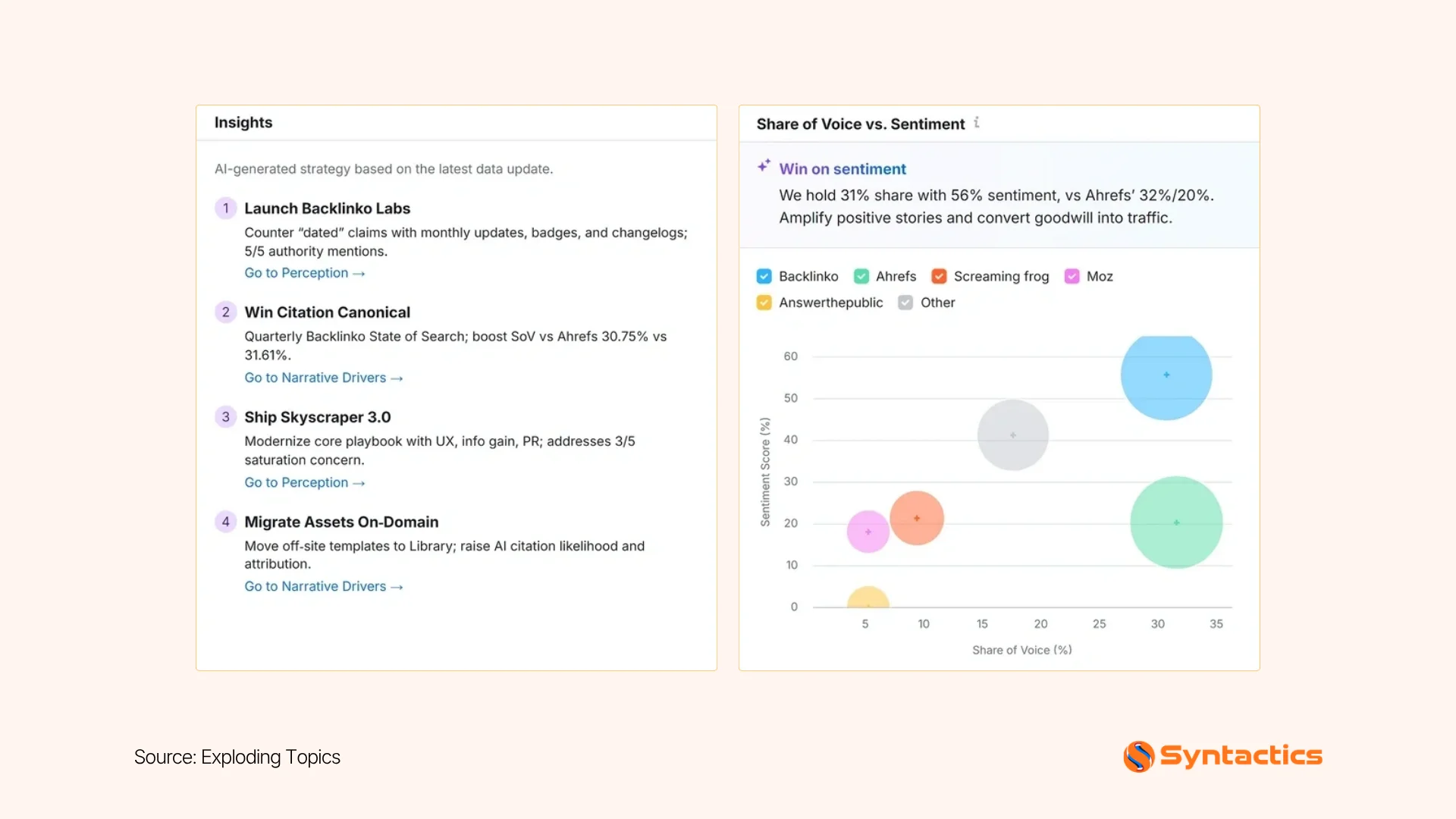
Run the same prompt set through each AI platform and record how often each brand appears. Dedicated tools such as Semrush can automate this process after a domain and competitor set are entered, while manual tracking remains useful for small-scale testing and spot checks.
This metric provides a category-level view of prominence. If a tracking set contains five brands in total, an equal-share baseline is 20%. If it contains your brand plus five competitors, the equal-share baseline is 16.7%. A result below the relevant baseline may point to a content, authority, positioning, or citation gap.
 Source: Exploding Topics.
Recommendation Rate
Recommendation rate measures how often an AI platform actively places a brand on a shortlist for buying, comparison, or provider-selection prompts.
It is different from mention rate. A brand may be mentioned as background context but never recommended as an option. For this reason, reports should separate “mentioned” from “recommended,” because recommendation rate is generally closer to commercial intent.
Recommendation rate can be calculated as:
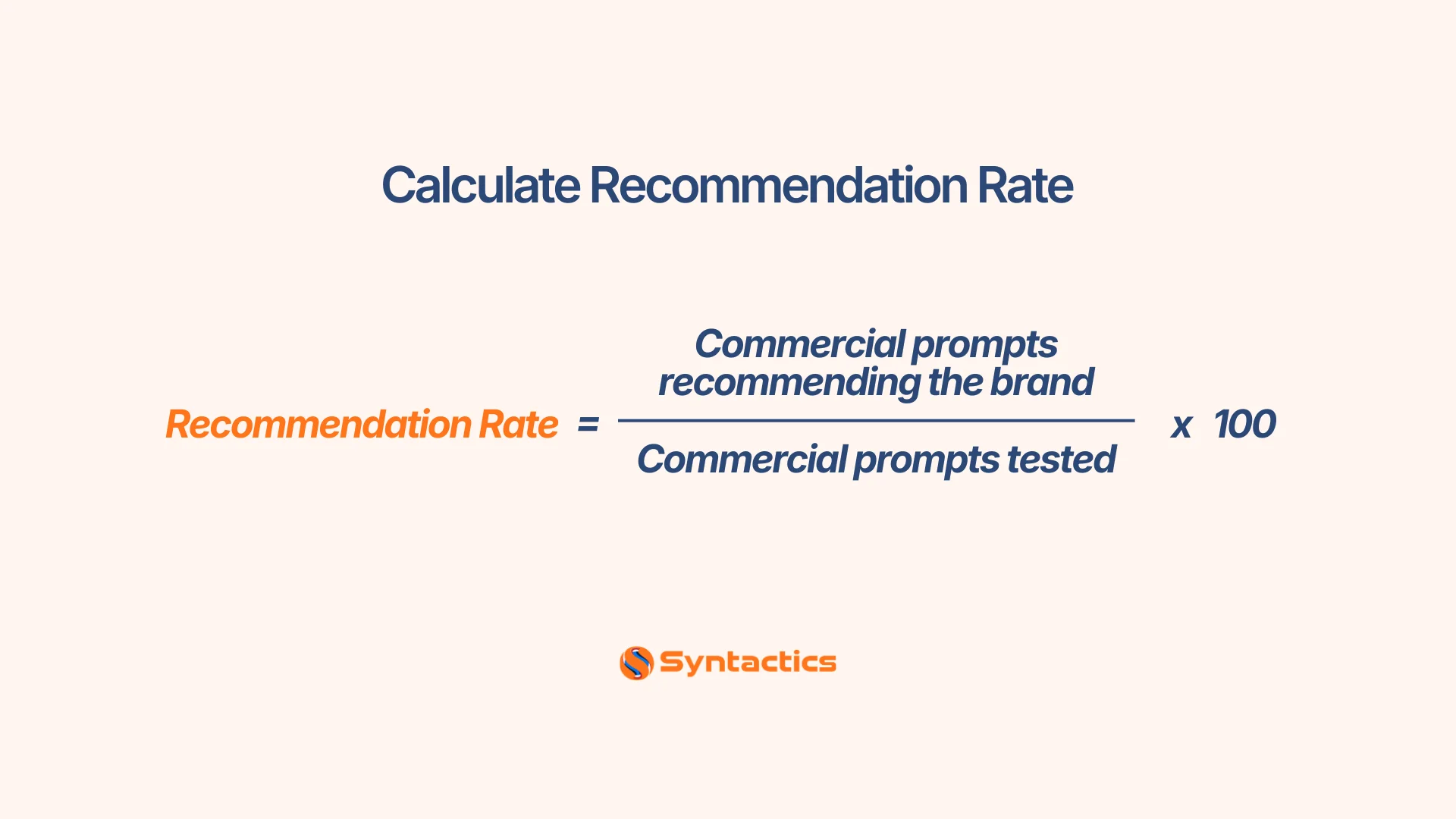
Commercial prompts tested
Recommendation rate is an emerging vendor and agency metric rather than a settled industry standard. HubSpot’s AI visibility framework includes platform coverage, mention frequency, citation rate, sentiment, consistency, and share of voice as inputs to its visibility score, while other platforms separately track recommendations.
Citation Rate
Citation rate measures how often AI platforms link to or cite a brand’s website or content as a source.
Citation rate is a useful AEO analog to source recognition, but an AI citation is not equivalent to a backlink and should not automatically be interpreted as a ranking signal. It identifies pages that appeared as sources in the sampled answers and may indicate that those pages are relevant or discoverable for particular prompts.
Track citation rate at the page level, not only at the domain level. A well-structured FAQ page, original research report, comparison guide, or data-backed article may receive most of a domain’s citations. That page can provide a useful template for future content.
A basic formula is:
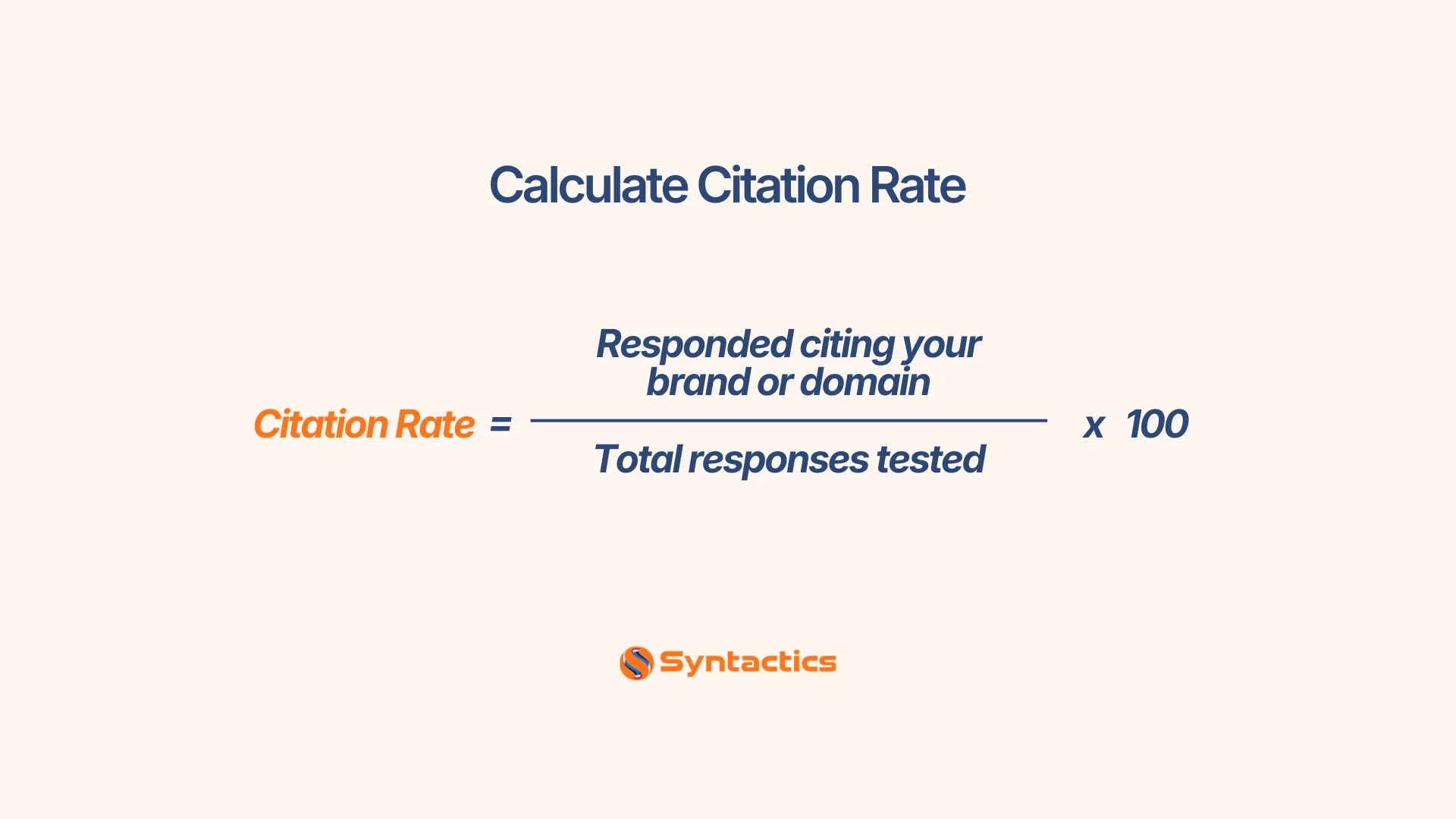
Total responses tested
Citation share can also be tracked to compare the brand’s citations with those received by competitors.
Sentiment and Narrative Accuracy
This measurement should separate two related but different issues:
- Sentiment: Whether the brand is described favorably, neutrally, or unfavorably.
- Factual accuracy: Whether the AI-generated description correctly represents the brand, products, services, location, pricing, and differentiators.
A positive-sounding but factually incorrect description still requires attention. A neutral description may simply indicate that the brand needs stronger, more specific supporting content.
Score sentiment on a simple three-point scale:
- Favorable.
- Neutral.
- Unfavorable.
Then log factual errors separately. If desired, teams can create a combined quality score, but they should publish the weighting method so leadership understands what the score represents.

Consistency Across Platforms
Consistency measures whether ChatGPT, Gemini, Perplexity, Google AI features, and other tracked systems describe the brand in a similar and accurate way.
Conflicting positioning across platforms can dilute a strong AI presence and confuse buyers who use more than one tool. Build a side-by-side table for each core prompt, with one column per platform.
Flag prompts where the platforms differ significantly in:
- Brand category.
- Target audience.
- Products or services mentioned.
- Differentiators.
- Named competitors.
- Tone.
- Factual accuracy.
- Recommendation status.
Since AI outputs can vary by model, date, location, account, browsing status, and personalization, consistency results should be treated as directional rather than permanent.
Competitor and Topic Gaps
Topic gap analysis identifies subjects where competitors appear in AI answers while the brand remains absent.
These gaps can point to content opportunities because AI platforms often surface sources that address a topic clearly, specifically, and comprehensively. Run the same prompt set against the brand and its major competitors, then record which prompts produce:
- No brand mention.
- A competitor mention only.
- A neutral brand mention.
- A recommendation for a competitor.
- A citation to a competitor’s content.
Prioritize gaps that overlap with high commercial intent, local demand, or important product and service categories.

Trend Score
A single snapshot shows current visibility, but a pattern across three or more reporting periods shows direction.
Track month-over-month movement in:
- Response share or mention share.
- Recommendation rate.
- Citation rate.
- Sentiment.
- Factual accuracy.
- Platform coverage.
- Branded-query impressions and clicks.
- Qualified traffic and conversions.
“Trend score” is not a universal metric, so teams should either call this trend analysis or publish the formula used to calculate a trend index. A flat mention count paired with improving accuracy and sentiment may represent progress. A rising mention count paired with falling sentiment may indicate a narrative problem.
How to Measure AI Visibility Metrics
A practical AI visibility program can begin with four steps.
1. Create a Fixed Prompt Set
Compile a stable set of buyer questions covering informational, comparison, recommendation, local, and service-specific intent. Record the prompt, platform, date, location, brand mentions, recommendations, citations, sentiment, factual errors, and competitors mentioned.
Keep the core prompts unchanged between reporting periods so your trend data remains comparable. Expand the set only between reporting cycles.
2. Track Visibility and Demand Together
Monitor AI responses alongside business signals:
- AI mentions, recommendations, and citations.
- GA4 referrals from AI platforms where identifiable.
- Google Search Console branded-query impressions and clicks.
- Qualified visits, conversions, calls, forms, and pipeline.
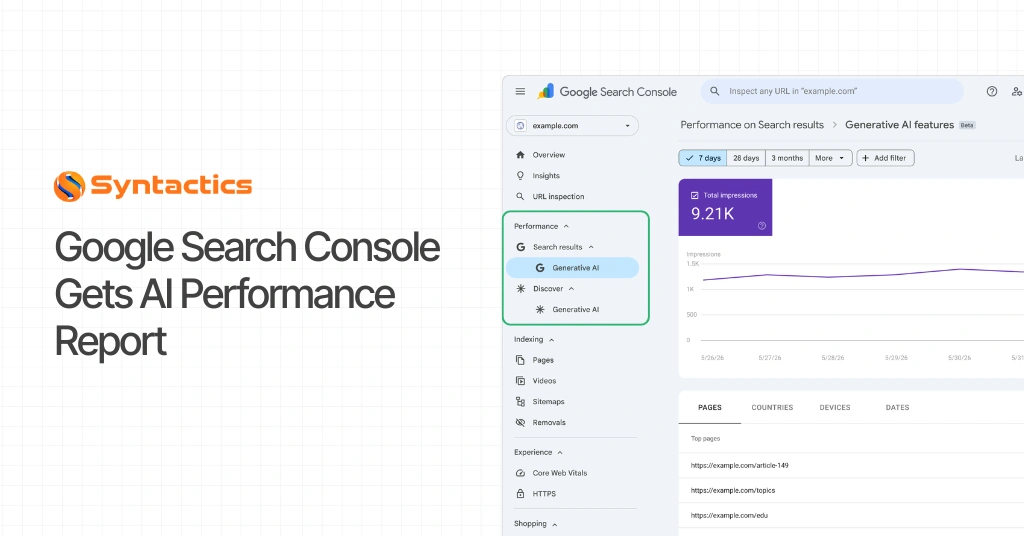
GA4 will capture only some AI-influenced activity because visits may appear as organic, direct, or other referral traffic. Search Console measures branded-query performance, not total branded search volume.
3. Compare Platforms Separately
Review ChatGPT, Gemini, Perplexity, Google AI Overviews, and other relevant platforms independently. Do not rely only on an overall average, since platforms may produce different answers based on their models, sources, browsing behavior, location, personalization, and date.
For each platform, track:
- Prompt coverage.
- Mention and recommendation rate.
- Citation rate.
- Sentiment and factual accuracy.
- Competitor presence.
- Positioning consistency.
4. Automate at Scale
Manual tracking works for a small prompt set. Larger programs can use tools such as Semrush’s AI Visibility Toolkit to monitor mentions, citations, competitor gaps, and share of voice.
Document the tool, prompt set, competitor group, platform coverage, reporting period, and metric definitions in every report. Vendor scores are useful for directional analysis, but they are not universal industry standards.
Connecting AI visibility to Leads and Revenue
The question every stakeholder eventually asks is whether AI visibility translates into pipeline.
Direct attribution remains difficult because AI-generated answers do not always pass referrer data in the same way as a traditional search-result link. A more reliable approach is to test relationships among several signals tracked together over time:
- Identifiable AI referral sessions.
- Branded-query impressions and clicks.
- Direct and organic traffic.
- Engagement with commercial landing pages.
- Form submissions, calls, and other qualified actions.
- Conversion rates.
- Sales-qualified opportunities and pipeline.
When AI visibility improves, teams can test whether branded-query performance, qualified traffic, and conversions also increase. A repeated relationship across several reporting periods strengthens the business case, but it does not prove that AI visibility caused the increase.
For competitive local markets, rising AI visibility for local-provider prompts can be useful. It becomes a stronger business signal when it occurs alongside branded-query growth, qualified visits, calls, form submissions, and pipeline, not when it occurs by itself.

Reporting Cadence: How Often to Check the Numbers
A three-tier cadence keeps reporting useful without creating noise:
- Weekly (lightweight): Conduct a lightweight scan of priority prompts for sudden changes in mentions, recommendations, citations, or factual accuracy.
- Monthly (core report): Report visibility by platform, response share or mention share, recommendation rate, citation rate, sentiment, factual accuracy, and branded-query performance compared with the previous month.
- Quarterly (executive summary): Provide an executive review connecting visibility trends with competitive position, qualified demand, conversions, and pipeline where sufficient data is available.
Meltwater’s research on CMO reporting notes that monthly reporting is a practical operating recommendation, not a universal rule. Teams with small prompt sets may need less frequent reviews, while high-risk industries or rapidly changing brands may require more frequent monitoring.
Common Mistakes That Distort the Data
Several habits can undermine otherwise useful AI visibility reporting:
- Expanding the prompt set mid-cycle, which inflates mention counts without proving genuine improvement.
- Reporting mention count alone instead of separating mentions, recommendations, citations, sentiment, and accuracy.
- Treating one snapshot as a trend.
- Combining all platforms into one average and hiding platform-specific differences.
- Changing the competitor set without documenting the change.
- Treating an AI citation as equivalent to a backlink.
- Assuming that higher AI visibility automatically produces more traffic or revenue.
- Ignoring factual errors because the overall sentiment appears positive.
- Failing to record prompt date, platform, location, model, or browsing conditions.
- Treating a vendor’s composite score as an industry-standard measurement.
Getting Started
AI visibility metrics add a measurement layer for brand presence inside AI-generated answers. They do not replace rankings, impressions, clicks, conversions, or revenue; they complement those metrics by showing what happens before or without a website visit.
Start with a stable prompt set, define each metric clearly, and track platforms separately. Over several reporting periods, compare AI visibility with branded-query performance, qualified traffic, conversions, and pipeline to identify where AI search presence may be supporting business growth.
For businesses ready to build this discipline, structured SEO services in the Philippines can align technical SEO, content authority, and AI-facing optimization under one plan. At Syntactics, Inc., we help brands turn these metrics into a repeatable growth system, rather than a one-time report.

Frequently Asked Questions
What is a good AI visibility score?
A good score depends heavily on industry maturity and competitive density. A SaaS brand in a crowded category sees very different baseline numbers than a niche local business with a handful of competitors. Benchmark against category peers, rather than a universal number.
How is AI visibility different from SEO visibility?
Traditional SEO visibility tracks rankings and clicks on a results page. AI visibility tracks whether a brand appears inside a generated answer, how it’s described, and whether the AI recommends it. Often, this happens well before any click takes place.
How often should AI visibility be measured?
A monthly cadence works well for most businesses, with a deeper competitive review each quarter. Faster-moving categories or major product launches may call for an additional check outside the regular schedule.
Can AI visibility drive leads without a click?
Yes. When an AI platform describes a brand favorably in a category comparison, that exposure builds brand recall. It can influence a direct visit or branded search later, even when the original AI session never generates a tracked click.

About Jalou Batilong
Related News:

Analyzing the Google May 2026 Core Update Rollout

Law Firm Website Design Branding Tips

Magento 1 Reaches EOL: Time to Switch Platforms







Comment 0