

Driving Mobile App ROI with Cross-Platform Development
Rising costs and the constant pressure for faster delivery are forcing a shift in how businesses build software. According to Gitnux, mobile app revenue in the United States is projected to surpass $613 billion by 2027, driven largely by businesses that pivot quickly to meet user needs.
To capture your share of this market, implement a strategy that prioritizes efficiency without sacrificing the high-quality experience users demand. By adopting cross-platform mobile app development, you create a direct path between high development costs and the need for rapid, multi-device deployment.
TABLE OF CONTENTS
Key Takeaways
- Over 43% of mobile developers actively use React Native in production apps. (Stack Overflow)
- Unified codebases for iOS and Android reduce long-term maintenance burdens.
- Rapid development cycles enable businesses to achieve faster market entry.
- Shared engineering efforts across platforms realize significant cost efficiency.
- Modern frameworks like React Native ensure digital assets scale with high-speed connectivity.
What Cross-Platform Development Means for Your Business
Cross-platform mobile app development lets you use a single codebase that runs across multiple operating systems. Instead of building separate native apps for iOS and Android, you streamline development into one unified workflow. This reduces redundancy, improves consistency, and simplifies long-term maintenance.
In real-world projects, this means:
- One feature update gets deployed everywhere at once
- Bugs are fixed once instead of twice
- UI/UX consistency is easier to maintain
- Development teams collaborate more efficiently
For example, when you work with a trusted application developer in the Philippines, you gain access to teams experienced with scalable frameworks such as Flutter and React Native.
This setup helps you build production-ready apps faster while keeping mobile app development costs under control. This is especially valuable for enterprises and startups that need rapid iteration without compromising quality.

The Business Case for React Native
React Native is one of the most widely adopted frameworks supporting cross-platform mobile app development. In fact, Stack Overflow’s 2025 Developer Survey found that over 43% of mobile developers actively use React Native in production apps.
With React Native, you can:
- Reuse up to 70-90% of your codebase
- Deploy updates faster across platforms
- Reduce debugging time
- Accelerate MVP launches
For businesses, this translates into faster validation cycles and lower wasted engineering hours. Moreover, when you collaborate with a reliable mobile application developer, you often benefit from teams already experienced in React Native ecosystems. As a result, it allows you to scale development without significantly increasing cost overhead.
A practical example is e-commerce apps, where frequent updates to pricing, UI elements, and inventory need to be reflected instantly across platforms. React Native makes this synchronization seamless.
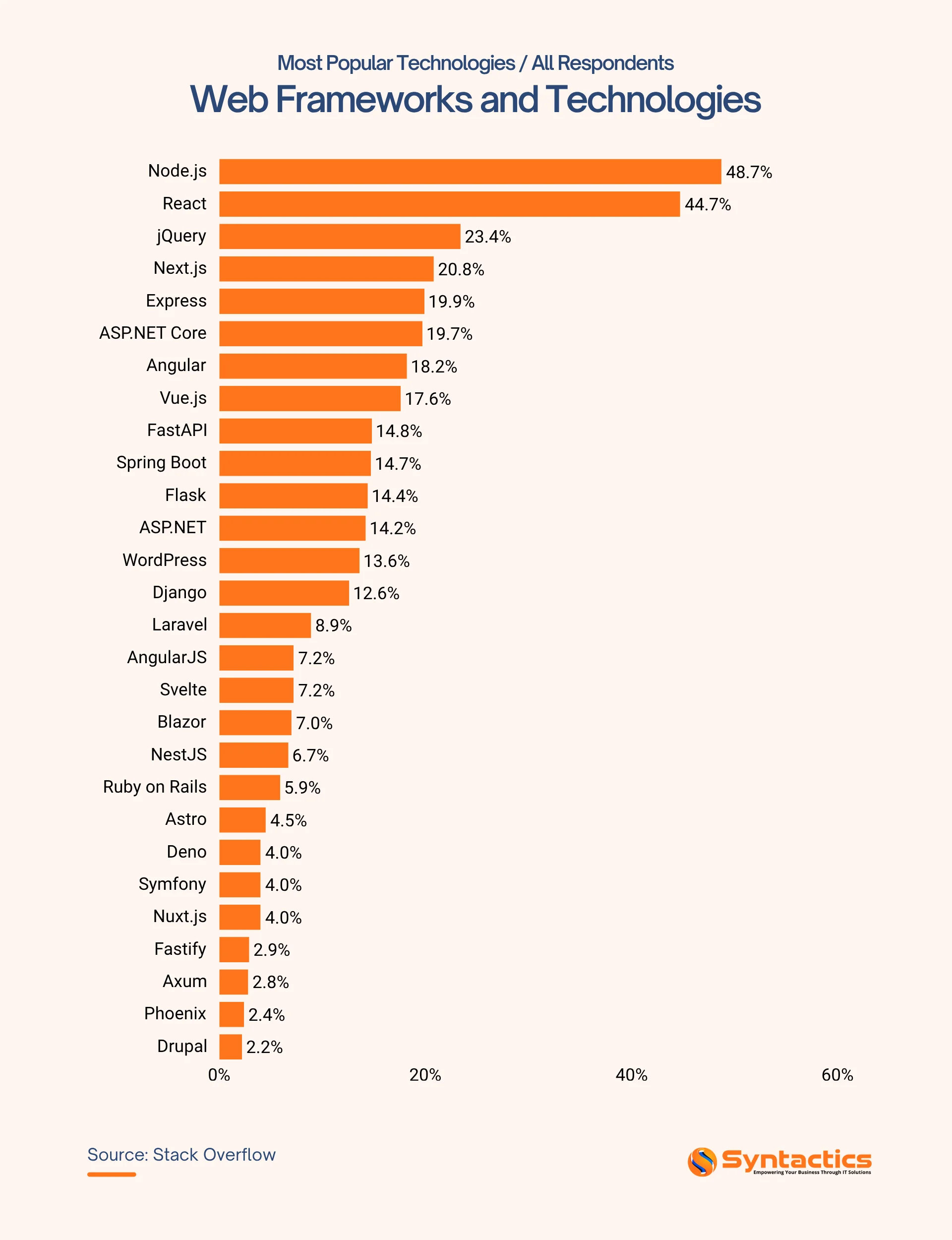
Source: Stack Overflow
Expo vs React Native CLI: Choosing the Right Approach
Expo offers a managed workflow that simplifies setup, testing, and deployment. Meanwhile, React Native CLI provides deeper access to native modules and full control over customization for complex builds.
In addition, Expo is designed to help you start building quickly without having to deal with native configuration complexity upfront. It handles most of the setup for you, which makes it easier to prototype and validate ideas early. On the other hand, React Native CLI gives you full control over native Android and iOS projects, making it better suited for advanced or highly customized applications.
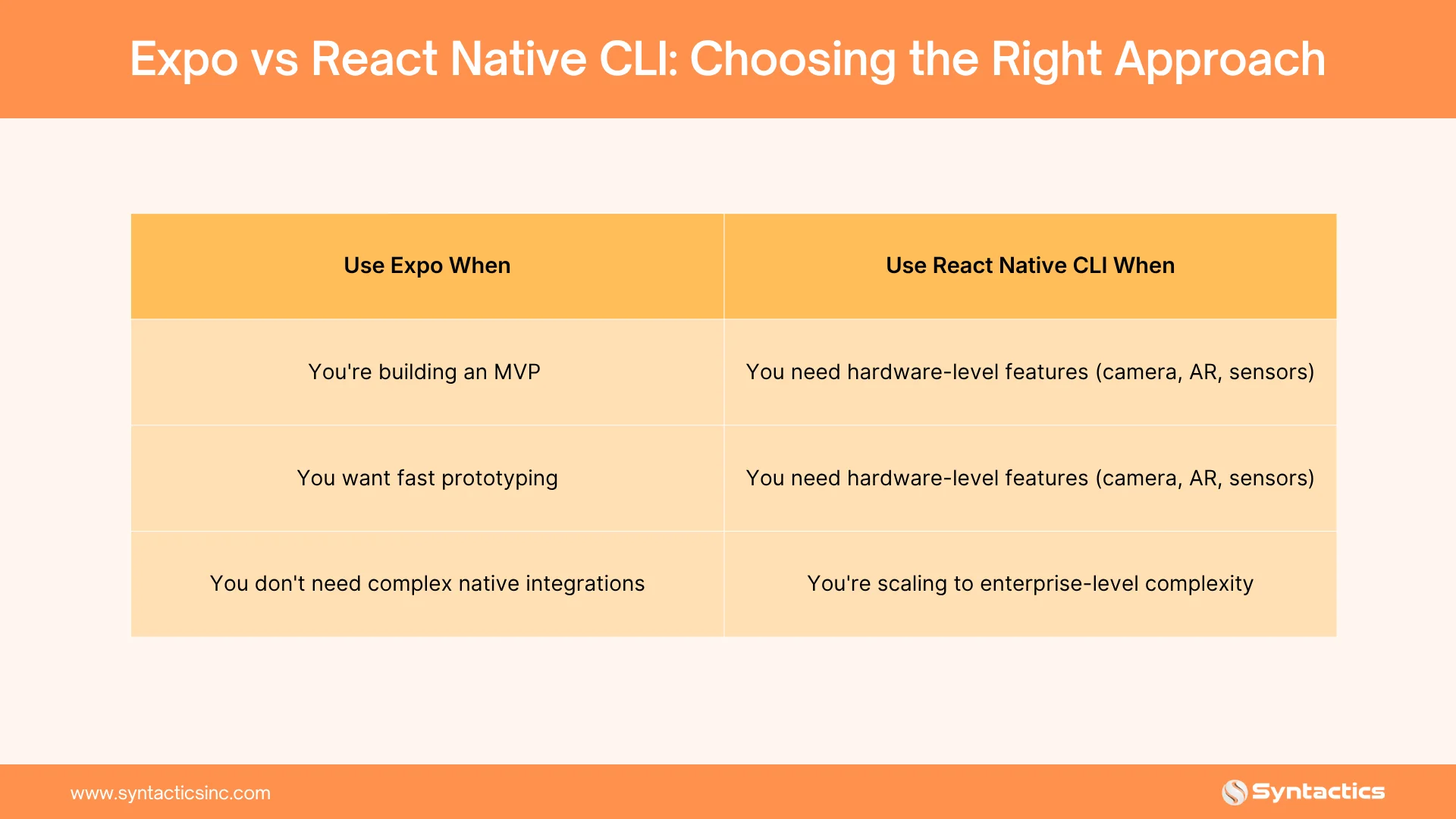
Many app developers in the Philippines start with Expo for rapid deployment, then migrate to CLI when product requirements become more advanced. This staged approach reduces risk while maintaining flexibility.
How Cross-Platform Development Impacts Cost and Speed
One of the strongest advantages of cross-platform development is how it directly improves cost efficiency and accelerates delivery timelines. Instead of building and maintaining separate native apps for iOS and Android, you streamline development into a single codebase that supports both platforms.
This efficiency comes from:
- Eliminating duplicate engineering work
- Reducing QA testing across multiple platforms
- Simplifying maintenance and updates
- Streamlining DevOps pipelines
Speed also improves significantly because updates are deployed once and applied across all platforms simultaneously. This lets you respond to user feedback faster, fix issues more quickly, and roll out features without waiting for separate app store release cycles.
This matters even more when you consider user behavior. According to Passport Photo Online, the average smartphone user has 35 apps installed on their devices. This means your app competes constantly for attention. Faster updates and consistent performance across devices help you stay relevant and keep users engaged.
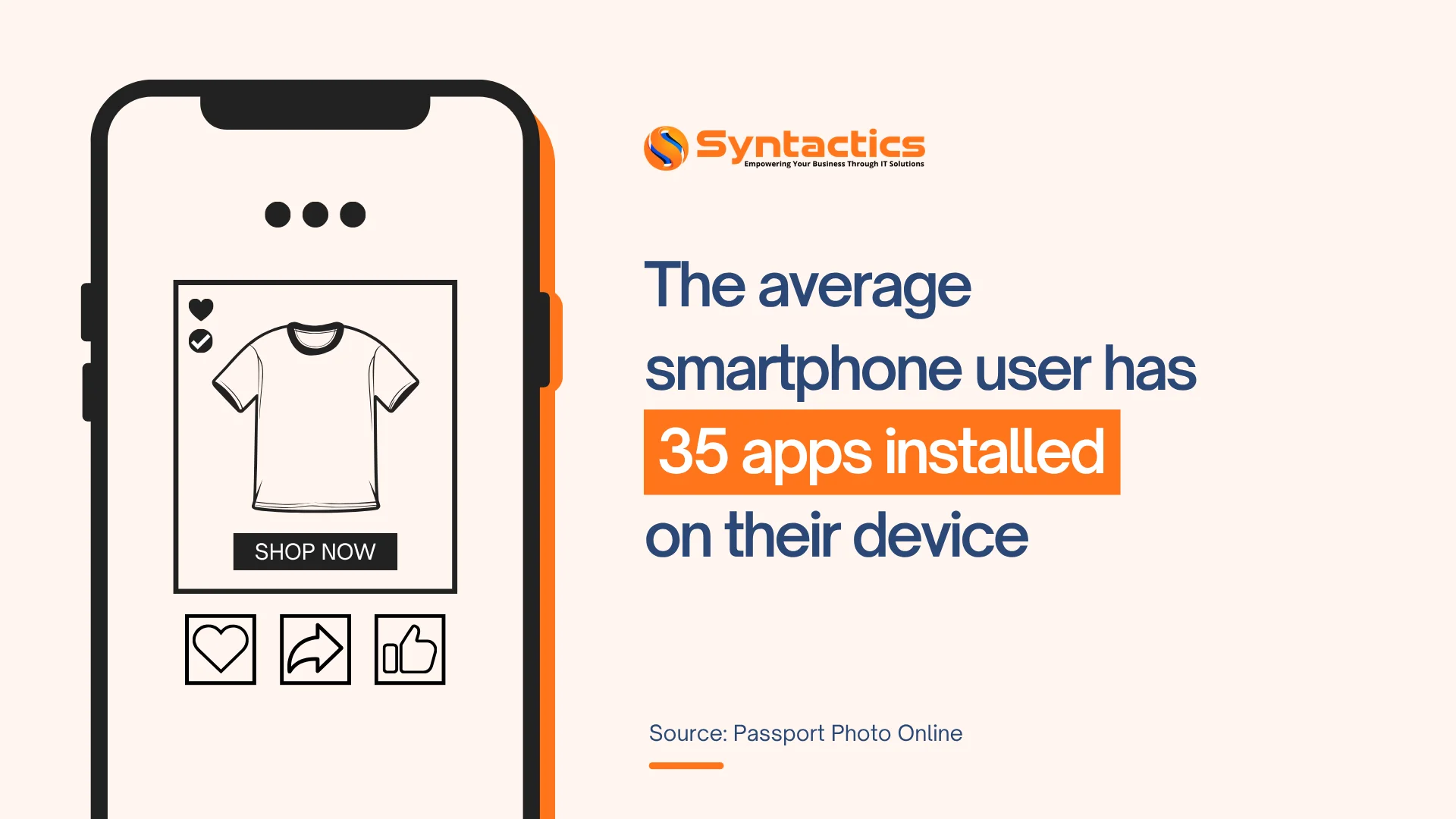
Source: Passport Photo Online
Common Challenges Businesses Need To Anticipate
While cross-platform mobile app development improves efficiency and reduces duplication, it also introduces technical trade-offs that need to be managed early in the development process. These challenges are not deal-breakers, but they require careful planning to avoid performance and scalability issues later.
Common challenges include:
- Performance limitations in graphics-heavy or real-time applications
- Dependence on third-party libraries for certain native functions
- Increased debugging complexity due to abstraction layers
- User interface (UI) inconsistencies across different operating systems
To address these challenges effectively, start with strong architectural planning before writing a single line of code. Begin by defining modular structures so each feature can scale independently without affecting the rest of the system. From there, use reusable components to reduce redundancy and make long-term maintenance easier.
Also, optimize API design early to prevent performance bottlenecks as usage grows. Finally, plan native integrations only when they’re truly necessary to avoid adding unnecessary complexity to your app.
Best Practices for Scalable Mobile App Development
To maximize ROI from cross-platform app development, you need structured and disciplined execution. Scaling successfully depends on how well you design, optimize, and maintain your application from the start.
- Build a modular architecture so each feature functions independently, allowing you to scale or update without breaking other parts of the system.
- Prioritize performance optimization early by using lightweight components and efficient data handling to improve speed and responsiveness.
- Enforce consistent coding standards across teams to maintain code quality.
- Implement automated testing and Continuous Integration (CI) or Continuous Delivery/Deployment (CD) pipelines to validate every update before release and reduce production risks.
From Development to Deployment: What Businesses Need to Know
Deployment is where your execution quality directly determines product success. After all, even a well-built app can fail if releases are unstable or poorly managed, so your focus needs to shift toward reliability and control.
With 96.9 billion app downloads recorded globally in 2025 (Business of Apps), the competition for user attention is intense. This makes stable releases, fast updates, and consistent performance across platforms important for retaining users and staying competitive.
That said, implement continuous integration pipelines that automatically test your app across different operating systems and devices before every release. This helps you catch bugs early and maintain stability.
Next, use staged rollouts to gradually release updates, reducing risk while collecting real-world user feedback. With cross-platform mobile app development, you can deploy updates simultaneously across Android and iOS, preventing version fragmentation.
Working with a reputable mobile application developer in the Philippines also helps streamline release management, monitoring, and post-launch optimization. After deployment, track crash analytics, user retention, session duration, and feature engagement to continuously refine performance and improve user experience.
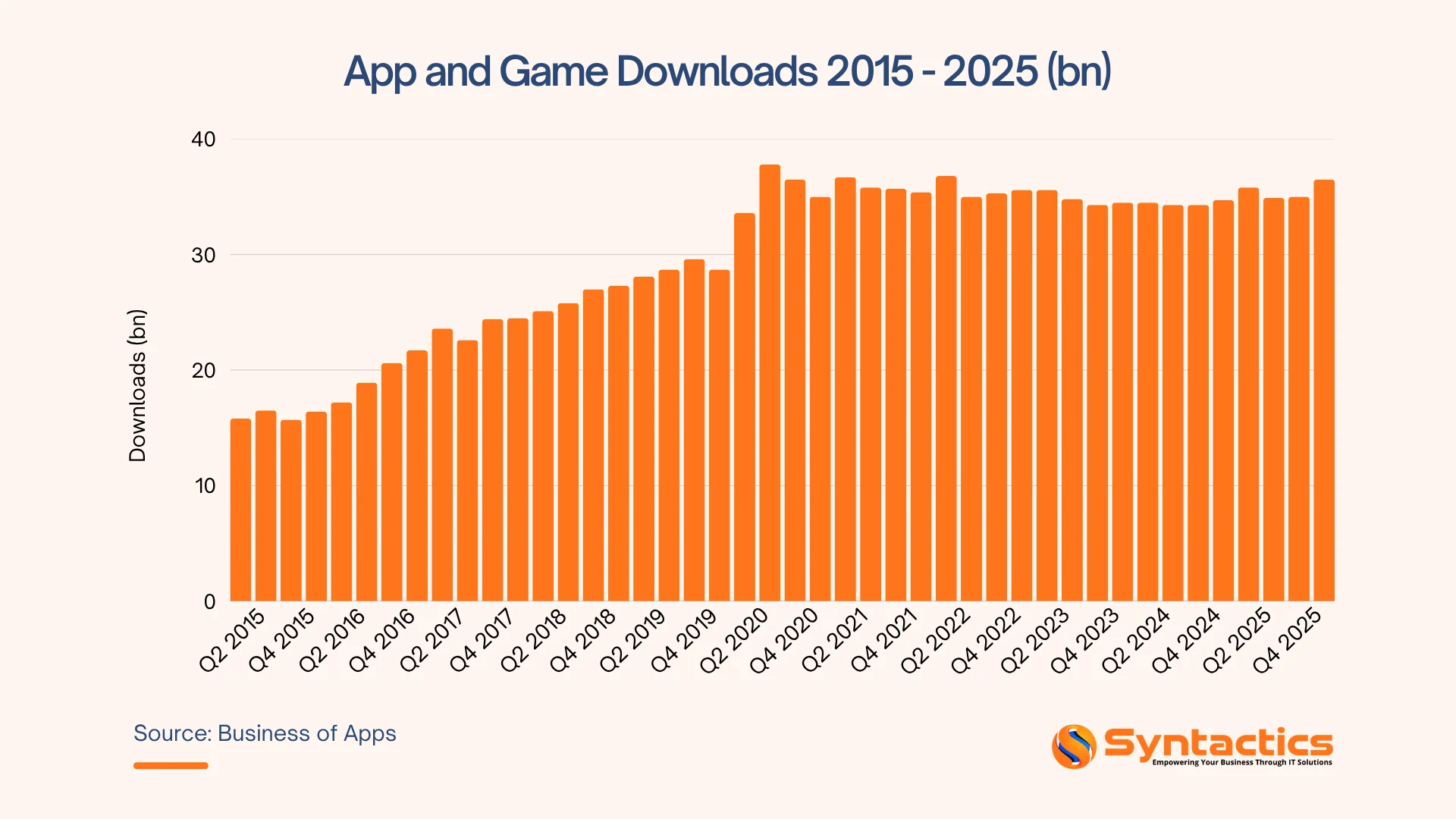
Source: Business of Apps
Conclusion
You operate in a market where speed, efficiency, and user experience directly impact growth. As such, cross-platform mobile app development gives you a practical way to reduce costs, accelerate delivery, and maintain consistent performance across iOS and Android without doubling your resources.
To execute this strategy effectively, get access to proven expertise in mobile app development in the Philippines from Syntactics, Inc. Our team helps you design scalable architectures, optimize performance, and manage deployments with precision. So, you can build smarter, launch faster, and take control of your mobile ROI today!

FAQs About Cross-Platform Mobile App Development
What is React Native?
It’s an open-source framework developed by Meta Platforms that enables you to develop mobile apps using React and JavaScript. This way, you can create apps for Android and iOS with a single codebase.
How does cross-platform development affect long-term scalability?
It supports scalability when properly architected. Modular design ensures features can grow without affecting system stability.
What industries benefit most from cross-platform development?
E-commerce, fintech, healthcare, and logistics benefit the most due to frequent updates and multi-device usage.













Comment 0