

Google’s Main Content Criteria Add a New Layer to E-E-A-T
Google just updated its helpful content guidelines with new details about main content quality and how Search Quality Raters assess it. Main content includes anything on a page that helps achieve its purpose. Google highlights four key attributes for main content: effort, originality, talent or skill, and accuracy.
Google made the change without an announcement, so staying current with these guidelines is essential. This article explains what changed, what each criterion means, and how you can update your pages now.
Key Takeaways
- Google says main content quality is one of the most important factors for judging a page’s quality.
- Main content includes text, media, interactive tools, user contributions, tabbed sections, titles, and headings.
- Raters look at effort, originality, talent or skill, and accuracy.
- If you publish a lot of generative AI text without reviewing it, Google considers that little to no effort.
What Changed in Google’s Guidance
Google updated its helpful content guidance and added two items.
- First, the guidelines now say that main content quality is one of the most important factors in the Search Quality Evaluator Guidelines.
- Second, there is now a full section that defines main content and lists the attributes raters use to judge it.
E-E-A-T is still part of Google’s guidelines, and trust remains the most important factor.
Google also released new guidance about AI-generated content, recommending manual fact-checks and reviews of AI output. It’s unclear if this update is related to the September 2026 spam update, but you should follow the guidance either way.

What Counts as Main Content
Google defines main content as anything on a page that directly helps the page achieve its purpose. What counts as main content depends on the page’s intent and can fall into five types:
- Primary text and media, such as articles, images, audio, and video.
- Interactive features, including calculators, online tools, games, and on-site search.
- User-generated contributions like forum discussions, reviews, and comments, when they serve the page’s purpose.
- Tabbed or expanded sections holding product specifications, safety notes, or reviews.
- Visible page titles and headings.
Content in tabs and expanded sections can be main content if it directly helps the page achieve its purpose. Headings also count. Google wants your title to describe the content clearly and avoid exaggeration or shock value. Vague or sensational headings make your main content weaker.
4 Attributes Raters Evaluate
Raters use four attributes to judge main content. Effort and originality look at the work and information behind the page. Talent or skill and accuracy show how well the page serves visitors. Review each of your important pages using all four attributes.
1. Effort
Effort measures the human work that goes into the content or the systems that create it. Examples of high effort include original analysis, translating a poem by hand, or building a custom interactive map for a game show. These show:
- Pages generated automatically from feeds score low.
- Large-scale generative AI text published without oversight or curation scores low too.
- Credit to other sources doesn’t replace original work. A page quoting ten studies still needs your own analysis.
2. Originality
Originality means your page offers information or perspectives that aren’t available on other sites. To check, search your target query, look at the top five results, and list what your page offers that’s unique.
- First-hand test results, proprietary data, client outcomes, and named expert commentary pass.
- A reworded summary of those five pages fails.
Say, a B2B comparison page is more valuable if you include your own pricing tests and client results, rather than just rewriting a list of features.
3. Talent or Skill
Talent or skill means the content shows you can give visitors a good experience. Google mentions clear writing, well-made videos, and working page tools. Not every topic needs credentials. For example, someone sharing a new way to clear snow from a driveway shows skill. Match your expertise to your topic.
4. Accuracy
Accuracy matters for every informational page. For topics like health, finances, safety, or societal welfare (called YMYL topics), you need high accuracy and agreement with expert consensus. Google also warns against obvious factual errors. Always check every statistic, date, and claim before you publish.
Why Rater Criteria Still Matter for Your Pages
Google says rater data doesn’t go directly into its ranking algorithms. Instead, rater feedback helps Google check if its systems give good results. So, use these criteria to review your own pages.
Rater guidelines also help you review your content and make sure it matches what Google’s automated systems look for. Effort, originality, talent or skill, and accuracy are four clear things to check.
You won’t get a score for these attributes. Instead, review your pages yourself and compare them to the top results for your target query. Look for ways to add more effort, original information, and reduce errors. Rewrite pages that fall short first.
Unreviewed AI Text Counts as Little to No Effort
The effort criterion targets one main workflow: creating lots of text with generative AI and publishing it without review. Google considers this little to no effort, and its spam policies are even stricter. If you use automation mainly to manipulate rankings, you could violate the scaled content abuse policy.
What the Data Shows
A 16-month experiment found that over 28% of unedited AI-generated pages ranked in Google’s top 100 in the first month. After three months, only 3% were still in the top 100.
Semrush’s data shows a clear gap at the top position. While the study doesn’t prove that all AI-assisted content does poorly, it does show a difference between unedited AI output and content that includes human expertise, review, and original input.
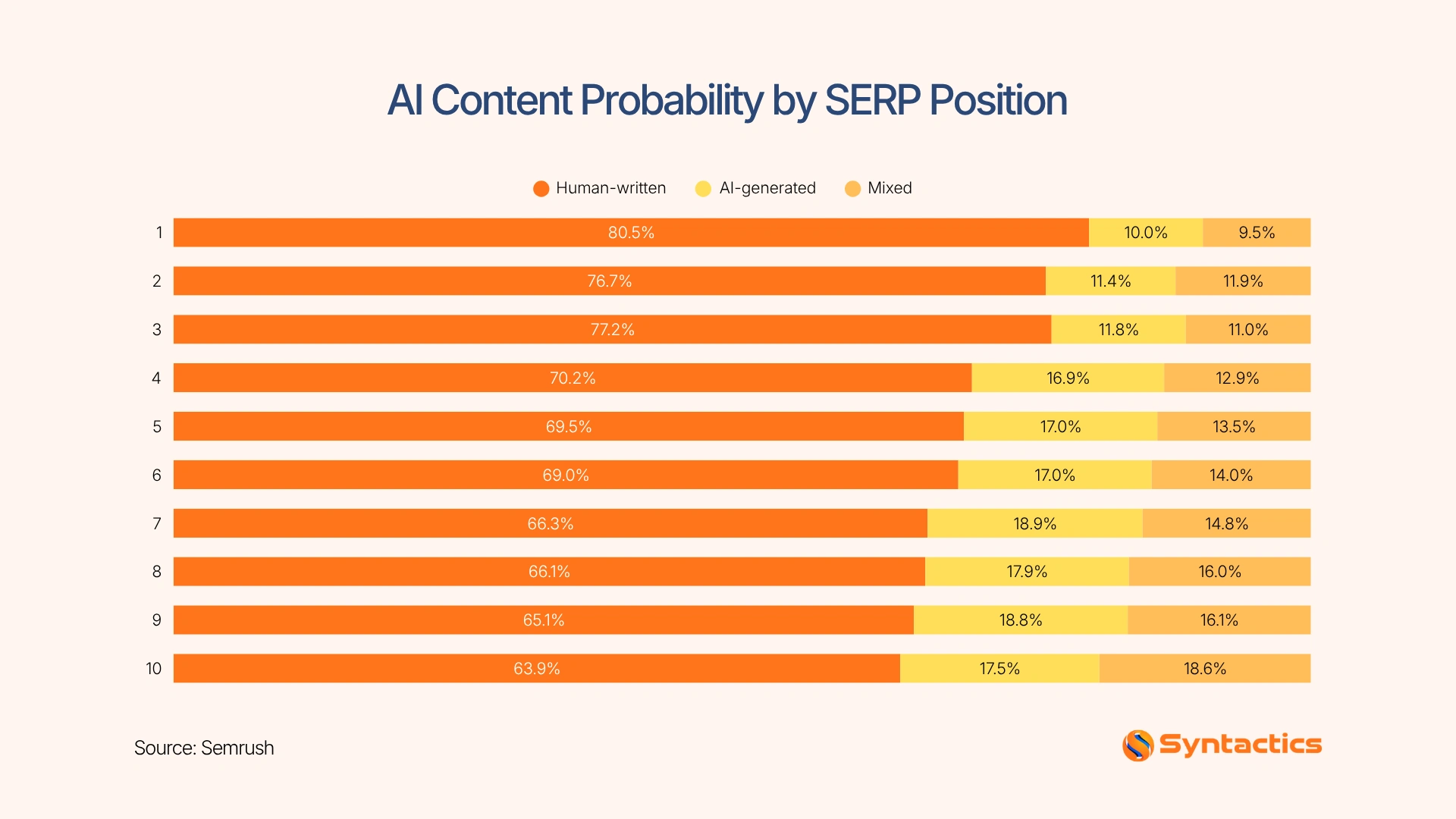
Source: Semrush.
Google’s guidance makes it clear that human oversight and curation are key. Publishers should keep track of how AI is used in their workflow and make sure people are responsible for the accuracy, usefulness, and trustworthiness of the final page.
How to Audit Your Pages: Step-by-Step Process
To get started, review your 20 highest-traffic informational pages. Follow these steps in order.
- Write one sentence stating the page’s purpose. Name what a visitor should achieve.
- List every main content element, such as text, media, tools, reviews, tabs, and headings. Remove anything that doesn’t serve the page’s purpose.
- Evaluate the effort involved. Note who created the content, which systems produced the draft, and what kind of human review was done.
- Add at least one original element to each page, like your own test results, internal data, or a quote from a named expert with credentials.
- Fact-check every claim and link each statistic to a primary source.
- Rewrite your headings so they clearly describe the content. Avoid exaggeration.
- Add a clear byline and link to a real author or contributor page if authorship helps readers judge the content. Never make up credentials, experience, or author profiles.
Pro tip: Start by reviewing pages that have lost traffic. Google recommends checking which pages dropped and for which searches, then comparing those pages to the four attributes.
Make Main Content Your Quality Standard
Google’s update gives you a clear standard for main content. Effort, originality, talent or skill, and accuracy decide if a page gives visitors a good experience. Pages with original work, verified facts, and clear authorship meet the standard and give AI answer engines content worth citing.
If your priority pages need a closer quality review, Syntactics can help assess their content, structure, sourcing, and technical implementation. Our SEO services in the Philippines cover content audits, rewrites, and technical fixes. The goal isn’t simply to satisfy a new checklist. It’s to make each page more useful, accurate, original, and satisfying for the people who visit it.

Frequently Asked Questions
What is the main content in Google’s guidelines?
Main content is anything on a page that directly helps it achieve its purpose. Google includes primary text and media, interactive features such as calculators, user-generated content like reviews, tabbed or expanded sections, and visible titles and headings. For example, a product page, a forum thread, and a calculator page each have different main content.
Does main content replace E-E-A-T?
No. Google’s main-content criteria are an extra way to assess page quality. E-E-A-T is still part of Google’s guidance, with trust as the most important part. Main-content criteria focus on whether the page’s core content serves its purpose through effort, originality, skill, and accuracy. Use both frameworks together.
Do quality raters change my rankings?
No. Raters review pages as part of Google’s search-quality process, but they don’t control rankings. Google uses their feedback to check if its systems produce good results. Their criteria still give you a useful checklist for reviewing your own pages.
Does AI-generated content break the new criteria?
There’s no rule against AI-generated content. But if you publish large amounts of AI text without real oversight or curation, it can count as little or no effort. Using automation mainly to manipulate rankings can break Google’s scaled content abuse policy.
Review every AI-assisted draft, add your own original information, fact-check important claims, and make sure someone is clearly responsible for the final content.

About Jalou Batilong
Related News:

How to Disavow Spammy Links: Step-by-Step Guide



Why Keep Your Antivirus Software Updated?

Choosing The Best Web Hosting Plan For Your Website







Comment 0