

Scrum Master vs. Project Manager: Which One Do You Need?
Choosing the right person to lead your IT project can make or break its success. Two roles often come up in this conversation: the Project Manager (PM) and the Scrum Master (SM). While they may appear similar on the surface, they operate from fundamentally different playbooks.
This isn’t just a matter of titles. These two roles differ in philosophy, methodology, team structure, and day-to-day responsibilities. If you’ve ever asked “Do I need a Project Manager or a Scrum Master?,” this guide will help you answer that clearly.
What Is a Project Manager?
A Project Manager is the central authority on a project. They plan, coordinate, and oversee every aspect of delivery, from scope definition and resource allocation to stakeholder communication and risk management.
In traditional project environments (often called Waterfall), the PM owns the project’s outcome. If the project succeeds, the PM gets credit. If it fails, the PM takes accountability. This concentrated responsibility is both the strength and the pressure point of the role.
Core Responsibilities of a Project Manager
- Define project scope, milestones, and deliverables
- Build and manage project timelines using tools like MS Project, Jira, or Asana
- Monitor budget and resource allocation
- Report project status to stakeholders and leadership
- Manage risks, issues, and changes to project scope
- Coordinate across multiple teams or departments
- Ensure final delivery meets client requirements
Project Managers are results-driven by nature. They prioritize hitting deadlines and staying within budget, and they’re willing to make tough calls, like reassigning underperforming team members, to protect the project’s outcome.
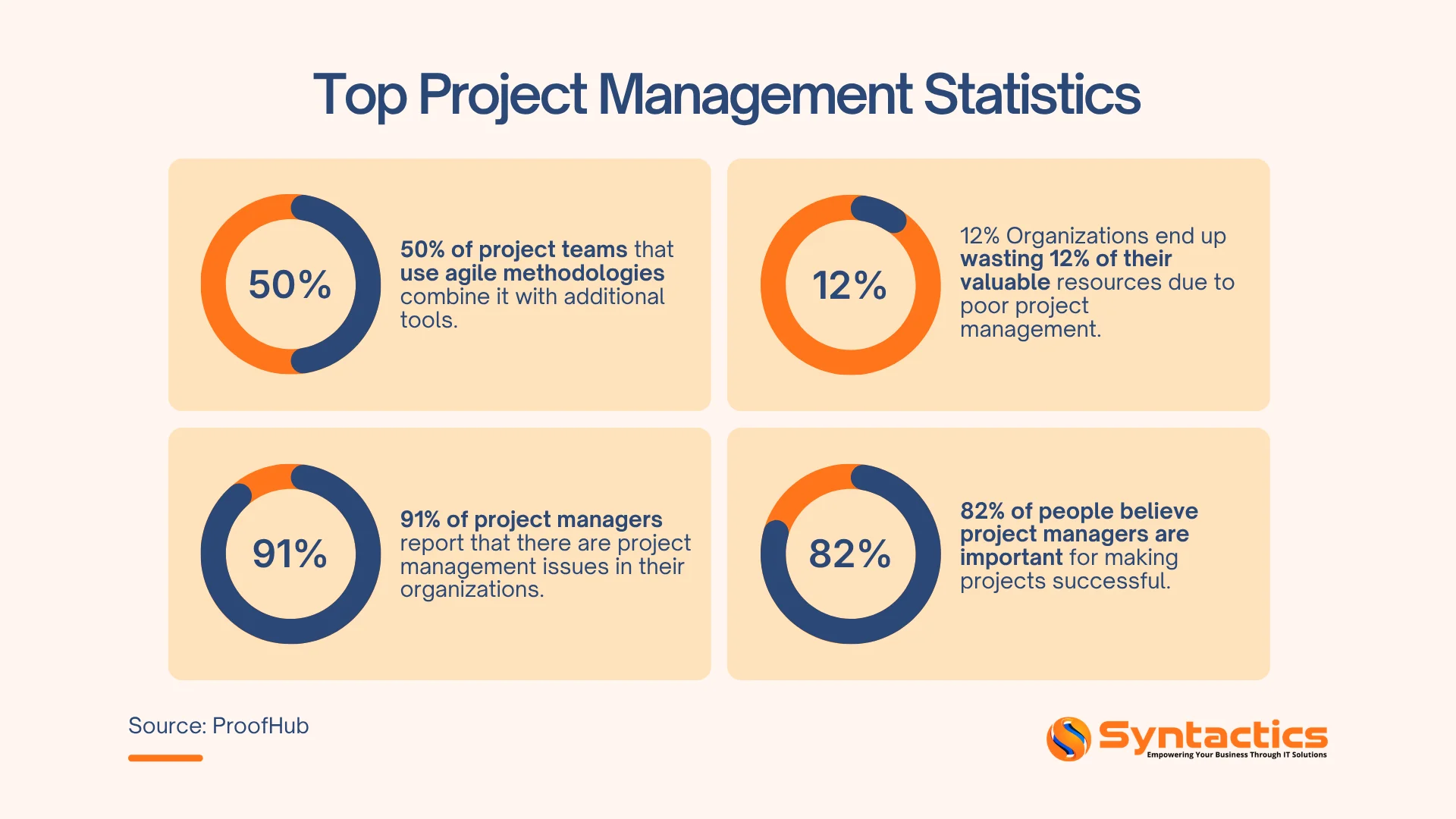
Source: ProofHub.
What Is a Scrum Master?
A Scrum Master is not a manager in the traditional sense. They are a facilitator, coach, and protector of the Scrum process, a framework within the broader Agile methodology designed for iterative, collaborative development.
Where a Project Manager directs, a Scrum Master enables. Their job is to remove obstacles and run Scrum ceremonies (like daily standups and sprint reviews). They also coach both the development team and the Product Owner on how to work within the Scrum framework effectively.
Core Responsibilities of a Scrum Master
To the Development Team:
- Facilitate daily standups, sprint planning, sprint reviews, and retrospectives
- Identify and remove blockers that slow the team down
- Coach the team on Scrum principles and Agile best practices
- Protect the team from outside distractions and scope creep
- Foster a culture of continuous improvement
To the Product Owner:
- Help refine and prioritize the product backlog
- Ensure clear communication of product goals to the development team
- Assist in writing effective user stories and acceptance criteria
- Help the Product Owner understand how to maximize product value
To the Organization:
- Advocate for Agile adoption across departments
- Lead change management efforts during Agile transformation
- Educate stakeholders on Scrum values and the sprint process
Summary Table: How Teams Benefit from Scrum
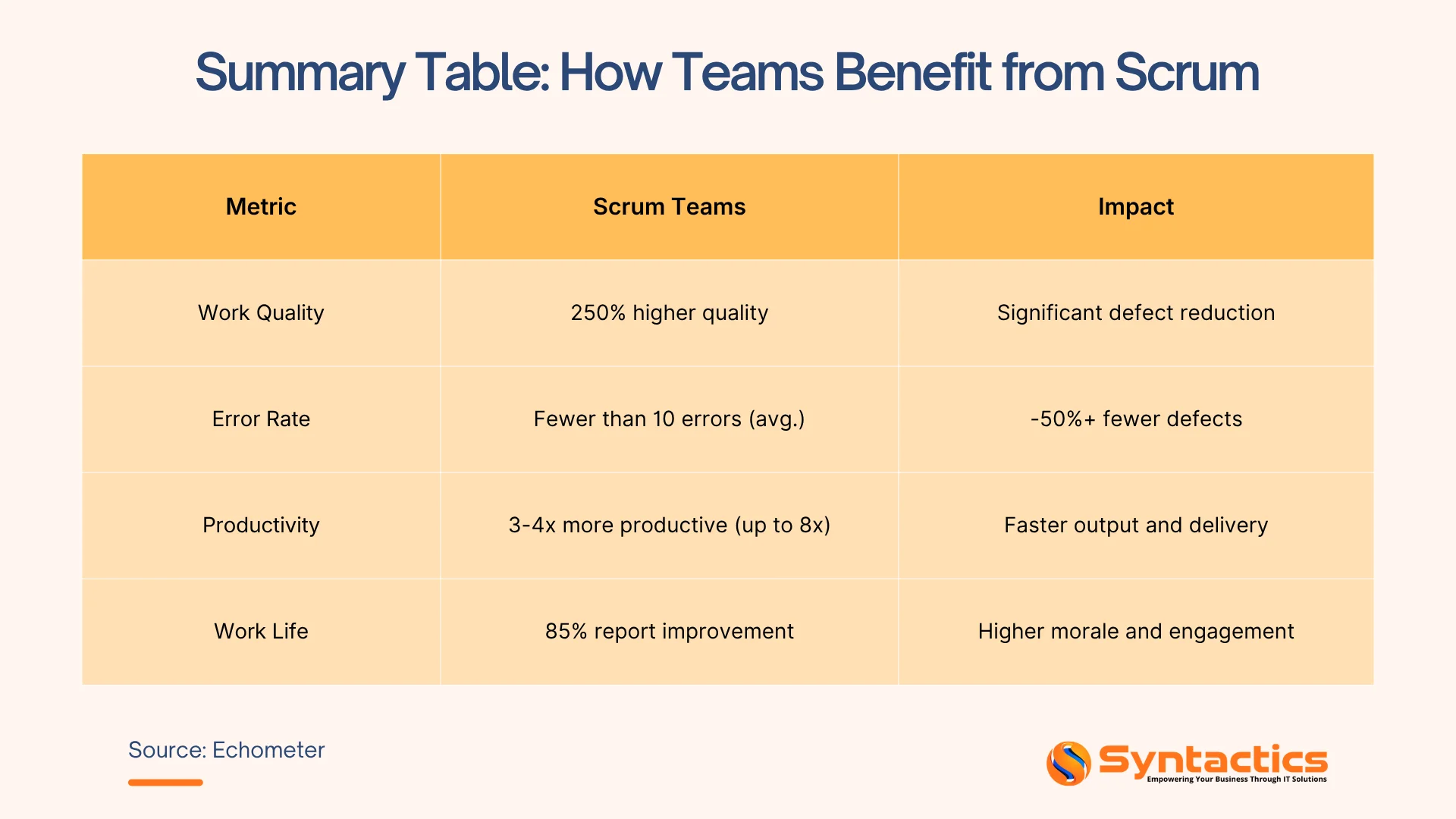
Source: Echometer.
Scrum Master vs Project Manager: Key Differences
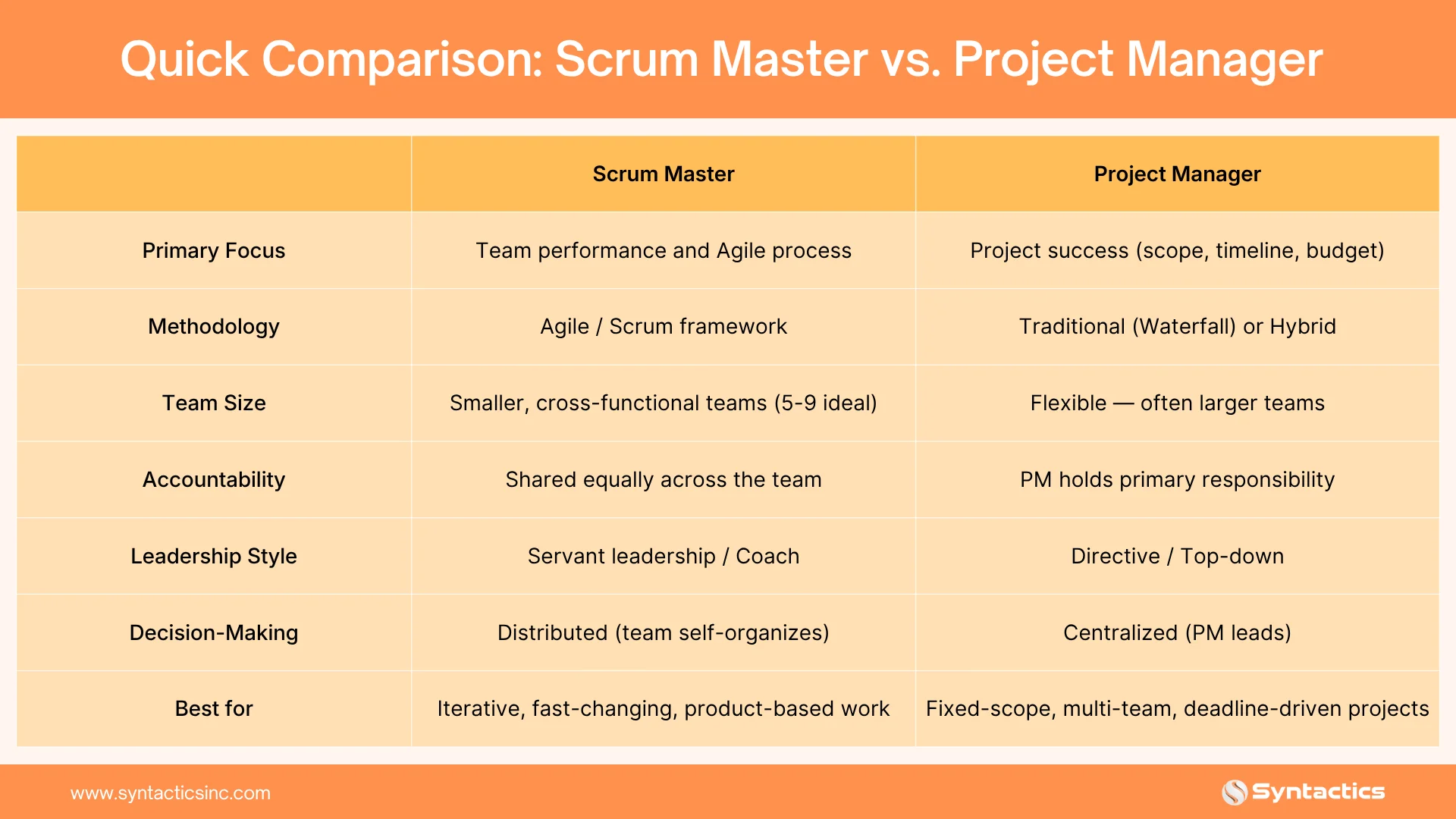
Focus: Project vs. Team
The most fundamental difference comes down to what each role is accountable for.
A Dedicated Project Manager‘s primary commitment is to the project, hitting the agreed scope, budget, and timeline. Everything revolves around delivering the defined outcome.
A Scrum Master‘s primary commitment is to the team, building a healthy, high-performing unit capable of delivering great work consistently. They believe that if the team functions well, great outcomes follow naturally.
Leadership Style: Authority vs. Servant Leadership
Project Managers operate with authority. They assign tasks, approve decisions, and are often the single point of contact for stakeholders. Their influence is positional.
Scrum Masters practice servant leadership, a model where the leader’s role is to serve the team. They don’t assign tasks. They don’t tell developers how to write code. Instead, they ask: What does this team need to do their best work?
Methodology: Waterfall vs. Agile/Scrum
Project Managers have traditionally worked within Waterfall environments, where projects follow a linear sequence: requirements → design → build → test → deliver. This works well when requirements are well-defined and unlikely to change.
Scrum Masters operate exclusively within Agile/Scrum, where work is broken into short cycles called sprints (typically 1–4 weeks). Teams build, test, and review incrementally, allowing for regular feedback and course corrections.
Team Size and Structure
Project Managers are comfortable scaling to large, multi-team projects. They’re built for complexity and cross-functional coordination.
Scrum Masters thrive with smaller, focused teams. The Scrum Guide recommends teams of 10 or fewer members: small enough for tight communication and shared accountability, large enough to deliver meaningful work each sprint.
Accountability Model
In a PM-led project, accountability flows upward. The PM is responsible for outcomes.
In a Scrum team, accountability is shared. Every team member, including the developer, tester, designer, owns the sprint’s success. The Scrum Master doesn’t take the blame when a sprint fails; instead, the team reflects together in a retrospective and adjusts.
When You Need a Project Manager or a Scrum Master
Choose a Dedicated Project Manager when:
- The project has a fixed scope, fixed budget, and hard deadlines
- You’re managing multiple teams, departments, or vendors simultaneously
- Stakeholder reporting and formal documentation are required
- The project follows regulatory or compliance requirements
- You’re running a one-time, defined initiative rather than an ongoing product
Choose a Scrum Master when:
- Your team is building a software product iteratively
- Requirements are expected to evolve based on user feedback
- You’re adopting or scaling Agile within your organization
- Team collaboration, velocity, and morale need improvement
- You want a culture of continuous delivery and continuous improvement
Can One Person Be Both?
Yes but with considerations.
Some organizations hire a PM/Scrum Master hybrid, especially in smaller companies or early-stage teams where headcount is limited. However, the philosophical conflict between the two roles can be challenging. A PM’s instinct to control and direct can undermine the Scrum Master’s goal of building a self-organizing team.
If budget allows, separating the roles tends to produce better results. If you need one person to cover both, look for candidates with strong Agile training and clear guidelines on when to wear each hat.
The choice between a Scrum Master and a Project Manager ultimately depends on how your work is structured.
 Make the Right Call for your Project
If your priority is control with clear scope, fixed timelines, and budget certainty, a Project Manager is the right fit. The focus is delivery predictability and end-to-end accountability.
If your priority is adaptability with iterative development, evolving requirements, and stronger team performance, a Scrum Master is more aligned. The focus shifts to enabling the team to deliver value continuously.
Many organizations use both, but clarity matters. When roles overlap without definition, execution slows down instead of improving. The key question is simple: are you optimizing for control of the project, or momentum of the team?
If you need both structure and agility working together, hire a dedicated development team from the Philippines that combines the right mix of project leadership and Agile execution tailored to your delivery goals.

This article was updated on April 23, 2026.
Frequently Asked Questions
Can a Scrum Master manage a budget?
Generally, no. Budget management is within the Project Manager’s domain. A Scrum Master focuses on team processes, not financial oversight.
Which role is better for software development?
For iterative software development with evolving requirements, a Scrum Master is typically more effective. For fixed-scope software projects with external clients and hard deadlines, a Project Manager is often better suited, or a hybrid approach combining both.
Is a Scrum Master above or below a Project Manager?
Neither. They are separate roles with different areas of responsibility. In organizations running both, they typically operate in parallel and collaborate rather than report to one another.

About Ladymieh Naallatan
Comment 1
1 Comments
Leave a comment
Related News:




Creating GIFs in Photoshop: A Step by Step Guide






Web Development Services Denver, CO
One of the best posts, I have ever come across. Not only did I learn lot of hidden things but also some technical stuff. Keep uploading and encouraging us.