

SEO Specialist Skills You Need to Look Out For
Search Engine Optimization helps almost every industry, from fashion e-commerce to travel. However, the skills needed have changed a lot since 2022. Now, a strong SEO specialist focuses not only on rankings but also on getting your brand mentioned in AI-generated answers from tools like Google AI Overviews, ChatGPT Search, and Perplexity.
This article covers what those skills look like now.
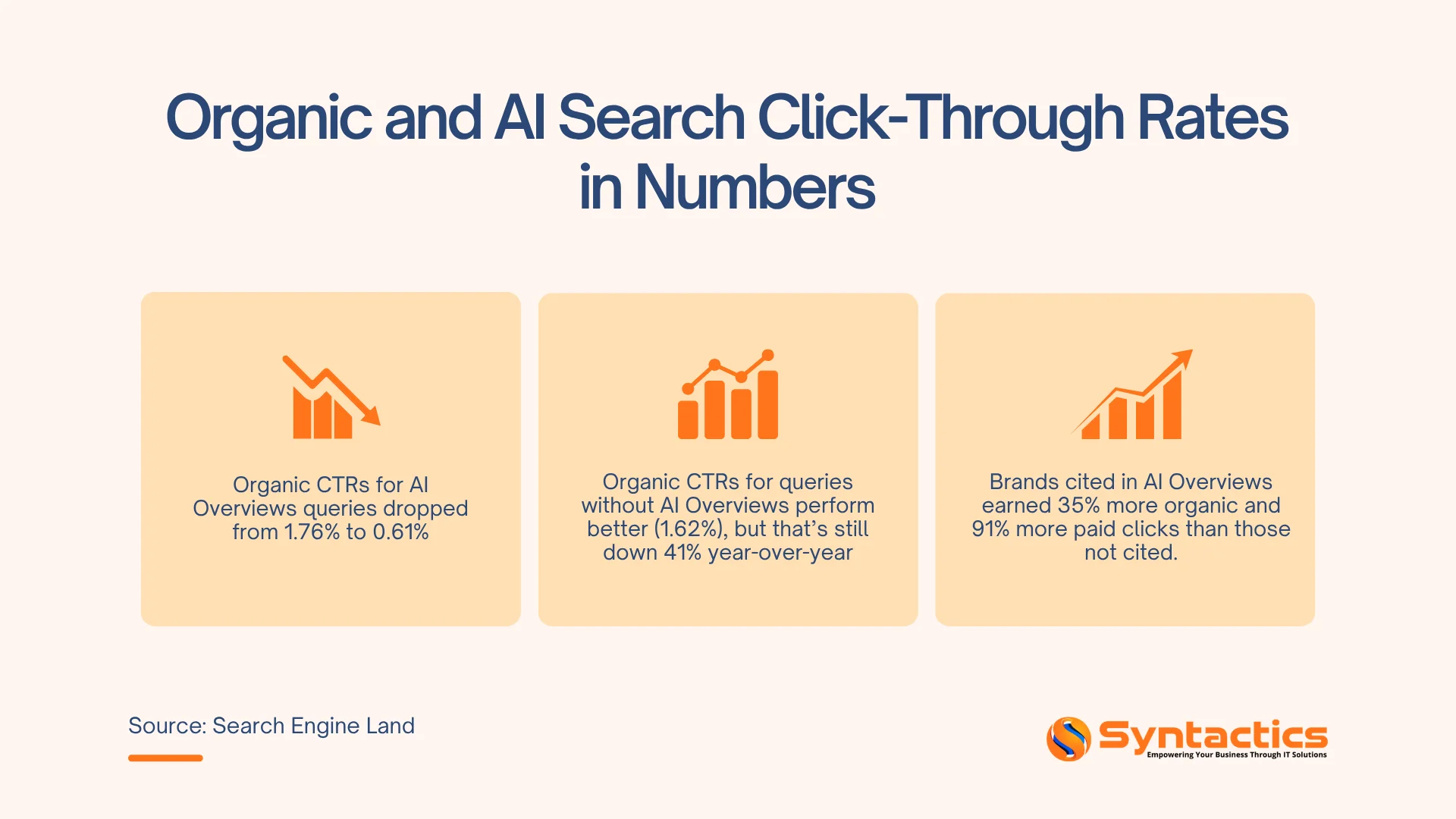
Source: Search Engine Land.
What Can SEO Specialists Do for Your Business?
SEO specialists drive organic website traffic by making your content visible where your audience is searching. That still includes Google’s traditional results pages, but it now extends to AI-powered answer engines that summarize information directly in the search interface.
The first result on a Google SERP still earns a substantial click-through rate advantage over lower positions. But AI Overviews now appear on roughly 45% of Google searches, and they often pull content from pages that rank second or third, not just the top spot. That changes how specialists need to approach both content structure and authority signals.
The right specialist understands both sides of this shift: how to rank and how to get cited.
The SEO Specialist Skills Your Business Needs
Creativity
Every website faces different competition. An SEO specialist needs to learn about your industry, your competitors, and how your audience searches. They should create a strategy based on your situation, not just use a one-size-fits-all approach.
Creativity is important for choosing keywords, finding unique content ideas that attract links, and spotting chances your competitors missed. For example, targeting long-tail keywords (less competitive phrases that match specific needs) often works better than going after broad, high-traffic terms.
Experimentation
SEO is not something you can set up once and leave alone. Search algorithms change, competitors add new content, and search habits shift, so you need to keep adjusting. A specialist who tries new ideas, measures results, and keeps improving is more helpful than someone who never changes their approach.
This is true for AI search as well. What gets cited in Perplexity now might change in six months, so testing is the only way to keep up.
Understanding Analytics
SEO generates a lot of data: traffic by page, rankings by keyword, click-through rates, crawl errors, and Core Web Vitals scores. A specialist needs to read this data, draw correct conclusions from it, and act on those conclusions. Pulling numbers from a dashboard is not the same as understanding what they mean for your strategy.
Modern tools include GA4, Google Search Console, and platforms like Semrush and Ahrefs. Increasingly, specialists also track AI visibility: whether your brand or pages appear in AI-generated answers, and on which platforms.
Conversion Rate Optimization
Traffic only matters if it converts. An SEO specialist should understand how to improve the pages that receive organic traffic, not just how to attract more visitors. This includes page structure, call-to-action placement, load speed, and mobile usability.
Rankings and conversions are linked. User behavior signals, like time on page and bounce rate, affect how search engines and AI systems judge your content.
People Skills and Client Communication
SEO is a long-term process. Organic rankings usually do not change overnight, so it is important to explain this clearly to clients or team members.
A specialist who sets clear expectations, explains results simply, and keeps communication open during slow periods is easier to work with than someone who is technically skilled but does not communicate when results take time.
Modern Skills to Watch Out For
The skills above have been standard for years. The next section covers what’s new in SEO today.
E-E-A-T Strategy and Demonstrated Expertise
Google’s quality guidelines now focus on four signals: Experience, Expertise, Authoritativeness, and Trustworthiness. Experience was added in 2022 and is now one of the hardest signals for AI-generated content to replicate.
A specialist who knows E-E-A-T will review your content for these signals and fix any gaps. They will credit real experts with clear credentials, cite original sources, and show first-hand experience, especially when competitors use only generic summaries.
Right now, this is one of the best ways to beat mass-produced AI content in both regular and AI-powered search results.
AI Literacy and Workflow Integration
Using AI tools is now a baseline expectation in most SEO roles, but the meaningful skill is knowing how to use them for work that actually matters.
That includes:
- Semantic mapping: Understanding the intent behind a search, not just the keyword itself. A query like “how to fix high bounce rate” is about diagnosing a site problem, not just writing an article about bounce rates.
- Predictive analysis: Using AI-assisted tools to identify keyword trends before they peak, so content is ready when demand rises.
- Workflow automation: Offloading repetitive tasks (generating meta descriptions, reformatting content for different formats, internal link audits) so the specialist can focus on strategy and judgment calls that require human input.
Fluency with tools like ChatGPT, Perplexity, Gemini, and AI-enhanced SEO platforms is expected. Knowing which tasks to delegate to them and which to handle manually is the actual skill.

Optimizing for AI Citations (GEO)
Ranking your pages is no longer the only goal. In 2026, appearing in AI-generated answers is its own objective.
Generative Engine Optimization (GEO) is the practice of structuring content so AI systems can extract, trust, and cite it. Practically, that means:
- Writing direct, self-contained answer blocks that work out of context. AI systems extract passages, not whole pages.
- Citing specific data and named sources. Research from Princeton’s 2024 study of Perplexity.ai found that adding statistics and citations increased AI citation rates by 37-40%.
- Adding FAQ sections with questions written in natural, conversational language that matches how people actually ask things.
- Keeping content updated with visible dates and author attribution.
- Ensuring AI retrieval crawlers (GPTBot, PerplexityBot, ClaudeBot, Google-Extended) are not blocked in your robots.txt.
A specialist who understands GEO treats each key page as something that needs to earn a citation, not just a ranking position.

Schema Markup and Structured Data
Schema markup is the structured data layer that tells search engines and AI systems what your content is about. Without it, even well-written content can be misclassified or overlooked by AI crawlers that rely on structured signals to categorize pages.
The most impactful schema types for most business websites include Organization, FAQPage, Service, Article with author attribution, and HowTo for process-based content. Content with proper structured data shows 30-40% higher AI visibility in studies comparing optimized to non-optimized pages.
A specialist who can implement and audit schema across your site is addressing one of the highest-value technical gaps in modern SEO.
Multimodal and Conversational Search Optimization
Search input has expanded beyond typed queries. Voice search, image search (Google Lens, for example), and conversational interfaces all require different optimization approaches.
For voice search, the practical implication is writing content in a conversational register and targeting long-tail phrases that mirror how people speak. “What’s the best way to hire a web developer in the Philippines?” is a voice query; “hire web developer Philippines” is a typed one. Both matter, but they require different content decisions.
For visual search, image optimization goes beyond alt text. File naming, surrounding context, structured data for images, and image quality all affect whether tools like Google Lens can identify and surface your content.
Finding the Right SEO Specialist
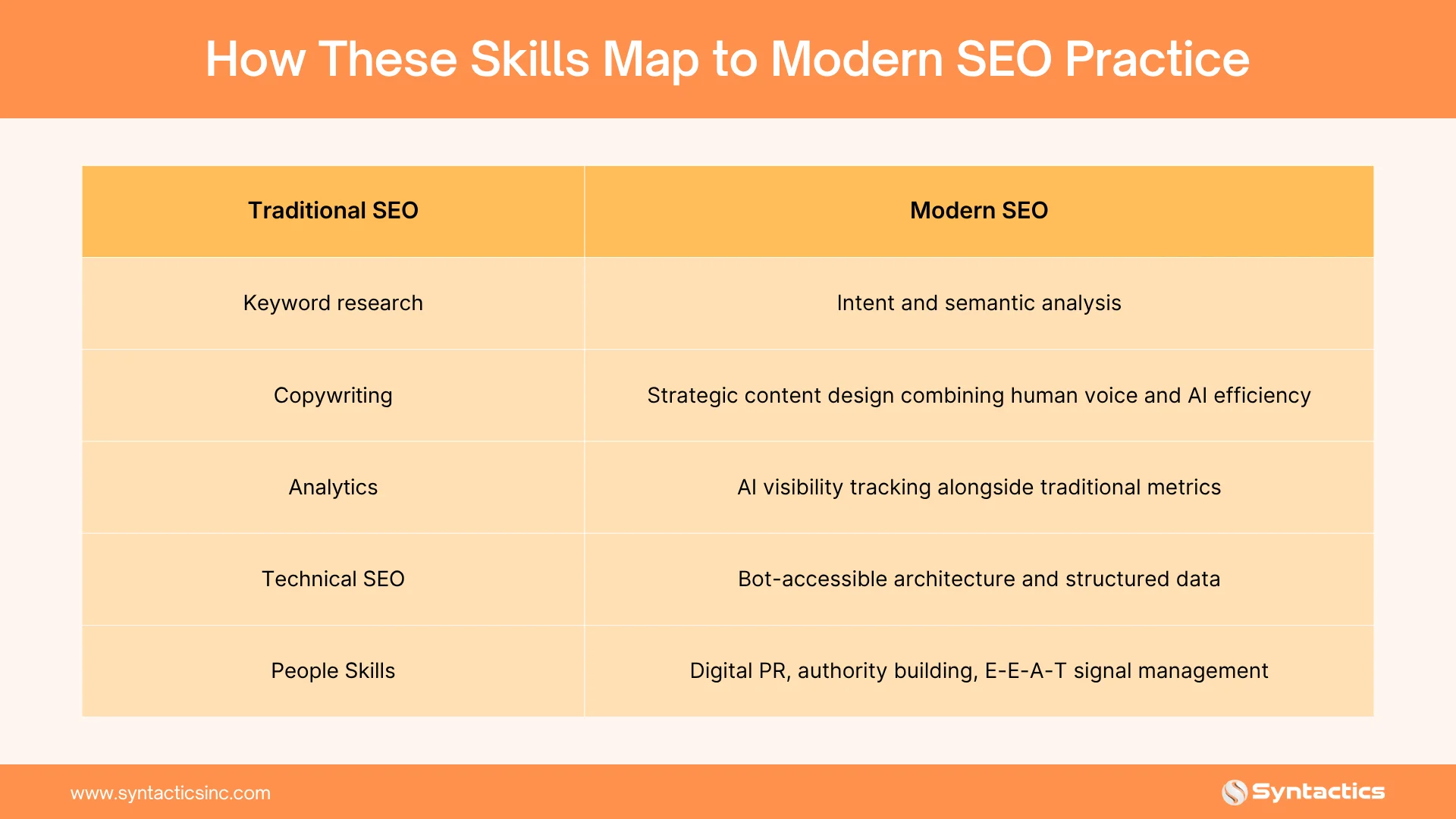
The fundamentals still apply: a good specialist is creative, analytical, technically capable, and communicates clearly. What has changed is the scope of technical SEO to include structured data and AI crawler access, the importance of content credibility signals under E-E-A-T, and the addition of GEO as a distinct practice alongside traditional SERP optimization.
A specialist who understands both sides of search in 2026, traditional rankings and AI citations, can position your business to capture visibility across the full range of how your audience finds information.
Syntactics, Inc. is a trusted SEO company in the Philippines with experience in both areas, helping you build that kind of program for your site.

This article was updated on May 05, 2026.
Frequently Asked Questions About SEO Specialist Skills
Do SEO specialists need to know how to code?
You don’t need to be a developer, but technical skills are important. Modern SEO includes adding schema markup, checking if your site is easy to crawl, fixing page speed issues, and making sure AI bots can reach your content.
A specialist who can read HTML, use JSON-LD structured data, and talk clearly with developers will work faster and spot problems that others might miss.
How long does it take to see results from an SEO campaign?
Most SEO campaigns start to show real progress in organic rankings within three to six months. This depends on your site’s current authority, how competitive your keywords are, and how steady the work is.
Sometimes, AI visibility improves faster, especially if you add structured data or update content on pages that are already indexed and ranking.
Should I hire an in-house SEO specialist or outsource to an agency?
Both have trade-offs. An in-house specialist gets to know your business well and can work closely with your teams every day. An agency or outside team usually has wider experience, more tools, and can adjust the amount of work as needed without extra hiring.
For most businesses that need ongoing SEO with technical, content, and strategy work, outsourcing to an experienced team is often the easiest way to start.

About Jalou Batilong
Related News:

Visual Search & Tips for Optimizing Site Images


Top 2024 eCommerce Website Design Trends




Comment 0