

Software Development Costs and Tips on Reducing Them
Customized Software doesn’t come cheap and for a good reason. Software development project pricing can depend on the scale of your software, the team’s experience building it, and the depth of your requirements. But spending more than necessary is avoidable.
The right planning and the appropriate strategies can keep project costs reasonable without cutting corners on quality. Here are the tips for reducing software development costs.
How to Reduce Software Development Costs
Start with a Plan.
Planning is a key step in business. It reduces mistakes and allows your team to follow your wishes even if you can’t direct the team. In addition, the team should be clear on the tasks needed to complete the project and the cost required. If a team is aware of these things, they become more efficient with resource assignment.
When you know what you want, you can direct resources where they matter most. This focus aids in preventing scope creep and extra costs. Teams work more efficiently, and projects with clear goals are much less likely to go over budget.
Learn the Needs of Your Users.
You manage development pricing better when you understand what your users actually need. Tailoring the project around real user behavior helps you avoid spending budget on features or design elements that add no value. The project hits its mark and fulfills your goals free of unnecessary extras.
One practical approach: involve real users early in the development cycle. Get feedback from a selected group while the product is still being built. That feedback surfaces usability issues before they turn into costly fixes later. It’s far cheaper to adjust a feature during development than to rebuild it after launch.
Rethink Outsourcing as Value-Based Partnership.
Outsourcing software development continues to be one of the most effective ways to control costs. The practice has matured since its early reputation as simple “cheap labor.” In 2026, the focus has shifted toward value-based global partnerships.
According to ISG Index data, the global technology services market reached a record $127.4 billion in 2025. It’s an 18% year-over-year increase driven by organizations committing to longer-term, higher-value engagements rather than short project work.
Moreover, the IT outsourcing market overall is projected to grow from $564 billion to nearly $977 billion by 2031, according to Mordor Intelligence.
The more important shift is how companies outsource. Two models now dominate:
Nearshoring and Specialized Hubs.
Rather than selecting a vendor solely on an hourly rate, companies increasingly choose partners based on technical specialization, cultural alignment, and time-zone proximity.
According to Grand View Research, Latin America has grown into a strong nearshore hub for North American businesses. Its region’s enterprise software market generated $15, 663.2 million in revenue in 2025 and is projected to grow at a 12.7% CAGR through 2030.
Eastern Europe remains the preferred nearshore destination for Western European firms. Nearshoring can reduce development costs by 30–50% compared to fully onshore teams while preserving real-time collaboration.
The Hybrid Model.
Many companies currently structure their teams with in-house core architects who own system design and business logic, paired with outsourced specialized squads that handle execution in specific areas. This structure integrates cost control with tactical oversight.
Research from the MIT Sloan Management Review shows that hybrid outsourcing models deliver 15–20% better project outcomes than fully single-source engagements [via Transition Technologies PSC].
When selecting an outsourcing partner, verify their expertise in AI-assisted development workflows.
Deloitte survey also found that 52% of companies outsource specifically to access AI and machine learning skills they don’t have in-house. Thus, a partner that hasn’t adopted modern AI tooling will cost you more in man-hours than a slightly cheaper rate justifies.
Leverage AI-Assisted Development
The single biggest shift in software development since cloud computing is the role of generative AI and large language models in the coding process itself. Teams that use AI-assisted development tools effectively compress timelines and reduce labor costs for routine work.
Tools like GitHub Copilot, Cursor, and similar AI coding assistants handle boilerplate code, suggest completions, and generate standard scaffolding. Research from Index.dev shows teams save 30–60% of time on routine coding tasks when AI handles standard patterns. This includes test case generation, API endpoint scaffolding, and documentation that consistently returns results.
The benefit is clearest for specific task types. New team members ramp faster with AI assistance. Developers working outside their primary language produce acceptable code more quickly with AI guidance. Entry-level and repetitive tasks see the largest productivity gains.
However, applying AI tools without governance introduces its own costs. Studies show 45% of AI-generated code contains security vulnerabilities such as SQL injection and cross-site scripting.
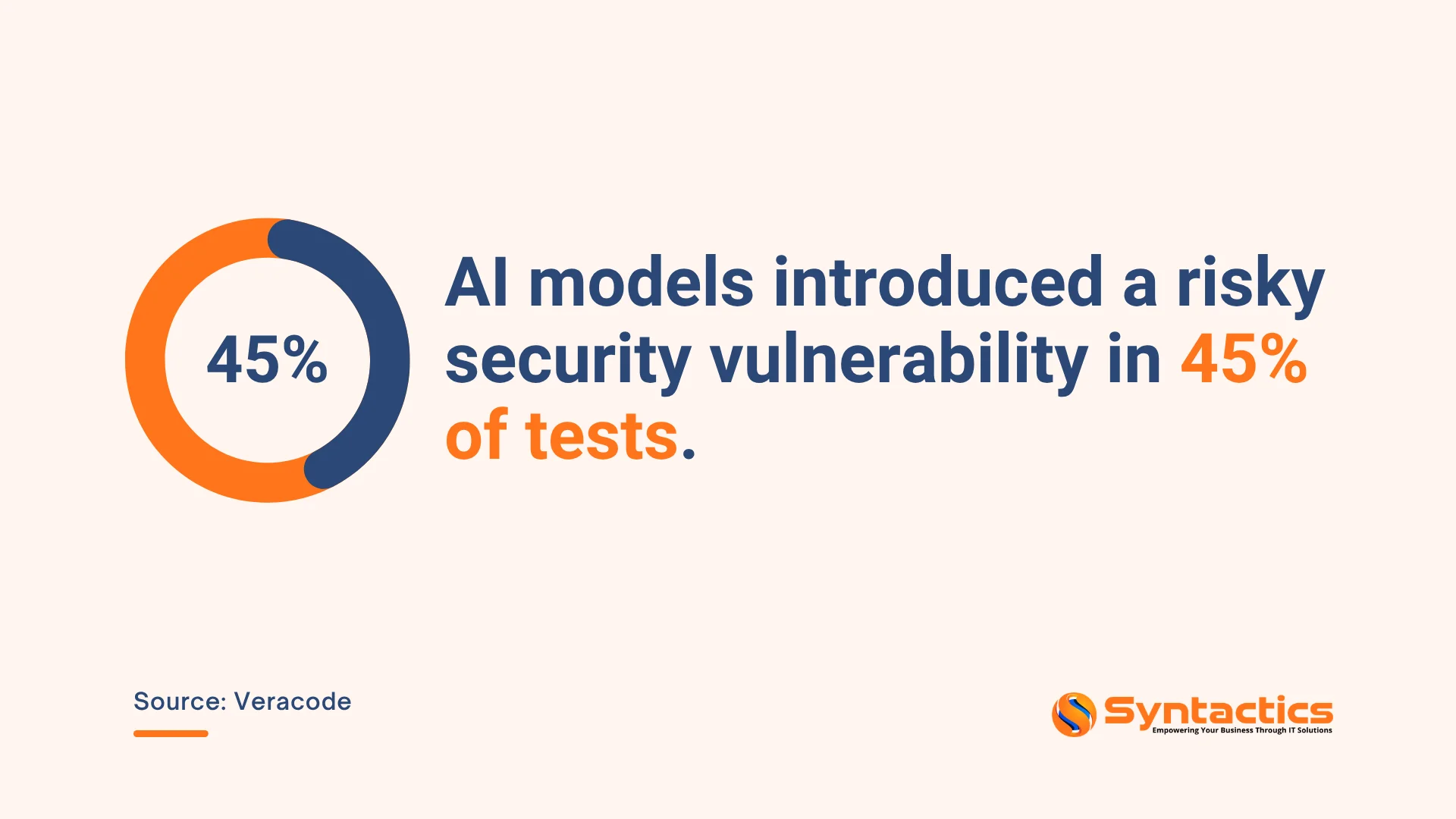
Source: Veracode.
A McKinsey analysis found that the actual gains depend heavily on task complexity and developer experience; and that developers need to prompt for quality, not just output.
The implication for hiring: prioritize developers who understand how to work effectively with AI, not just those who can produce large volumes of code. Prompt engineering skills and code-review judgment are now core competencies for any development team worth hiring.
Finalize and Clarify Requirements.
A watertight set of requirements keeps project pricing predictable. When requirements are vague, developers fill the gaps themselves — sometimes incorrectly, always expensively. Purposeful ambiguity increases the cost of rework and creates friction throughout the project.
Being transparent about requirements saves time and money. Define what the software must do, what constraints it must respect, and what success looks like. Treat requirements as a contract between your team and the development team, not as a starting point for improvisation.
Communicate Throughout the Project.
Communication directly affects project cost. The sooner a feature or iteration gets approved, the sooner the development team moves to the next phase. Delayed responses to clarification requests stall progress and inflate billable hours.
Establish a cadence for progress updates, obstacle reporting, and change requests. When a team member needs input, others can provide it quickly. When an obstacle surfaces, the team addresses it before it compounds. Consistent communication keeps everyone aligned, and alignment keeps costs on track.
Conduct Tests Galore.
Testing is essential to keeping software development costs manageable. Defects found early are significantly cheaper to fix than defects found post-launch. The principle of testing throughout the development lifecycle, not just at the end, is well established. Two newer practices sharpen this further.
Self-healing Test Automation
Traditional automated test scripts break whenever the UI changes, pulling QA teams away from actual testing to fix them. AI-powered self-healing tests detect whether a failure stems from a structural change or a genuine defect, and automatically update the script. Test maintenance stops being a bottleneck.
Shift-left Security (DevSecOps)
Security testing traditionally happens near the end of the development cycle – the worst time to find a problem. Shift-left security moves those checks into the CI/CD pipeline so vulnerabilities surface while code is still being written. The earlier an issue is caught, the cheaper it is to fix.
Focus on the Required Features.
Stick to the agreed-upon requirements. Features beyond what’s needed for the software to function properly should be tabled until after launch and user feedback.
You can’t know whether additional features are worth building until you understand how users engage with the initial version. Starting lean with an MVP keeps costs controlled and gives you real data to justify further development. The initial version isn’t the final version, but a foundation for informed iteration.
Apply Agile Methodology.
The Agile Software Development Method remains one of the most cost-effective frameworks for managing projects. At its core, Agile enables development teams to deliver working software in cycles while responding to changes quickly. Each iteration ends with a review, which produces feedback that drives the next cycle’s priorities.
Agile reduces the risk of building large sections of software in the wrong direction. Catching misalignment early in a sprint costs far less than discovering it after months of work. The method keeps development aligned with actual requirements throughout the project.
Choose Cost-Efficient Technology Stacks.
Technology choices have a direct impact on long-term costs, not just initial development expenses. Today, two approaches deserve priority attention.
Serverless Architectures
Platforms like AWS Lambda, Google Cloud Functions, and Azure Functions eliminate the cost of maintaining idle server capacity. You pay only for actual compute time. This works particularly well for APIs, background jobs, and event-driven workloads where traffic is unpredictable.

Cross-Platform Frameworks
Building separate native apps for iOS and Android doubles both development effort and maintenance burden. Frameworks like Flutter and React Native use a single codebase that deploys to both platforms. For most business applications, the cost savings outweigh any performance trade-offs.
Negotiate Fixed Development and Maintenance Costs
Plan for the software’s full lifecycle, not just the launch. Software requires ongoing maintenance to function correctly and securely. Some vendors increase their pricing after the development phase ends, charging rates different from those agreed upon during the build.
Before engaging a development company, clarify on both development and post-launch maintenance pricing. Both parties should agree on these terms at the start of the engagement. Surprises in maintenance billing are entirely avoidable with upfront negotiation.
Hire a Proactive Team with AI-ready Skills.
The team you hire directly determines project cost. Skilled, proactive developers catch problems early, communicate issues as they arise, and work efficiently within budget. This includes proficiency in AI-assisted workflows.
Developers who use AI coding tools effectively and review generated output critically deliver more per hour. Look for teams with these tools already integrated into their standard process.
Knowledge of relevant frameworks matters too. PHP and Laravel remain solid for web backend work. Proficiency in React Native or Flutter proficiency is a strong signal for cross-platform mobile projects. For AI-integrated products, experience with LLM API integrations and prompt engineering are increasingly important hiring criteria.

Invest in Automated Testing
Automated testing reduces long-term project costs in ways that manual testing cannot replicate at scale. Manual testing is slower, more error-prone, and more expensive to sustain as the codebase grows.
Modern automated testing setups create scripts that run consistently across builds. Combined with the AI-powered self-healing capabilities described above, automated testing reduces the cost of maintaining quality as the software evolves. It also shortens feedback loops, accelerating development cycles and reducing the overall project timeline.
Final Takeaways
Custom software development costs can exceed initial projections when planning is weak, requirements are vague, communication breaks down, or testing gets deprioritized. Each of these failure modes is avoidable. But the strategies above work together to keep costs manageable without compromising the software’s functionality.
A custom software development company in the Philippines, such as Syntactics, can help you navigate these decisions and deliver high-quality software at a price that makes sense for your business.

This article was updated on May 6, 2026.
Frequently Asked Questions
What is the average cost of custom software development?
Custom software development costs vary widely depending on project complexity, team location, and feature scope. A simple MVP typically starts around $10,000–$30,000, while mid-size business applications range from $50,000–$150,000. Enterprise-level builds can exceed $300,000.
The best way to get an accurate estimate is to define your requirements clearly before engaging a development team. Contact us for a tailored quotation.
How can I avoid going over my software development budget?
Start with a fixed scope and resist adding features mid-project. Communicate regularly with your development team, approve deliverables promptly, and conduct testing throughout, not just at the end. Scope creep and late-stage bug fixes are the two most common causes of budget overruns.
Is outsourcing software development cheaper than hiring in-house?
Outsourcing eliminates overhead costs like benefits, equipment, and office space. It also gives you access to specialized skills on demand without long-term salary commitments. The key is choosing a partner based on technical capability and communication quality, not just hourly rate.

About Xenia Labis
Related News:

Best Practices for Designing Accessible Websites

How to Set Up a Meta Pixel

7-Day Portfolio Fix for Businesses Ready to Scale






Comment 0