

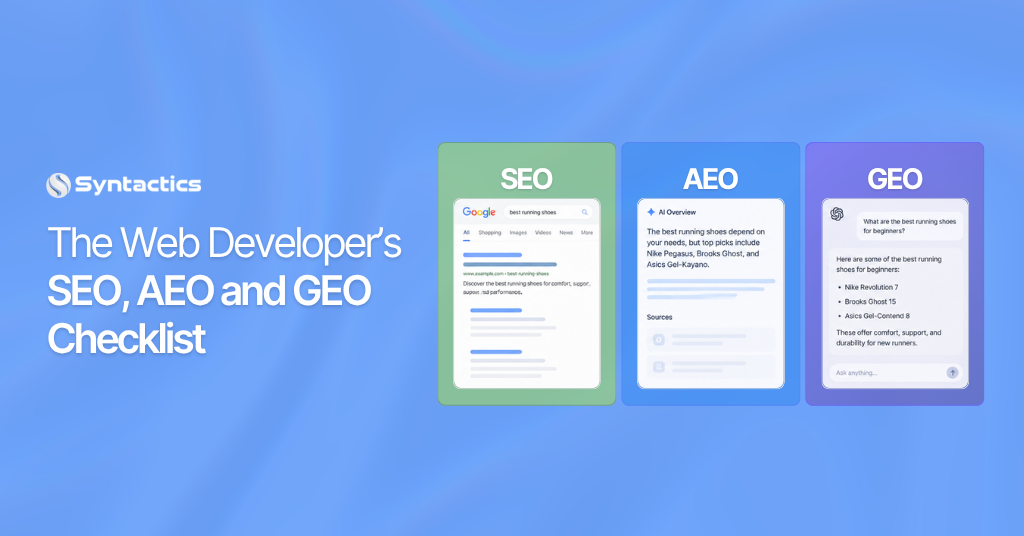
The Web Developer’s SEO, AEO and GEO Checklist
This SEO checklist helps web developers strengthen a site’s technical foundation and improve User Experience (UX) at every stage of development.
Search Engine Optimization and web development work best as connected disciplines. Collaboration between web developers and SEO experts increases website visibility and improves User Experience (UX) by implementing an SEO checklist.
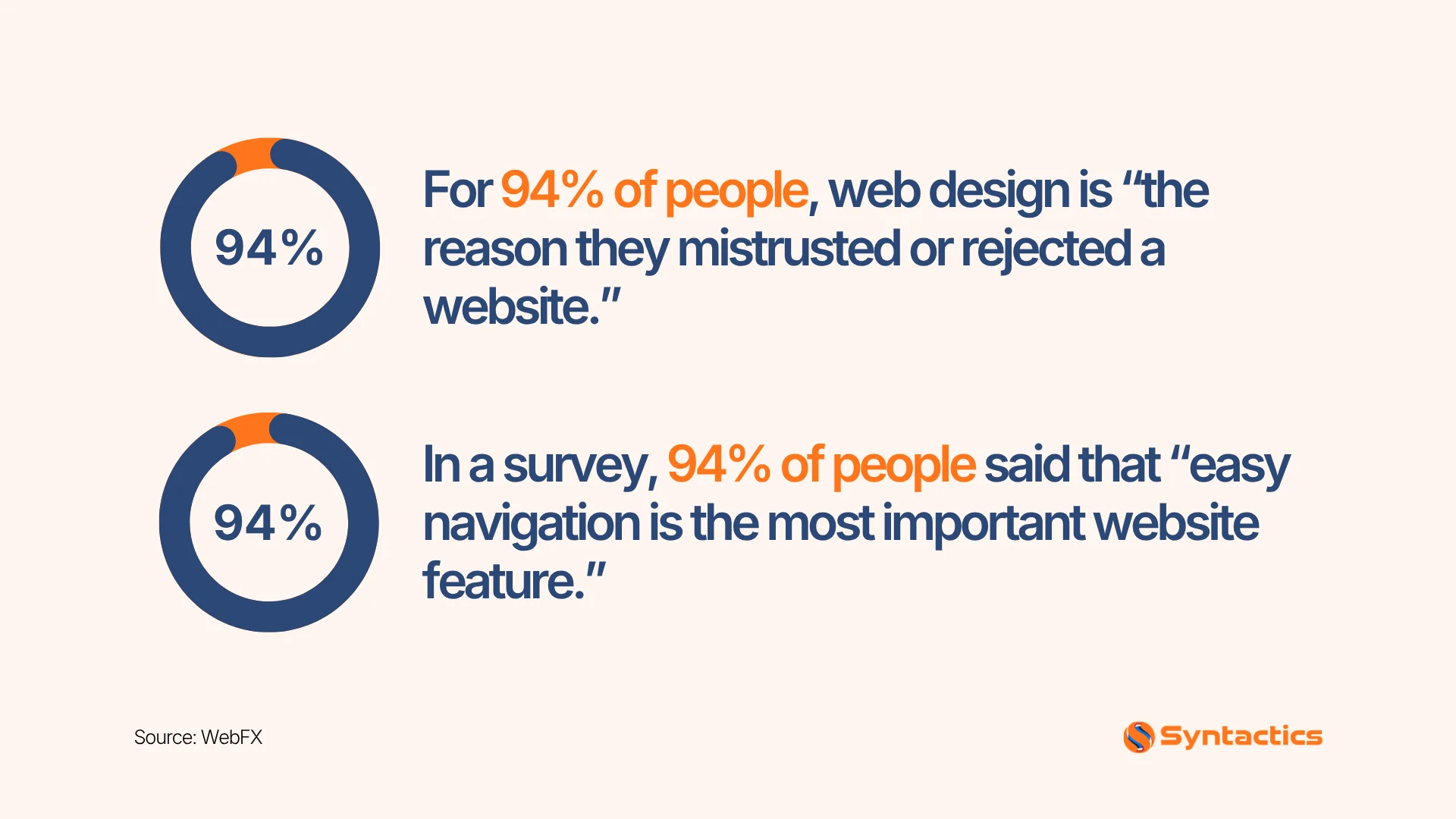
Source: WebFX.
SEO Checklist for Web Developers
Website Architecture and Structure
A well-structured website is essential for effective SEO, increasing a site’s visibility and UX.
Below are key components of website architecture:
Clean, Crawlable Site Links
Website links help users navigate the site from Search Engine Results Pages (SERPs). Google awards websites that follow proper structure with site links.
To improve crawlability, make site links descriptive and include relevant keywords, especially near the beginning of the slug. Use hyphens instead of underscores between words, and avoid special characters, long strings of numbers, and unnecessary parameters.
Mobile-Friendliness (Responsive Design)
These days, most Internet users browse on mobile devices. Additionally, Google ranks websites based on their mobile versions. This highlights the need for mobile-friendly and responsive web design.
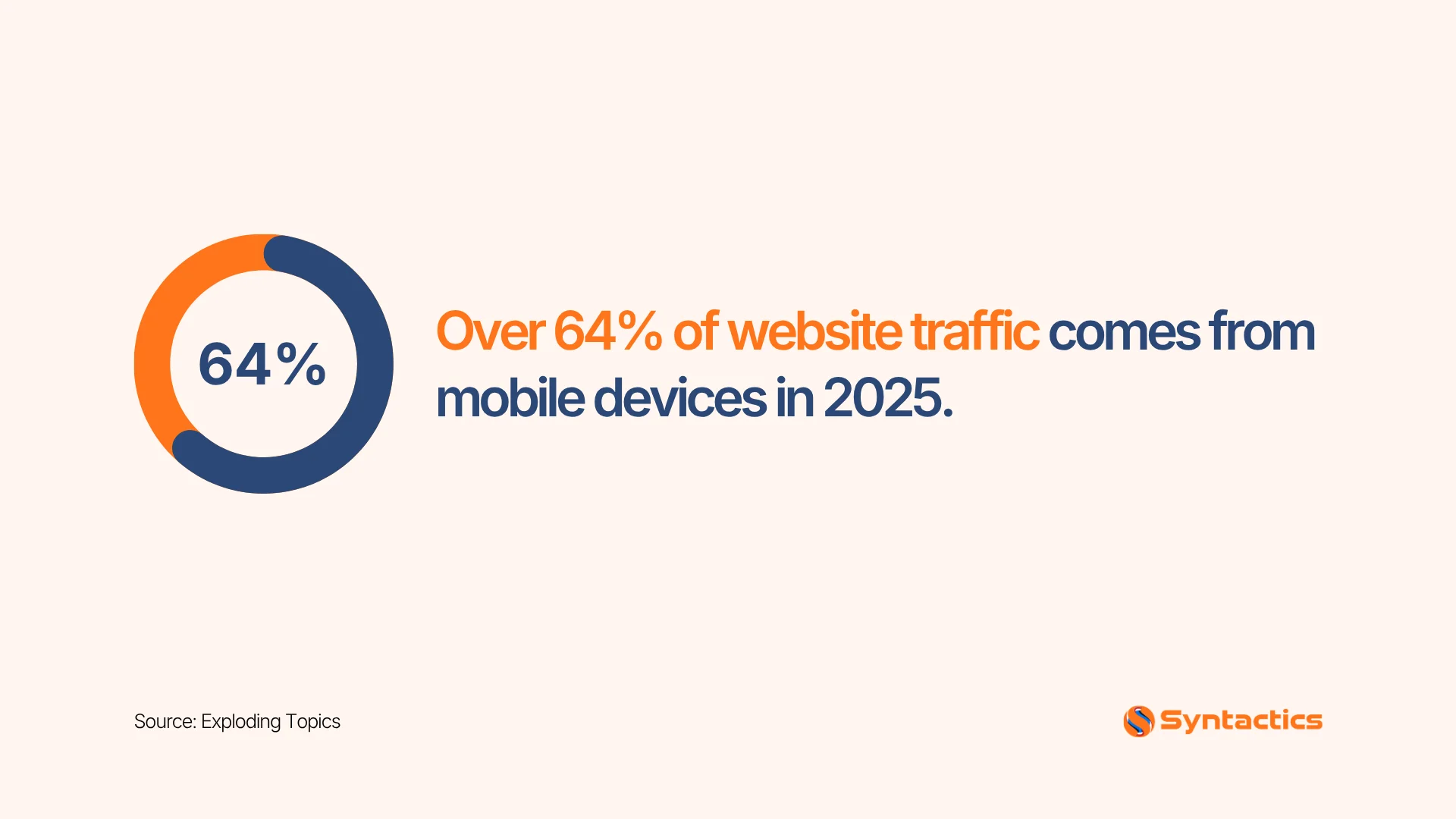
Source: Exploding Topics.
Professional developers optimize websites for various screen sizes to enhance mobile browsing experiences and SEO rankings.
Website designers use responsive design techniques such as flexible grids, media queries, and responsive images.
Proper Use of Internal Linking
Internal links help search engines understand the site’s hierarchy and page relationships while distributing page authority throughout the site. They also improve navigation and guide users to related content.
Here’s how websites can maximize their internal links:
- Use keyword-rich anchor text.
- Ensure that critical pages are easily accessible through internal links.
- Avoid orphan pages.
- Avoid overloading pages with links.
XML Sitemap Creation and Submission
Extensible Markup Language (XML) sitemaps help websites accurately rank in SERPs. Search engines recognize and rely on sitemaps to discover and index content, especially when they’re updated.
By submitting a well-structured sitemap to Google Search Console or Bing Webmaster Tools, developers help search engines index website pages more efficiently. As a result, it drives more traffic to the site.
Straightforward Navigation for Better User Experience
Google places significant value on user experience, which partly depends on a site’s navigability.

Source: Blogging Wizard.
As such, clear navigation helps search engines understand website content hierarchy. It also allows users to quickly find the pages or information they’re looking for.
Developers can further improve user engagement by:
- Implementing simple menus with a logical hierarchy.
- Ensuring that navigation menus are consistent across all web pages.
- Using breadcrumb navigation.
- Ensuring that important pages are no more than three clicks away from the homepage.
- Logically organizing content using categories and subcategories.
Page Speed Optimization
Most users only wait a handful of seconds for web pages to load before clicking away. That’s why developers utilize various strategies to ensure that a site loads in three seconds or less.
Fast Loading Times
Page speed is a crucial factor for UX and SEO, and fast-loading websites achieve higher rankings in search results.
A website with improved Core Web Vitals loads faster, which improves crawl efficiency and helps search engines index more pages. Key metrics in Google’s ranking algorithm include:
- Largest Contentful Paint (LCP);
- First Input Delay (FID), and
- Cumulative Layout Shift (CLS).
Websites with fast loading times have higher conversion rates because users are more likely to complete purchases or sign up for services quickly.
Test Page Speed
Web developers use various tools to analyze performance and identify bottlenecks to improve website performance, SEO, and UX:
- Google PageSpeed Insights: Scores site speed and suggests improvements.
- GTmetrix: Generates detailed reports on load times and optimization techniques.
- Pingdom: Tests site speed from multiple global locations and provides load time breakdowns.
- WebPageTest: Allows advanced testing under different conditions, including various browsers and connection speeds.
Optimize Loading Times
Web developers can implement the following to improve page speed optimization:
- Reduce file sizes using tools like TinyPNG, or convert images to the WebP format. This way, the site will load faster without sacrificing quality.
- Lazy loading or loading image and video files only when they appear in the user’s viewport.
- Minify code by compressing CSS, JavaScript, and HTML by removing unnecessary spaces and characters.
- Enable browser caching to reduce repeated server requests.
- Use a Content Delivery Network (CDN) and distribute content across global servers. This reduces latency and speeds delivery.
- Optimize server response time. Choose a reliable web hosting plan and reduce HTTP requests to speed up performance.
Mobile Optimization
As the number of Internet users increases, so will the number of potential online customers. They use different devices, and web page load times can vary.
Pages on a desktop may not load as quickly on a mobile phone, tablet, or other handheld device. This is why Google prefers Accelerated Mobile Pages (AMPs).

Mobile-first Indexing by Google
Google primarily crawls and indexes a website’s mobile version rather than its desktop version. Optimizing for mobile, in addition to desktop, improves rankings.
One way website developers create mobile-friendly versions of websites is by verifying their responsiveness. They also ensure consistency in content, metadata, and structured data across mobile and desktop.
Ensuring Mobile Responsiveness and Usability
A responsive site adapts seamlessly to different screen sizes, improving usability and engagement.
A developer utilizes the following best practices:
- Utilizing flexible grids, layouts, and media queries to ensure that content adjusts across devices.
- Implementing mobile-friendly navigation elements such as touch-friendly buttons and hamburger menus.
- Optimizing font sizes and spacing to ensure readability without zooming.
- Avoiding adding intrusive pop-ups that disrupt the mobile experience.
- Using HTML5 for animations and multimedia.
- Compressing images and streamlining scripts to improve website loading speeds.
Testing for Mobile-Friendliness
Regular testing ensures mobile-friendliness and a positive UX. Key testing tools include Google’s Mobile-Friendly Test, Lighthouse, Chrome DevTools, and Google Search Console.
Developers can also use cross-device and user testing to optimize mobile performance.
Technical SEO Elements
Technical SEO optimizes the backend aspects of a website, ensuring that search engines can easily crawl and index it. Web developers implement these technical elements to boost visibility and SERP rankings:
Use of Structured Data/Schema Markup
Structured data makes content more visible and SEO-friendly. They help search engines better understand web content, resulting in rich snippets that boost Click-Through Rates (CTR).
It also increases the chances of website content appearing in voice search results.
Use the JSON-LD format when implementing schema markup, since it’s the format Google recommends. Common schema types include Breadcrumb, Article, Product, and FAQ.

Properly Implemented 301 Redirects
301 redirects guide human users and search engines from an old URL to a new one, preserving SEO value. They transfer link equity, prevent broken links and outdated pages, and maintain search rankings.
301 redirects help search engines recognize URL changes, making them essential for site migrations or restructuring.
Canonical Tags to Avoid Duplicate Content Issues
A canonical tag helps search engines focus on a website’s most valuable content. In addition to improving crawl efficiency, it prevents SEO dilution and consolidates ranking signals.
Hreflang Tags for Multilingual Websites
Hreflang tags signal a page’s language and regional variations, helping prevent duplicate content on multilingual sites and improving international SEO.
Robots.txt Optimization
A well-optimized robots.txt ensures search engines focus on valuable pages while preventing the indexing of unnecessary or sensitive content. It also enhances web security by restricting access to admin areas.
Fixing Crawl Errors (Using Google Search Console)
Regularly monitoring and fixing crawl errors boosts rankings and site performance. Tools like Google Search Console provide detailed crawl error reports that developers can use to improve user experience and maintain a healthy, search-friendly site.
On-Page SEO Factors
A website developer plays a key role in on-page SEO by optimizing site structure, code, and performance. Search engines use on-page SEO factors to understand and rank web pages while enhancing visibility, user experience, and accessibility.
Title Tags and Meta Descriptions
Well-optimized title tags improve CTR and help search engines understand page content. Compelling meta descriptions improve CTR by providing a clear preview of the page’s content. Integrating keywords in meta titles and descriptions further increases web content‘s searchability.
Manually customizing metadata for each page, including product pages with photos, keeps titles and descriptions specific rather than generic across the site.
Header Tags
Header tags structure content hierarchically, allowing search engines to understand content structure and relevance. Proper usage of headings significantly improves user experience, readability, and SEO.
Alt Text for Images
Alternative text describes images for search engines and screen readers, improving both accessibility and SEO.
Use of Keywords in Content and Headers
Keywords in web content help determine page relevance. They improve search rankings and ensure content relevance for both human users and search engines.
AEO and GEO Considerations for Web Developers
SEO alone no longer covers the full scope of search visibility, since AI-generated answers now capture a growing share of user queries.
Answer Engine Optimization (AEO) and Generative Engine Optimization (GEO) extend a developer’s technical SEO work to make content citable inside AI-generated answers from platforms like ChatGPT, Perplexity, and Google AI Overviews.
Developers who already understand schema markup, robots.txt, and site structure are well positioned to implement these practices, since AEO and GEO build on the same technical foundation.
Look at how AEO-ready architecture differs from a traditional SEO build.

Structured Data for AI Parsing
Schema markup does more than generate rich snippets. It gives AI systems structured context they can parse directly, which increases the likelihood of citation.
Developers should prioritize:
- FAQPage schema for Q&A content, enabling direct extraction of question-answer pairs.
- HowTo schema for step-by-step guides, which supports process-based AI queries.
- Article schema with author and date fields, since AI systems weight expert attribution and freshness.
Pages with proper schema markup show meaningfully higher AI visibility than pages without it.
Machine-Readable Content Files
An emerging practice is publishing an llms.txt file, a plain-text summary that gives AI systems a quick overview of a site’s purpose, structure, and key pages. This works alongside robots.txt and XML sitemaps rather than replacing them. Developers can treat llms.txt as an AI-facing companion to the sitemap, pointing toward pricing pages, documentation, and other high-value content.
Answer-First Content Architecture
AI systems extract passages, not entire pages, so the placement of an answer within a page matters as much as the answer itself. Developers can support this by structuring templates so each section opens with a direct, self-contained statement before expanding into supporting detail.
Keeping key passages between 40 and 60 words also improves extractability, since that range aligns with how AI systems select and quote snippet-length content.
AI Bot Access in Robots.txt
A robots.txt file that blocks AI crawlers removes a site from citation eligibility on that platform entirely. Developers should confirm the following bots are not disallowed, unless a business reason justifies the exclusion:
- GPTBot and ChatGPT-User (OpenAI)
- PerplexityBot (Perplexity)
- ClaudeBot and anthropic-ai (Anthropic)
- Google-Extended (Gemini and AI Overviews)
- Bingbot (Microsoft Copilot)
Regular audits of robots.txt should include a check for these entries alongside standard crawl-budget review. Site owners wanting to exclude AI training while preserving citation eligibility can block CCBot specifically, since it feeds Common Crawl’s training datasets rather than live search.
Ongoing Maintenance and SEO Best Practices
Maintaining and improving search rankings ensures long-term SEO success and a strong online presence. Here are strategies for keeping a website competitive and relevant:
Semantic HTML
Use semantic HTML elements like <header>, <nav>, <main>, <section>, <article>, <aside>, and <footer> to improve accessibility and SEO.
Schema Markup
When adding schema markups, use the JSON-LD format to add structured data for rich results, including schema types like Breadcrumb, Article, Product, or FAQ.
Optimize Metadata
Websites and search engines communicate using metadata. Use titles, descriptions, and canonical tags to provide context to search engines and improve CTR.
Developers can ensure that relevant keywords are present in meta titles and descriptions. Also, they can manually customize metadata for each page — including product photos — to keep them more specific.
Mobile-Friendliness
Ensure that website content is accessible and readable on mobile devices to tap into the significant population of mobile users online.
Voice Search Optimization
Incorporate structured Frequently Asked Questions (FAQs) and direct answers on pages to optimize for long-tail, conversational queries.
A/B Testing for SEO
Web developers A/B test key elements to identify what resonates with users and drives traffic, such as:
- Canonical tags
- Redirects
- Structured data
- Page speed optimization
- Javascript and rendering
Error Handling
Web developers can implement custom and informative 404 and 500 pages that guide users back to functional pages. They can also redirect a web page with broken links to new or related site content.

Final Thoughts
SEO brings more people to a website, helping it reach its full potential to serve the company. SEO alone no longer covers the full scope of search visibility, since AI-generated answers now capture a growing share of user queries. Implementing the strategies listed above can increase a website’s Google search rankings.
Ultimately, each website is unique, and what works for one might not work for others. SEO goals and priorities vary across organizations. For instance, some may prioritize site revamps and migration techniques to boost SEO, while others prioritize content optimization or technical enhancements.
To achieve the best results, adjust your website SEO checklist to align with specific business objectives and development needs.
Get Design and Functionality
Specific to your Brand!
- Build a website that's mobile-friendly and responsive.
- Custom designs aligned with your brand.
- Optimized for SEO and user experience.
- Scalable and feature-rich solutions.

This blog was updated on August 19, 2026.
FAQs About Website SEO
What are the 4 pillars of SEO?
The four pillars of SEO are:
- Technical SEO (includes page speed, mobile-friendliness, SSL encryption, XML sitemap, and Robots.txt)
- Content SEO (involves keyword research, content quality and depth, and content marketing)
- On-page SEO (involves optimizing titles and meta descriptions, header tags, and internal linking)
- Off-page SEO (involves link building, social signals, and local SEO)
Do web developers do SEO?
Developers ensure that a website is technically optimized for search engines by implementing technical SEO and optimizing on-page elements. Content creation and off-page optimizations typically fall to dedicated SEO or marketing specialists.
Do web designers need to know SEO?
Designers need a working understanding of SEO fundamentals, since design choices directly shape UX and engagement metrics. Designers also ensure the site is accessible and usable, which helps search engines crawl and index it more effectively.
What is an off-page SEO checklist?
An off-page SEO checklist includes activities that help improve a website’s visibility and credibility outside of its own domain. Here are some key considerations:
- Link building (guest blogging, reviews, broken link building)
- Social media (content sharing, engagement)
- Local SEO (Google My Business, NAP consistency, local directories)
- Content promotion (content partnerships, PR)
- Reviews and ratings (encouraging and responding to customer reviews)

About Xenia Labis
Related News:



9 Web Design Trends That You Might Miss in 2024

Why Hire a Marketing Assistant for Your Business?









Comment 0